Thursday, October 5, 2006

Channel to China! -- Xi'an


Photobucket - Video and Image Hosting


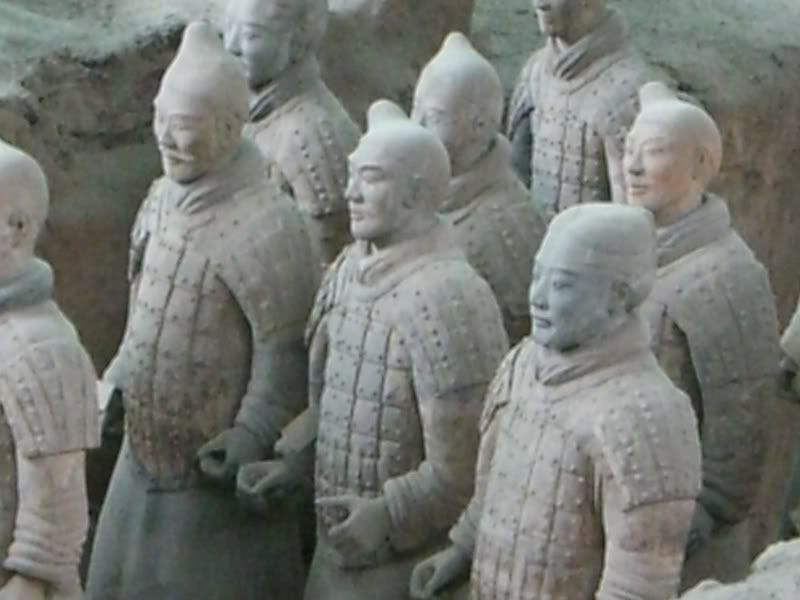
The Terracotta Warriors of Xi'an. Click on the photo to see the full album.


I heard bad things about Xi'an, so I made my visit short. Just three nights. I was hoping that my friends were wrong.

Unfortunately, they weren't. Xi'an is an ugly industrial city, especially in the surrounding outskirts. As I rode into town on a bus, I saw demolished buildings, huge trucks hauling construction materials, and miserable weather.

Things improved at the border. Xi'an has a well-preserved city wall that encloses the city center. After Beijing and Shanghai, Chinese cities are all starting to look the same. I keep seeing the same big billboards and department stores everywhere. That's what happens with central government planning. I've heard Hong Kong has been the prototype for the modern cities springing up all over China.

I stayed at the Han Tang Inn. Big mistake! The outside looked nice enough, but the inside might as well have been a condemned building. Graffiti lined the walls, empty beer bottles littered the stair landings, and the concrete floors were dirty.

I took one look at the grim bunker that was supposed to be my dorm room and immediately switched to a private double room. I should have changed hostels altogether, but I was too lazy to find another one. The room was a little nicer. But the bathroom wasn't much of an improvement. There was no curtain to separate the shower from the toilet, so water would splash everywhere. When I flushed the toilet, water leaked out from the base of the bowl. Totally disgusting.

Going to the Terracotta Warriors lifted my spirits. In Beijing, an Australian backpacker told me it was better to go there by public bus instead of taking a tour. If I took a tour, I'd get up way early in the morning, be led to one tourist trap after another, and get only a little time with the Warriors.

The best way to see the Warriors is to take the green 306 bus. It picks up passengers across the street in front of Xi'an train station, near a China Post office. Costs 7 RMB for a one-way ticket and takes about 1.5 hours to get there. It's always cool when you can dodge the tourist vortex and bask in local culture on the cheap.

I met Sophie my last night at the hostel. She worked there part-time while studying to become an English teacher. When she talked about her aspirations, I was struck by how similar they were to Americans. She wanted to move to Beijing or Shanghai to find a better life. Going to the big city to make your dreams come true; that's a story everone can relate to. I guess the Chinese aren't always so different from us.


Photobucket - Video and Image Hosting


Saturday, September 30, 2006

Channel to China! -- Beijing


Photobucket - Video and Image Hosting
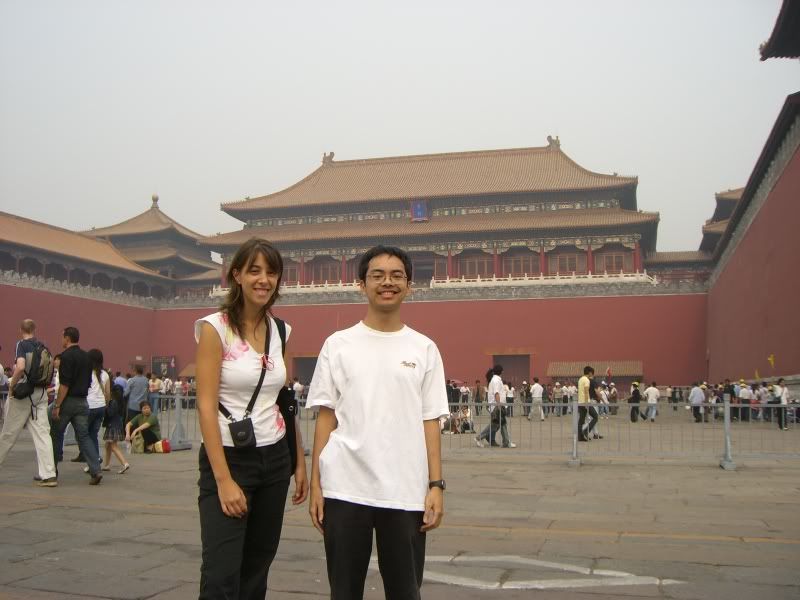
Caroline and me at the Forbidden City. Click on the photo to see Beijing album #1.

More photos in Bejing album #2

I've finished up my contract teaching English, so I've set out to travel across China. Choosing the first stop was easy. Beijing has the classic relics of ancient China. At the same time, it's at the forefront of a nation modernizing in a hurry.

Part 1: New Friends

I always feel the same nervousness when I arrive at a new place. Not because I'm worried about my safety; Los Angeles felt more dangerous than any other place I've been. It's because traveling by myself it gets lonely sometimes. This is especially true on my first night at a hostel. Everyone else seems to be laughing together, talking, all the old-timers know each other. I'm the new kid with no friends.

I stayed at the Beijing Jade International Youth Hostel. The place was really nice, but there was still another important factor that wasn't certain. In the elevator, I actually crossed my fingers and prayed for cool roommates. The people you meet on the road can make or break your experience.

This time, I hit the jackpot! My two roommates were Ben and Colin, two cool guys from Scotland. The story got better. They were studying abroad in Singapore with loads of other students from all over Europe. A big group of them were visiting Bejing and staying at the same hostel! I was happy beyond belief. My first night, and I've already made like 20 new friends!


Photobucket - Video and Image Hosting


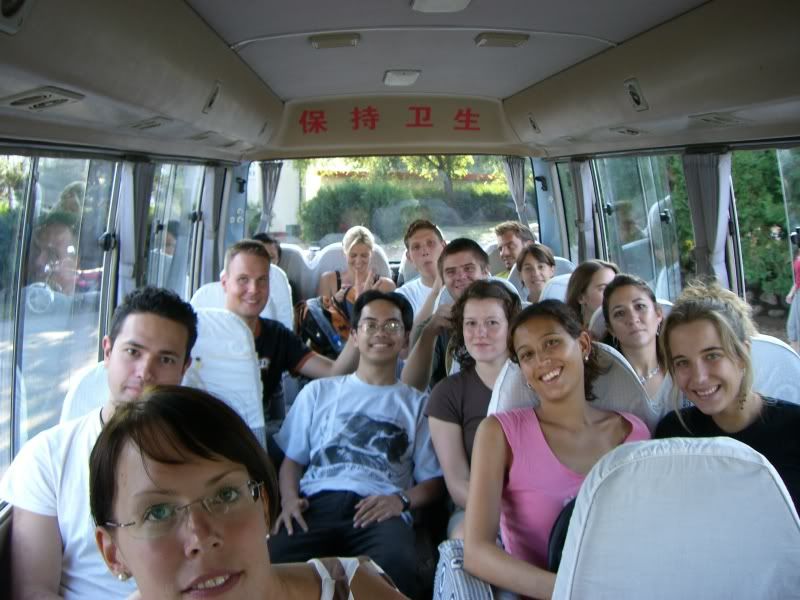
The Singapore group, on our way to the Great Wall

Part 2: Beijing Roast Duck

One of the joys of China is the food. The flavors run the gamut from the fiery peppers of Sichuan to the refined cuisine of Hong Kong.

Beijing Roast Duck is one of the most popular dishes in China. I've found it on pizza, at Kentucky Fried Chicken, practically every restaurant has some version of it.

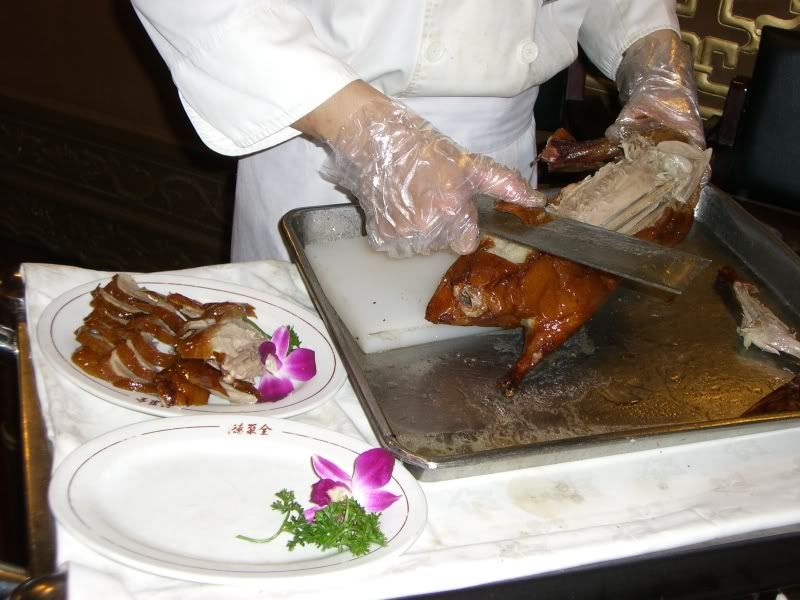
The place to go in Bejing is the Quanjude Roast Duck Restaurant. The walls carry framed photos of Fidel Castro, former U.S. President George H.W. Bush, and other world leaders who've dined on the best roast duck in Beijing.

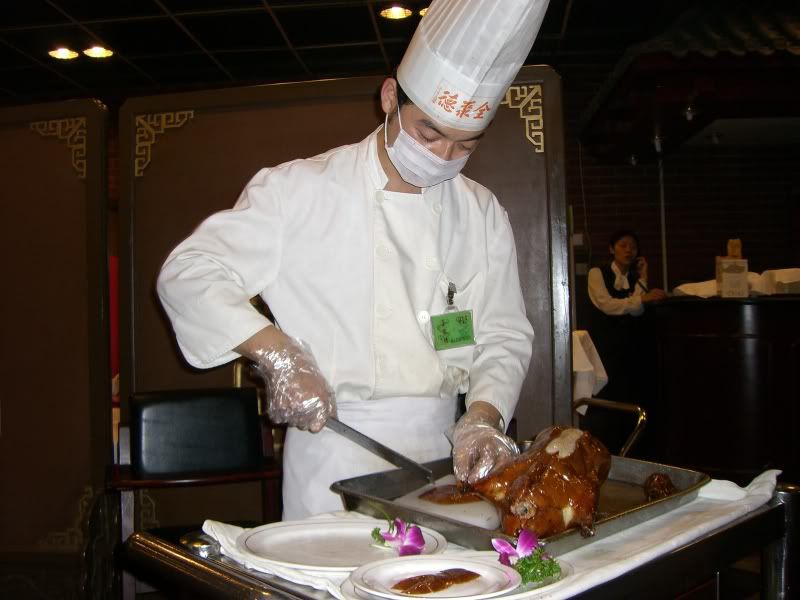
The service is excellent. A dapper chef carves up a fresh roast duck at your table:

Photobucket - Video and Image Hosting


Photobucket - Video and Image Hosting


Looking at these pictures makes me wish I could go back there!

Part 3: The Wall

"All those other places are okay, but it's really all about The Wall. It's such a fucking big wall!"
--Joe, roommate at my hostel


Photobucket - Video and Image Hosting


The Great Wall is divided into sections, so you have to pick which spot to visit. Badaling is the most touristy and commercial. Jiankou is really remote and more authentic. A popular option for hardy trekkers is to walk from the Jinshanling section to the Simatai section.

Our group settled on Simatai. It's a good middle-ground choice. Simatai has the restrooms and conveniences of a tourist trap; but it also had considerably less tourists.

Most tours to the Great Wall go to Badaling and include a visit to the Ming Tombs. My friends who've been there said the Ming Tombs were empty and boring. Luckily, our group got around that by chartering a minibus and going on our own.

Bring comfortable shoes! There's a lot of walking up steep steps. Learn to say, "Bu yao [don't want]," because hawkers will try to sell you postcards, picture books, and other crap along the way. If there's one thing that almost ruined Beijing for me, it was the hawkers. They're lurking at every major tourist attraction.

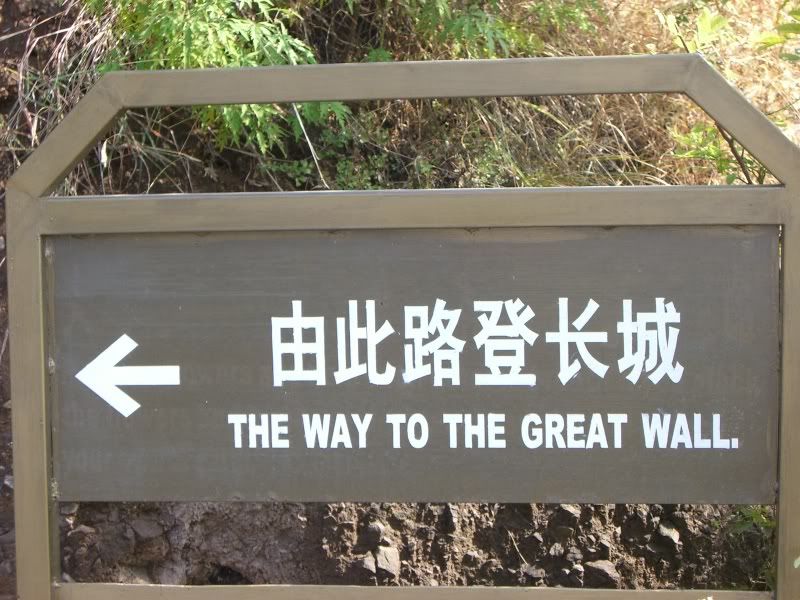
At Simatai, you walk up a mountain pass. You make a turn into a rock building, and suddenly you're on the Great Wall!

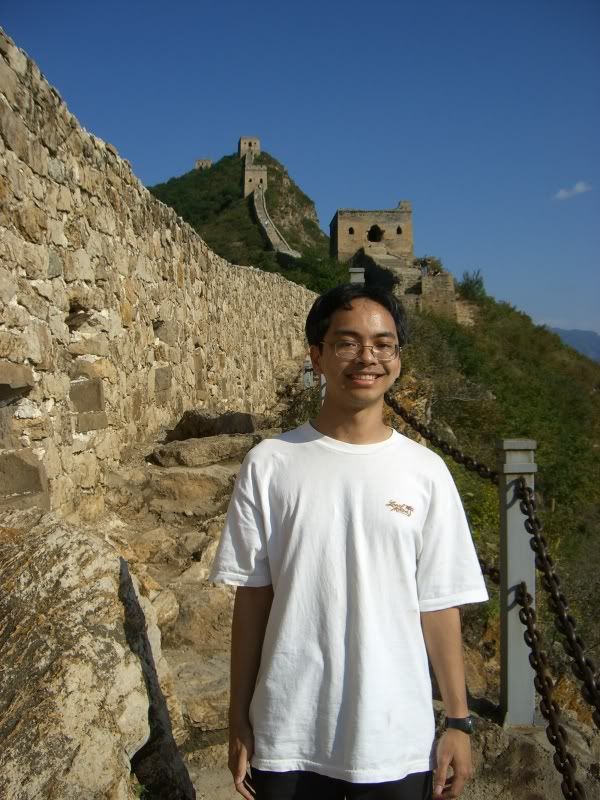
I was so excited I never felt tired. Every step was like walking across the top of China. Just when I felt like stopping, there was a always another tower in the distance promising even greater views.

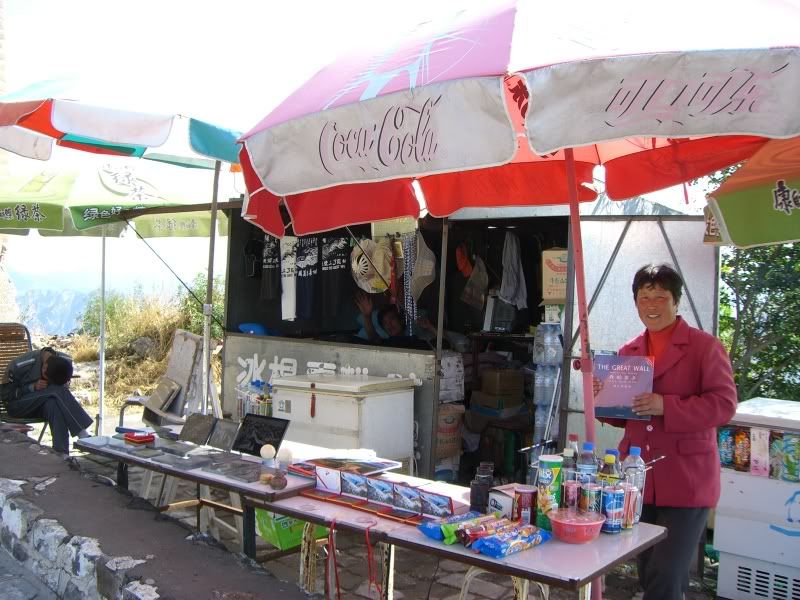
Finally, I felt the climb starting to catch up with me. Just one more tower! As I wheezed over the last step, here's the sight that greeted me:


Photobucket - Video and Image Hosting


Another tacky souvenir shop! I couldn't believe it! I climbed up the Great Wall for this?!

I gave up and bought some ice cream bars. Food never tasted so good. It wasn't just the ice cream. My one year in China flashed in front of me: I spent my first month in Hell, studied one of the most difficult languages in the world, and finally made it to the Great Wall. This was the sweet taste of victory.

Photobucket - Video and Image Hosting


Thursday, August 17, 2006

Shipped to Shanghai! Vol. 20 -- Lap of Luxury

I've been too negative about Shanghai lately, so I'll dwell on some of the perks of living in the world's biggest construction area.

Westerners who come to the lower-cost destinations in Asia are often tempted to stay longer. Except for falling in love with a local, I think one of the big reasons is that things are just so much cheaper:

--Taxis. The meter starts at 11 RMB ($1.37 USD) for the first few kilometers. It's the total opposite of Europe, where'd I 'd feel my bank account draining whenever I took a taxi.

--DVDs. 10 RMB ($1.25 USD) max, if from a shop. Goes for half that if you buy them off the street.

--Travel. Long-distance trains and buses are insanely cheap compared to flights when traveling within China.

--Clothes. Choose the fabric and have your clothes hand-tailored at the Fabric Market on Lujiabang Rd. I've known girls to get dresses personally made before going back home.

--Housekeeping. We pay our maid 25 RMB ($3.16 USD) to clean our apartment for two hours, once a week. There's no way we could afford a maid back in the West.

A guilty pleasure many expats enjoy in China is massages. Legit ones, I mean! Not the whorehouses that pretend to be "barbershops."

My friends and I hit C's, a seedy hip-hop bar, a few nights ago. The air conditioner in the bar was operational, but the one in the dance floor was broken. So after dancing hard to one of my favorite songs, "Kimosabe," I was soaked with sweat. Time to relax.

Luckily, the group was planning to hit up a massage parlor nearby and get foot massages. They're cheap, only 30 RMB ($3.76 USD) for a 90-minute foot massage. Elizabeth has been trying to get me to go for a long time, but I've resisted. I felt weird about having some stranger touch me. That and I'm extremely ticklish.

Since it was Erica's last night before returning to England, I gave in. I definitely wanted to hang out with her before she left.

We went to Elizabeth's favorite foot massage place just down the road from our apartment. The women cheerfully greeted us in Chinese and got to work.

First, they plunged our feet into buckets of hot water. I'm really new at this, so I thought the water was too hot. My masseuse poured in some cold water to cool it a little.

I'm not sure if this was normal, but my masseuese dug her nails into my legs a lot when she was doing her work. This was supposed to be relaxing?

Elizabeth told me later that I'd gotten the worst masseuse in the parlor. That's why it hurt to walk afterwards. The Marcus Luck in effect.


Photobucket - Video and Image Hosting


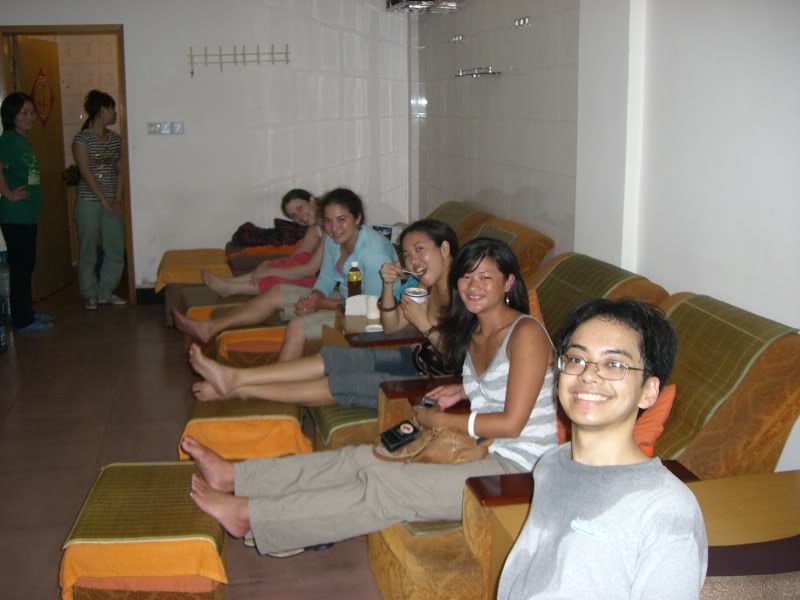
The Massage Crew (right to left): Me, Erica, Chantel, Melissa, and Elizabeth

Sunday, July 30, 2006

Shipped to Shanghai! Vol. 19 -- Laser Tag Showdown


It took a long time for me to play my first game of laser tag. With my love of action movies, especially the bullet-riddled masterpieces of John Woo, laser tag was a perfect fit.

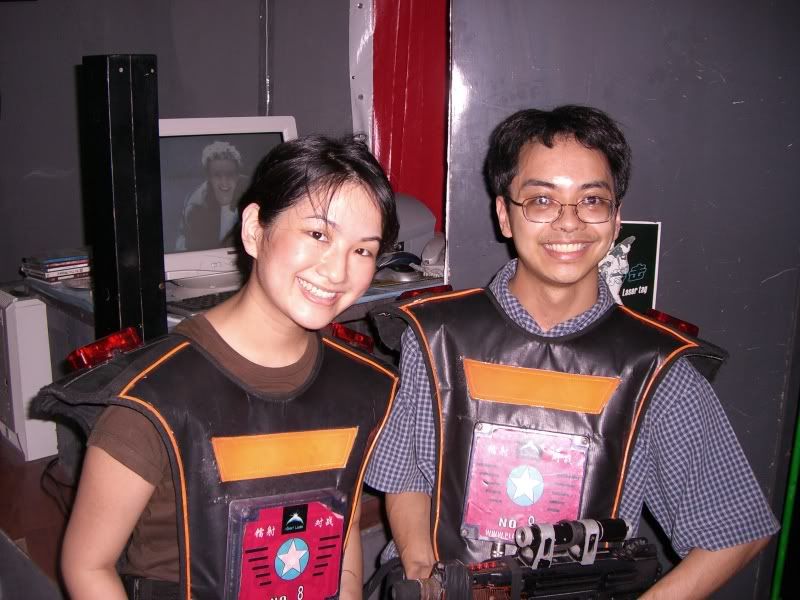
My company was sponsoring a laser tag match to reward the employees and say farewell to one of the departing English teachers, Anita (shown above). At first I didn't want to go. The venue was at Hongkou Football Stadium, which way far away from where I live.

But when Anita sent me a text asking whether I would come, I gave in. I didn't want to let down a friend who's so cool.

I have this problem: I'm chronically punctual. Usually, I'm anywhere from 15-30 minutes early for every occasion. It happened again for laser tag. I got to Planet Laser at 6:30pm, while the party wasn't due to start until 7:00pm. Even worse, I was the only English-speaking person there!

I was seriously sweating when sent a text message to Marie, a fellow English teacher from Australia. She had texted, saying she wasn't coming and that she hoped I had fun. I replied: "That's Mission: Impossible, but I'll try. I'm the only non-Chinese person here! :("

After an endless stream of Chinese staff, Anita finally showed up, along with Trent, another teacher from Australia. On a side note, I'll confess my jealousy of Australians and New Zealanders. The world loves Aussies and Kiwis. They can get working holiday visas for practially any country!

I've heard it's a case of reciprocation. We don't let anyone into America, so the rest of the world keeps us from staying too long. We can only work in Australia, New Zealand, and the UK, and that's for less than 1 year. No wonder everyone else out-travels us.

An employee gathered us together and demonstrated how to play the game. Chest hits were worth 100 points, back hits were 150 points, and shoulder hits were 200 points. We wore these big flak jackets with sensors.

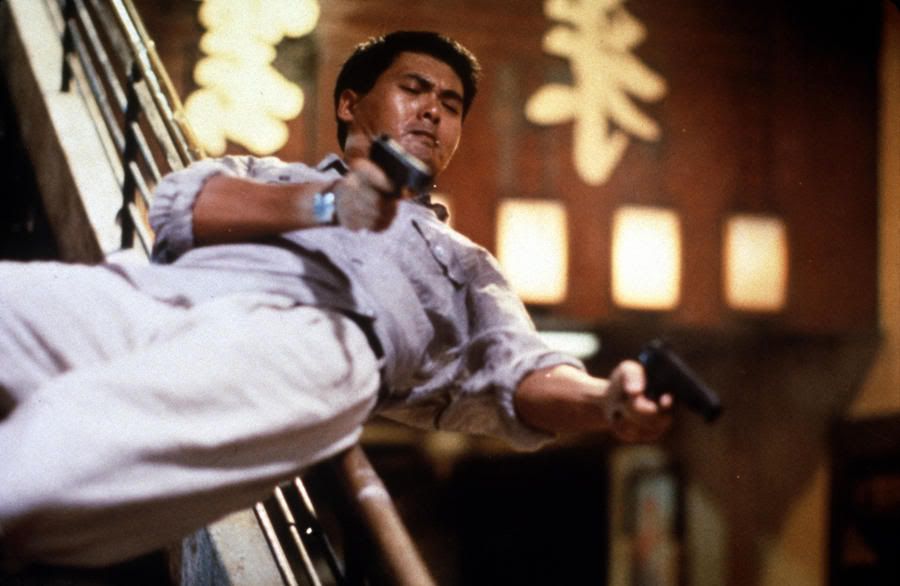
I was disappointed. I wanted to jump sideways, dive down, and roll across the floor shooting like I've seen in action movies. I couldn't do that when the jackets had lights the size of watermelons that could break. We only got one gun per person, so I couldn't bust out the two-fisted pistol action like in John Woo movies:


Photobucket - Video and Image Hosting

Chow Yun-Fat looking badass in John Woo's Hardboiled

We were the Red Team and our opponents were the Green Team. When the siren sounded, we stormed into the shooting area. It was a dark maze of black walls, windows, and weird flashing lights. Feeling lazy, I positioned myself in a dark corner and played sniper, picking off everyone who walked by.

That's the cheap way to play laser tag. Eventually I got bored and went hunting for real. I pulled out all the SWAT-team moves I'd picked up from watching too many action movies:

--Run low to the ground

--Stand sideways when shooting

--Use available cover

--Peak around corners

--Match my eye movements with the sweep of my gun

I was creeping around when I saw my opportunity. A guy from the Green Team was standing in the middle of the doorway, with his back to me. It was too good to be true.

I checked both ways to make sure this wasn't some trap. Nobody. I snuck up behind him until I was within point-blank range. He was busy looking for enemies in front of him. I pumped ten shots into his back before he even knew I was there!

By the time he turned around and started shooting, I was already booking it and dove behind some walls. All that time in high school I spent playing Virtua Cop 2 finally paid off.

Monday, July 10, 2006

Hard Seat to Suzhou


I've finally gotten myself out of the Stone Age and bought a digital camera. It's so great, I don't know why I kept using disposable cameras for so long!

The great thing about Shanghai is that there's loads of interesting towns and cities nearby. Trains and buses that will go to most places at very low cost. My hard seat ticket to Suzhou was less than $2 USD!

Suzhou public transportation

There are four classes of comfort in Chinese trains:

Soft Sleeper
Hard Sleeper
Soft Seat
Hard Seat

The names are self-explanatory. Soft sleeper cabins are hotel-quality and cost about as much as a plane ticket. Hard seat cabins on long-distance trains can be a nightmare: crowded with dirty migrant workers eating, smoking, and playing cards, with no room to sit down.

Buying a train ticket can be a test of endurance. Long lines, noise, and ticket sellers trained in the Communist style of customer service: "Better a late train that's Communist than a train on time that's Capitalist."

The guidebooks recommend bypassing train stations altogether and buying tickets through hotels and hostels instead. Most of them have an in-house travel agency with English-speaking staff. There's a small service charge, but it's worth it for the convenience. Sometimes they have special contacts that can score tickets even during high season.

In addition, there are advanced-purchase offices that sell train tickets. This is the best option, since they're more conveniently located than the main train station, and have a lower service charge than a hotel. No English though, so bringing along a Chinese friend is a must. But sometimes these ticket offices are so well-hidden that even locals don't know about them! The one closest to my apartment is buried in the back of a tobacco shop. I used to wonder why I saw long lines there all the time!

It's also a good idea to buy an onward ticket or return ticket at the same time that you buy your initial ticket. Thanks to overpopulation, tickets get sold out fast on popular routes. That goes tenfold for Chinese holidays. The government only allows three 1-week vacations during the year: National Day (October), Spring Festival a.k.a. Chinese New Year (January or February), and Labor Day (May). This is the only time Chinese people can travel. They often to choose to go back to their hometown or travel to famous tourist sites. They don't have 2-week vacations they can take whenever, like America. So in high seasons, the tourist infrastructure is pressed to the limit.

Scalpers ("piao fanzi") make a fortune by buying up as many train tickets as they can for the holidays and reselling them at ridiculously high prices. They also do this for sports events and pop music concerts too. The most heartless scalpers buy up the wait-in-line numbers at hospitals and sell them to patients needing emergency care!

Since this was my first-ever trip into another part of China, I chose Suzhou ("su joe"). It's only an hour away from Shanghai by train. One of the most famous Chinese tourist blurbs goes, "In heaven, there is paradise. On Earth, there is Suzhou and Hangzhou." Suzhou if famous for its gardens and canals. Hangzhou is famous for West Lake, a huge lake that has cool old architecture.

When I polled my foreign friends and students, they unanimously recommended Hangzhou over Suzhou. The West Lake was big and had more stuff to see. They all thought Suzhou was too small, too boring, and not that great. While I thought it wasn't that bad, I definitely wouldn't stay there longer than a day.

I did like that the sky was clear and blue. The buildings didn't tower over me and block out the sky like they do in Shanghai. A lot of them had more traditional-looking roofs.

CIMG0056

CIMG0055

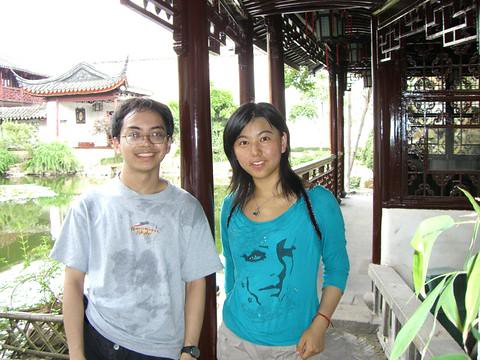
While I was wandering through the Garden of the Master of the Nets, I met Jessie, a girl from Beijing. When I told her I'd come to China without being able to speak Chinese, she gasped.

"You are so great!" she said. "You must be very brave to come to a country where you can't speak the language."

I brightened at that. Whenever I make a radical decision, i.e. to backpack through Europe, to teach English in China, I am never sure whether I'm being incredibly brave or incredibly stupid. The only way to find out is go for it.

Jessie from Beijing

Saturday, May 27, 2006

Shipped to Shanghai! Vol. 17 -- Going for the Dream

"To know the road ahead, ask those coming back."
--Chinese proverb

One of my great pleasures is to give advice to future travelers. It's a big boost to your confidence when you know someone who's been there and can give you the straight story. The key person in my decision to come to China was a past graduate of my university. He visited my class and talked about his exciting career in the trading business, where he made money and got to travel around the world. Shanghai was his top pick in today's global economy. If I had slacked off and skipped class that day, who knows where I would have ended up?

Actually, I do know. I was very close to surrendering my dream of traveling to give up and become a real estate agent in Hawaii. A 6-week real estate licensing class vs. 3 years of law school, it was the easy way out. If I had gone through with that, I would be going to work every day dreading the coming downturn in the housing market. Instead, I'm studying Chinese and enjoying my front-row seat watching the fastest-developing city in the world.

Through my parents and friends who follow my adventures, I get inquiries from people about how to go abroad. In travel, there is no such thing as an unimportant detail. Every tip, every website can make a huge difference in someone's life. Know where to find the right information, and the impossible becomes possible.

The daughter of one of my father's co-workers was thinking of going to Japan. Here's my e-mail to her:

Dear ____ ,

Happy to help. The good news is that the JET program isn't the only game in town. Aeon and ECC are both supposed to be reputable companies. Nova has a really bad rep on the Internet, but they hire almost anybody. Despite the bad press, I have two friends who worked for Nova and liked it. Read the latest gossip on ESL Cafe. After a year in Japan, you can change to a better job. Gaijin Pot is where to look for jobs once you're in Japan.

The general advice is to avoid Tokyo, Osaka, and Kyoto. They're the most expensive. If you work somewhere else, you'll be able to save more of your salary. Many teach English in Japan or Korea to pay off student loans. Insider tip: there are more people from Hawaii in Fukuoka than any other place in Japan. It's a medium-sized city in Kyushu.

I don't think getting a teaching credential is necessary. Most companies don't require it and will provide some training. The work itself is pretty easy once you get some experience. You'd be much better off taking a Japanese class for the summer. I wish to God I'd studied Chinese before I came over here.

Teaching English is actually only half your job. The other half is answering questions about America. Or many times, defending America. All they know is what they've seen in movies, so I have to constantly remind my Chinese students that not all Americans carry guns and take drugs.

I'm not sure how bad it is in Japan, but racism is a big problem in China and everywhere else in Asia. Most English-teaching companies in Asia require you to send a photo with your resume, a blatantly prejudiced request. Asian-Americans and Asian-Canadians get turned down for jobs all the time. It might be a good idea to send your resume without a photo. Write on your resume that you're a U.S. citizen and native English speaker. That forces the company to call you or even better, interview you. Either way, they get a chance to hear you speak English before possibly rejecting you.

The first month in any foreign country will always be the hardest. Try to stick it out. That being said, ordering food by pointing at pictures gets old fast. The 4 priorities are: job, apartment, studying the language, and making friends. Once you get those four down, everything else will fall into place.

Japan is better than other places than Asia for a first-time expat. It's clean, developed, great food, companies provide health insurance, etc. I can give you advice on finding English speakers anywhere. This sounds really ageist and sexist, but if you need someone who speaks English, go for young women under 30. They're more likely to speak English than any other group. I've asked young men so many times, and they can't. Ditto for old people. Studying English is popular among the young, and I think women are better at languages than men. I was the only boy in a lot of my English classes. Most of my professors were women, too. I majored in English Creative Writing.

You can definitely make a career out of teaching. A lot of foreigners come abroad and never leave. Easy job, saving substantial money, the glamor of living abroad, and local celebrity status (especially if you're white and in a smaller town). On the flip side, there are a lot of foreigners who don't teach for long and move on to do something else. Part of it is the snobbery they get from expats with professional jobs, i.e. "English teachers are just backpacker trash."

Some of the foreigners who enjoy the benefits above are what one of my friends call an LBH = Loser Back Home. That's the ugly, gross, overweight, geeky guy that women back home would've deemed untouchable. But in Asia, he can score a hot girlfriend and a good-paying job just for being white.

You may not have thought about this, but dating can be a challenge for Western women in Asia. Almost every foreign guy I know has a Chinese girlfriend. Some Western women complain that they can't compete with the slim, ultra-fashionable, sometimes more subservient Asian women. Asian men can find Western women too strong and independent, so they avoid them. These are broad generalities, but I know plenty of single Western women as evidence.

My route to getting a job in China is a long, twisted story. Read my blog to get all the gory details:

http://bluefox808.blogspot.com/

My adventures in China start in September 2005. Scroll to the story on the bottom, and read your way upwards.

Feel free to ask me any questions. I'm all for helping people to travel. No education is complete without it!

Marcus
Monday, May 15, 2006

Shipped to Shanghai! Vol. 16 -- English was his passport

". . . to leave the world a bit better, whether by a healthy child, a garden patch or a redeemed social condition; to know even one life has breathed easier because you have lived. This is to have succeeded."

- Ralph Waldo Emerson, writer.


"I must learn English," John said.

"Why do you want to learn English?" I asked. We were sitting opposite each other at the classroom table.

His shabby jacket and cheap pants concealed his true identity: a highly trained computer programmer for a state-owned enterprise (SOE).

"I must move my family to Canada for a better life," John said simply.

"Why not go to America?" I asked.

He shook his head sadly. "Is better, but not possible. No one can go to America now."

I winced at his dire opinion. It was right on the money. This was a recurring theme with my students. With America closing the gates, the foreign talent were skipping the States in favor of Canada and Australia.

John was on the verge of going to Canada. The papers were filed, his name was on the roster, the process was rolling.

That left the interview at the Canadian embassy. According to John, "The interview scares me the most." Like most of my students, he had solid reading, writing, and listening skills. It was his broken English that might blow this opportunity.

The responsibility on me weighed a ton. If I failed to prep him for the interview properly, it would take John a long time to get another chance. If he got another chance. Botching this would ruin someone's life. That haunted me.

So I overcompensated. Over the next few weeks, we attacked the interview materials John brought. I scripted answers to every sample question that John got from Canadian immigration. He took exhaustive notes of everything I said. We recited the answers together over and over again.

I wanted to change to simpler words, but John was convinced that my first-choice words sounded smarter. The words were great, but he couldn't say them without stumbling over the syllables. A lot of the sample questions asked the same things. I was getting confused. John's progress was slow. He was going to fail the interview and it was going to be all my fault. I started freaking out.

Then one day, John walked in.

"Hey John, how's it going?" I asked.

He looked at me and his voice broke. "Marcus, I'm going to Canada."