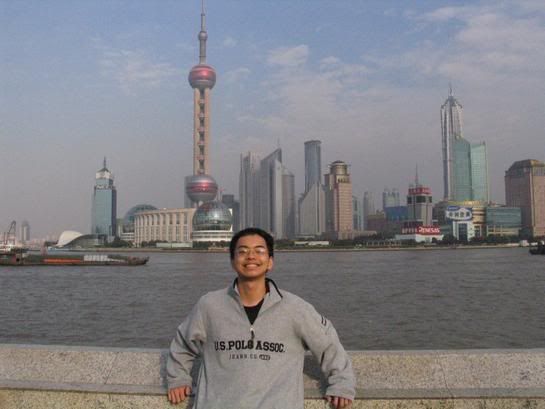
Goodbye, Shanghai.
What a difference a year makes. When I first arrived in China, I had never worked abroad, never lived on my own and knew no Chinese. Now I feel like I've adapted to one of the biggest cities in the world.
I feel proud of myself for not giving up, since everything went to hell my first month here. To protect against that possibility, I came to China with an open-ended return ticket. My friends were amazed that I stuck it out. It wasn't like I stayed in China because I ran out of money. Most of my friends said if things had gone as badly for them as it did for me, they would definitely have gone home. Especially if home was Hawaii!
This might be melodramatic, but I felt I had to stay in China for a year. If I had gone home, I think my spirit would have been broken, and I'd never have the confidence to travel on my own again.
Now that I've been able to survive for a year, the world has opened up to me. I feel like I can go anywhere and actually live there, not just travel through like a tourist. I think the first year in a developing country is the hardest experience; after that, things become more bearable. Shanghai is actually not bad, after hearing from friends who've been to places like Africa and India.
The key thing that kept me sane was my friends. I was lucky to hang out with a wonderful group of people. Since the world is coming to do business in Shanghai, my friends came from everywhere. So many of my friends were English, it was like I was back studying abroad in England. China, Europe, Canada, Australia and the United States were also well-represented in my social circle. All the people I met were so supportive, giving me the encouragement I needed just when I was ready to quit and go home.
I'm not big on throwing parties in my own honor. I usually let my birthday slip by without telling anyone. This time, I threw a farewell party, just so I could see my friends before I left.
I chose to have it at Cotton's Bar, because it's my favorite bar in Shanghai. It's a house, so it feels cozy and comfortable. There's outdoor seating on wooden furniture amidst leafy greenery, which makes for a beautiful backdrop for lazy conversations. Cotton's is also the site for one of the best parties I'd ever been to, for New Year's 2006. My friends and I totally destroyed that place, dancing on chairs, tables, going totally nuts. Like trashing someone's house at a house party, except for not having to clean up.
People came and went at different times, so it was a weird dynamic. It was like being at several different parties. Richard and Andy were the first to show up, and they had known me since I first came to Shanghai. It was fun to reminisce about the old days.
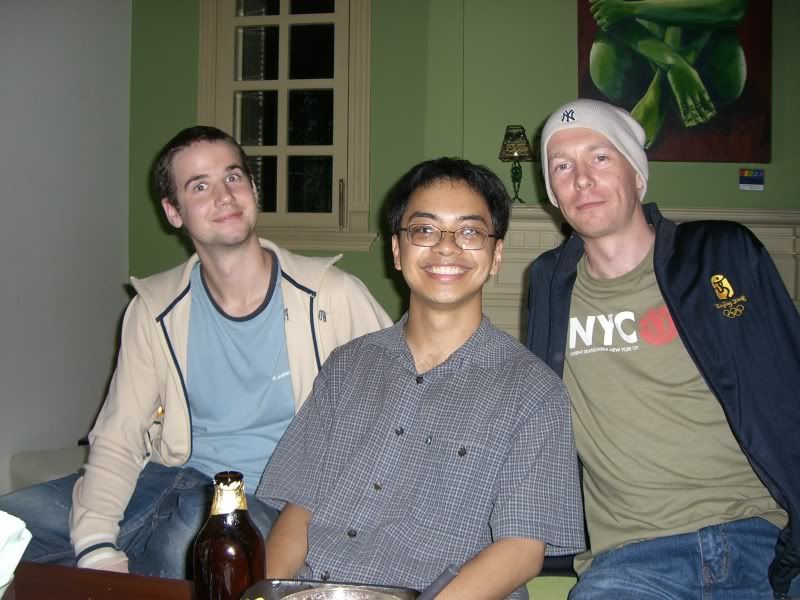
Richard and Andy at my farewell party at Cotton's Bar.
They left early, and the rest of my friends came later. Looking at all of these awesome people, I felt blessed. I hadn't even left yet, and I was already planning to come back and visit them.
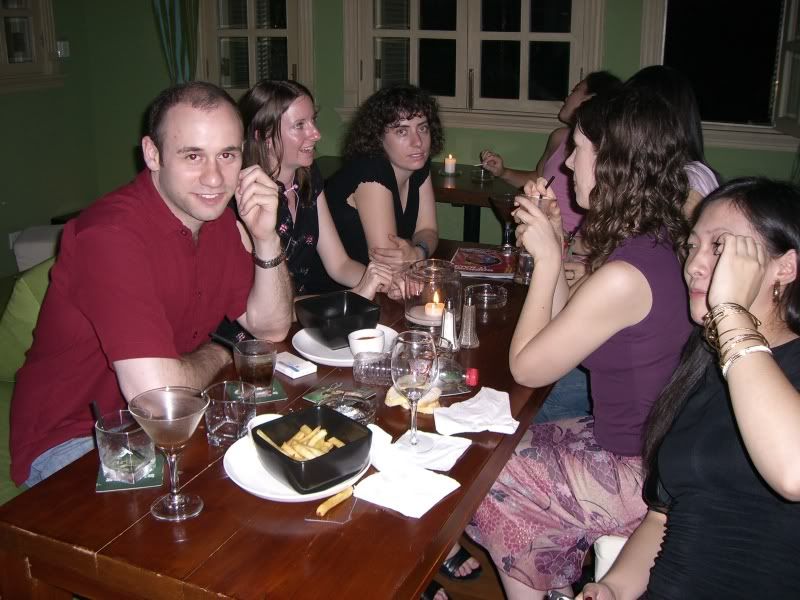
The Shanghai Gang. So many parties, so many memories.
The popular conversation topic was taking the next step. Melissa and Shauna moved up to teaching at international schools. My roommate Elizabeth was looking into working for a multinational company. Some of our friends had gone home to attend grad school. Others stayed to study Chinese, which would improve their career prospects.
As for me, I was going to move to a new country. Staying in China would have been so easy, since I had friends and knew my way around. But I wanted to keep moving, to see what else was out there. If I ever changed my mind, there was always Shanghai.
Inside Information
Getting into the city
Arrival: Most international flights land in Pudong airport. The Maglev train is not convenient for getting into the city. It's difficult to transfer from the airport to the Maglev, and it goes to Longyang metro station, which is still on the outskirts of Shanghai.
Airport buses are a better choice. Bus #2 is the most useful, as it goes directly to Jing'an Temple.
Where to stay
I stayed at Le Tour Travelers Rest. Nice hostel, and a great location near Jing'an Temple. Convenient for bars, clubs, and restaurants. Mingtown ETour Hostel has a super-central location near People's Square, a hub for the metro lines. It has gotten good reviews in guidebooks and online, but I haven't stayed there.
Captain Hostel (Bund branch) is one of the oldest hostels in Shanghai. Even if you don't stay there, it's worth going to the rooftop bar. Great views of the skyline in Pudong, at a fraction of the cost of other bars on the riverfront.
The information below is accumulated from my time living in Shanghai. Good for if you've decided to move there.
Appendix 1: Living Costs in Shanghai
What does it cost to live in Shanghai? Mercer Human Resources Consulting compiles a list of the world's most expensive cities every year. There's a link to the complete list over at CNN.
Shanghai ranked #30 overall. This list is skewed, though. Companies hire Mercer to calculate compensation packages for the American executives they send abroad. The Director of China Operations for a multinational corporation will demand a higher standard of living than a poor college graduate on a student budget. Shanghai can be very expensive or very cheap, depending on the person.
Enough talk. Time to show you the money!
My Monthly Expenses (estimates in RMB):
1400 Rent
1200 Food
200 Utilities
64 Bus
80 Taxi
80 Subway
300 Clubbing (Drinking and Cover Charges)
80 DVDs
300 Books
50 Mobile phone
+100 Long-distance phone calls
3854 RMB TOTAL US$477.58 a month, using the Universal Currency Converter
Comments on Costs
Rent -- Housing is the biggest expense, just like it would be anywhere else. Executive expats live in country club-style communities that can cost over $10,000 a month. Serviced apartments, which are basically long-stay hotel rooms, cost almost as much.
Younger expats usually share apartments. Smart Shanghai is the best to look for apartments (and jobs). Shanghai Expat, and Craig's List Shanghai are also worth a look. If you are fluent in Chinese, you can find some spectacular deals on Anjia.
If you have one roommate and a 2-bedroom apartment in the city, your rent shouldn't cost more than 2500 RMB ($310). If you live further from the city, that much could get you your own 1-bedroom apartment. 3-bedroom apartments can be had for less than 8000 RMB ($1000). For more info, check out this rental chart.
The bigger the apartment, the better the value. 1-bedroom apartments are usually bad and overpriced. 2-bedroom apartments range from okay to somewhat nice. 3-bedroom apartments are huge, new, and are well-located. Not to mention cheaper, because the rent is split among three people. The difference in price between 2-bedroom and 3-bedroom apartments is not that much sometimes. One of my friends said, "When it comes to apartments, 3 is the magic number."
Emoo is an expat services company that has excellent move-to-Shanghai packages. For one price, they'll pick you up at the airport, put you in a hotel, find you an apartment, and even toss in an international phone card. They also help with visas. Click on "Traveling." The special offers aren't there now, but should be back up soon. You can probably find a cheaper apartment on your own, but I think Emoo is the most convenient way to move to Shanghai for the first time.
Food -- Good news for people like me who are too lazy to cook. I average 40 RMB ($5) a day on food, eating out three times a day. If you stick to water and stuffed steam buns (baozi), could spend less than $1 a day. I tend to mix Western and Asian food. Pizza is expensive, so most of my friends eat Hello Pizza, a cheap local chain.
The bad news is cheese. There's no cheese in China! Carrefour (Jialefu in Chinese) is one of the few places that carry a decent selection, because they're like the French version of Costco. The Chinese I talk to say they don't like cheese, it smells too bad. Ironic, since one whiff of their stinky doufu could knock out a rampaging elephant.
Utilities -- These usually don't amount to much, but paying them can be a pain in the ass. You have to go to a convenience store like KEDI or Lawson's. You give them the bill, they scan it, and you pay. Some of the clerks can be anal about only accepting utility bills at certain times of the day. I get the best service when I pay at the post office, so now I do all my business there.
Bus -- on old buses (no air-conditioning), it costs 1 RMB for a one-way bus ticket. New buses cost 2 RMB. An old woman will come along the aisle with a dirty purse, collecting money, making change, and handing out bus tickets. The newer buses have coin machines and card scanners
Taxi -- The base fee is 10 RMB ($1.25) for the first kilometer and 2 RMB each kilometer afterwads. After 11:00PM, the base fee is 13 RMB ($1.61) There's a ton of taxis in Shanghai, and the drivers are very professional. At least compared to what I experienced in Beijing. Typically, they wear suits, ties, and white driving gloves. They don't speak English, so you'll have learn a little Chinese. Lu ("loo") means road. Nanjing Road becomes Nanjing Lu. Give the driver the street and cross-street, and you'll be fine.
Taxis come in different colors (each with a different company), but 99% of them are Volkswagen Santanas. Volkswagen was one of the first companies to enter the China market, so their cars are everywhere. The Santana is relatively cheap and super-reliable. But it's almost impossible to get a taxi when it's raining.
My favorite taxi company is Da Zhong Taxi, they're turquoise in color. They're part of a state-owned enterprise that enforces professional standards. Qiansheng taxis, which are yellow, are pretty good too. I thought the worst taxis were the maroon-colored ones, I forget the name. Old cars and the drivers didn't know where anything was.
Always keep the taxi receipt, you can use it to recover lost belongings or complain about a taxi driver. You can call the taxi company, and they can use the receipt to resolve any problems. Stay away from abnormal-looking taxis. They're private taxis and generate the most complaints.
Subway -- Shanghai's subway system is clean and efficient, but there's only 4 lines right now. The good news is that they're planning to add 8 lines.
It's highly recommended to get a Shanghai Public Transportation Card. It can be used on the subway, taxi, and some buses. The lines at subway ticket booths can be really long during peak times. It's faster to just pass the card over the scanner at the turnstiles. The scanners are powerful; I've seen women hold huge handbags over the scanner and it still detected the card.
Clubbing -- Drinking is expensive compared to other living costs, especially if you drink in the trendy Xintiandi area. The clubs I've gone to so far charge about 60 RMB ($7.44) for entry and about 50 RMB ($6.20) for mixed drinks. That's why my friends and I always end up at Windows Too, which has 10 RMB ($1.25) drinks. So far, my favorite club is Guandii. It was founded by Hong Kong media stars and has good hip-hop music. The place is always packed with overseas Chinese and ABCs (American-Born Chinese).
Here are some of the main clubbing areas:
The New Factories
The Bund
Tongren Road
Hengshan Road
Fuxing Park
Maoming Road
SH Magazine is a free weekly publication that has all the latest restaurant and clubbing info. You can pick it up at most Starbucks and Western restaurants. Smart Shanghai is another great source. Their venue listings also have the useful option of printing out directions in Chinese for a taxi driver.
There's a great service called Guanxi. If you send a text with the name of a bar, restaurant, or nightclub, it will reply with the address and contact info of that venue. You can also get Guanxi to translate those details into Chinese, so you can show it to a taxi driver.
DVDs -- China is heaven for movie lovers, since pirated DVDs are everywhere. DVDs in shops go for about 10 RMB ($1.25). On the street, they can go as low as 5 RMB ($0.62). I got a Philips DVD player for 400 RMB ($50) at Gome, a big electronics store. It's best to stay away from the newest Hollywood movies. Many times they're bad because the movie was recorded with a home video camera someone snuck into a movie theater. The annoying thing is that they often don't have the special features, like deleted scenes, director commentary, etc.
Books -- Books are relatively expensive. Paperback copies of literary classics are the best bargains at about 18 RMB ($2.25). Any other book can cost over 200 RMB ($24.81). Thanks to government censorship, there is a lack of variety, except for books about learning the Chinese language and doing business in China. Most bookstores will have a small section of English-language books, usually guidebooks and classic literature. The best bookstore is the Foreign Languages Bookstore, on Fuzhou Road.
Mobile Phone -- They say "mobile phone" more than "cell phone" here. Good ones usually cost more than 1000 RMB ($124.03). I got a Motorola for about 500 RMB ($62.01). One of my Chinese friends took me to a mobile phone store at Middle Henan Road subway station, Exit 1. You can sign up with China Mobile and pay a monthly fee. My friends and I buy phone cards and add credit as we go. Phone cards come in 50 RMB or 100 RMB. Since I mostly send text messages instead of talk, a 50 RMB card can last me a month.
Long-Distance Calls -- Just like with mobile phone cards, long-distance ones come in denominations of 50 RMB or 100 RMB. Try to buy them off the street from the shabbiest operator you can find. Normally you can buy for 50% or 66% off the face value. If you look Caucasian, you'll probably end up paying full price. A 100 RMB card lasts 45-50 minutes when calling America.
Appendix 2: Average Salaries in Shanghai
After talking to some people, here's what I came up with. Strictly word-of-mouth, no statistics to back these up. All numbers are monthly figures.
1000-3000 RMB ($124-$372) Recent College Graduate
5000-7000 RMB ($620-$868) Mid-level Employee
10,000 + RMB ($1240) Executive
Looking at this list, I can see why Western companies are in such a rush to send jobs overseas. You could pay a Chinese CEO half of what an American high school student makes at McDonald's. Note that factory workers make even less. Since rents are often higher than starting salaries in Shanghai, many young professionals live with their parents.
English is in such demand that I make more as an English teacher than many of my students. People are paid monthly here, rather than biweekly like the U.S. Some employers do direct deposits to bank accounts, while many still pay in cash.
Appendix 3: Exchanging Money
The yuan is a closed currency, meaning it is difficult to change. There's all sorts of exchange controls to let money come into China, but not go out. For example, when you change money at the airport or a bank, you are given an exchange memo. You always have to show that exchange memo before you can change yuan back into dollars. You can't get back more dollars than you first exchanged. Exchange memos are only valid for 6 months. Customs regualations prohibit carrying more than $5000 or 20,000 RMB in cash out of the country.
The best of all worlds is to have an American employer who pays you in dollars. Executive-level expats usually have their main salary wired to their U.S. bank account, while taking living allowances in cash for daily expenses.
Then there's the black market. Outside the main Bank of China headquarters near the Bund, there's street currency traders who will happily change as many dollars as you want. If they're blatant, they might run away with your money. If they have some subtlety, they'll yell "Police!" and then run away with your money. Or they will be totally professional: once back at your hotel, you'll discover you got carefully cut pieces of newspaper, even if you swear the money never left your hands.
The Hong Kong Dollar is freely convertible, so one of my friends proposed opening a bank account there if I ever visit Hong Kong to buy a Chinese visa. Wire the money to Hong Kong, then America. Or carry bundles of cash to Hong Kong. Some of the other schemes expats have come up with are too crazy to mention here.
Getting into the city
Arrival: Most international flights land in Pudong airport. The Maglev train is not convenient for getting into the city. It's difficult to transfer from the airport to the Maglev, and it goes to Longyang metro station, which is still on the outskirts of Shanghai.
Airport buses are a better choice. Bus #2 is the most useful, as it goes directly to Jing'an Temple.
Where to stay
I stayed at Le Tour Travelers Rest. Nice hostel, and a great location near Jing'an Temple. Convenient for bars, clubs, and restaurants. Mingtown ETour Hostel has a super-central location near People's Square, a hub for the metro lines. It has gotten good reviews in guidebooks and online, but I haven't stayed there.
Captain Hostel (Bund branch) is one of the oldest hostels in Shanghai. Even if you don't stay there, it's worth going to the rooftop bar. Great views of the skyline in Pudong, at a fraction of the cost of other bars on the riverfront.
The information below is accumulated from my time living in Shanghai. Good for if you've decided to move there.
Appendix 1: Living Costs in Shanghai
What does it cost to live in Shanghai? Mercer Human Resources Consulting compiles a list of the world's most expensive cities every year. There's a link to the complete list over at CNN.
Shanghai ranked #30 overall. This list is skewed, though. Companies hire Mercer to calculate compensation packages for the American executives they send abroad. The Director of China Operations for a multinational corporation will demand a higher standard of living than a poor college graduate on a student budget. Shanghai can be very expensive or very cheap, depending on the person.
Enough talk. Time to show you the money!
My Monthly Expenses (estimates in RMB):
1400 Rent
1200 Food
200 Utilities
64 Bus
80 Taxi
80 Subway
300 Clubbing (Drinking and Cover Charges)
80 DVDs
300 Books
50 Mobile phone
+100 Long-distance phone calls
3854 RMB TOTAL US$477.58 a month, using the Universal Currency Converter
Comments on Costs
Rent -- Housing is the biggest expense, just like it would be anywhere else. Executive expats live in country club-style communities that can cost over $10,000 a month. Serviced apartments, which are basically long-stay hotel rooms, cost almost as much.
Younger expats usually share apartments. Smart Shanghai is the best to look for apartments (and jobs). Shanghai Expat, and Craig's List Shanghai are also worth a look. If you are fluent in Chinese, you can find some spectacular deals on Anjia.
If you have one roommate and a 2-bedroom apartment in the city, your rent shouldn't cost more than 2500 RMB ($310). If you live further from the city, that much could get you your own 1-bedroom apartment. 3-bedroom apartments can be had for less than 8000 RMB ($1000). For more info, check out this rental chart.
The bigger the apartment, the better the value. 1-bedroom apartments are usually bad and overpriced. 2-bedroom apartments range from okay to somewhat nice. 3-bedroom apartments are huge, new, and are well-located. Not to mention cheaper, because the rent is split among three people. The difference in price between 2-bedroom and 3-bedroom apartments is not that much sometimes. One of my friends said, "When it comes to apartments, 3 is the magic number."
Emoo is an expat services company that has excellent move-to-Shanghai packages. For one price, they'll pick you up at the airport, put you in a hotel, find you an apartment, and even toss in an international phone card. They also help with visas. Click on "Traveling." The special offers aren't there now, but should be back up soon. You can probably find a cheaper apartment on your own, but I think Emoo is the most convenient way to move to Shanghai for the first time.
Food -- Good news for people like me who are too lazy to cook. I average 40 RMB ($5) a day on food, eating out three times a day. If you stick to water and stuffed steam buns (baozi), could spend less than $1 a day. I tend to mix Western and Asian food. Pizza is expensive, so most of my friends eat Hello Pizza, a cheap local chain.
The bad news is cheese. There's no cheese in China! Carrefour (Jialefu in Chinese) is one of the few places that carry a decent selection, because they're like the French version of Costco. The Chinese I talk to say they don't like cheese, it smells too bad. Ironic, since one whiff of their stinky doufu could knock out a rampaging elephant.
Utilities -- These usually don't amount to much, but paying them can be a pain in the ass. You have to go to a convenience store like KEDI or Lawson's. You give them the bill, they scan it, and you pay. Some of the clerks can be anal about only accepting utility bills at certain times of the day. I get the best service when I pay at the post office, so now I do all my business there.
Bus -- on old buses (no air-conditioning), it costs 1 RMB for a one-way bus ticket. New buses cost 2 RMB. An old woman will come along the aisle with a dirty purse, collecting money, making change, and handing out bus tickets. The newer buses have coin machines and card scanners
Taxi -- The base fee is 10 RMB ($1.25) for the first kilometer and 2 RMB each kilometer afterwads. After 11:00PM, the base fee is 13 RMB ($1.61) There's a ton of taxis in Shanghai, and the drivers are very professional. At least compared to what I experienced in Beijing. Typically, they wear suits, ties, and white driving gloves. They don't speak English, so you'll have learn a little Chinese. Lu ("loo") means road. Nanjing Road becomes Nanjing Lu. Give the driver the street and cross-street, and you'll be fine.
Taxis come in different colors (each with a different company), but 99% of them are Volkswagen Santanas. Volkswagen was one of the first companies to enter the China market, so their cars are everywhere. The Santana is relatively cheap and super-reliable. But it's almost impossible to get a taxi when it's raining.
My favorite taxi company is Da Zhong Taxi, they're turquoise in color. They're part of a state-owned enterprise that enforces professional standards. Qiansheng taxis, which are yellow, are pretty good too. I thought the worst taxis were the maroon-colored ones, I forget the name. Old cars and the drivers didn't know where anything was.
Always keep the taxi receipt, you can use it to recover lost belongings or complain about a taxi driver. You can call the taxi company, and they can use the receipt to resolve any problems. Stay away from abnormal-looking taxis. They're private taxis and generate the most complaints.
Subway -- Shanghai's subway system is clean and efficient, but there's only 4 lines right now. The good news is that they're planning to add 8 lines.
It's highly recommended to get a Shanghai Public Transportation Card. It can be used on the subway, taxi, and some buses. The lines at subway ticket booths can be really long during peak times. It's faster to just pass the card over the scanner at the turnstiles. The scanners are powerful; I've seen women hold huge handbags over the scanner and it still detected the card.
Clubbing -- Drinking is expensive compared to other living costs, especially if you drink in the trendy Xintiandi area. The clubs I've gone to so far charge about 60 RMB ($7.44) for entry and about 50 RMB ($6.20) for mixed drinks. That's why my friends and I always end up at Windows Too, which has 10 RMB ($1.25) drinks. So far, my favorite club is Guandii. It was founded by Hong Kong media stars and has good hip-hop music. The place is always packed with overseas Chinese and ABCs (American-Born Chinese).
Here are some of the main clubbing areas:
The New Factories
The Bund
Tongren Road
Hengshan Road
Fuxing Park
Maoming Road
SH Magazine is a free weekly publication that has all the latest restaurant and clubbing info. You can pick it up at most Starbucks and Western restaurants. Smart Shanghai is another great source. Their venue listings also have the useful option of printing out directions in Chinese for a taxi driver.
There's a great service called Guanxi. If you send a text with the name of a bar, restaurant, or nightclub, it will reply with the address and contact info of that venue. You can also get Guanxi to translate those details into Chinese, so you can show it to a taxi driver.
DVDs -- China is heaven for movie lovers, since pirated DVDs are everywhere. DVDs in shops go for about 10 RMB ($1.25). On the street, they can go as low as 5 RMB ($0.62). I got a Philips DVD player for 400 RMB ($50) at Gome, a big electronics store. It's best to stay away from the newest Hollywood movies. Many times they're bad because the movie was recorded with a home video camera someone snuck into a movie theater. The annoying thing is that they often don't have the special features, like deleted scenes, director commentary, etc.
Books -- Books are relatively expensive. Paperback copies of literary classics are the best bargains at about 18 RMB ($2.25). Any other book can cost over 200 RMB ($24.81). Thanks to government censorship, there is a lack of variety, except for books about learning the Chinese language and doing business in China. Most bookstores will have a small section of English-language books, usually guidebooks and classic literature. The best bookstore is the Foreign Languages Bookstore, on Fuzhou Road.
Mobile Phone -- They say "mobile phone" more than "cell phone" here. Good ones usually cost more than 1000 RMB ($124.03). I got a Motorola for about 500 RMB ($62.01). One of my Chinese friends took me to a mobile phone store at Middle Henan Road subway station, Exit 1. You can sign up with China Mobile and pay a monthly fee. My friends and I buy phone cards and add credit as we go. Phone cards come in 50 RMB or 100 RMB. Since I mostly send text messages instead of talk, a 50 RMB card can last me a month.
Long-Distance Calls -- Just like with mobile phone cards, long-distance ones come in denominations of 50 RMB or 100 RMB. Try to buy them off the street from the shabbiest operator you can find. Normally you can buy for 50% or 66% off the face value. If you look Caucasian, you'll probably end up paying full price. A 100 RMB card lasts 45-50 minutes when calling America.
Appendix 2: Average Salaries in Shanghai
After talking to some people, here's what I came up with. Strictly word-of-mouth, no statistics to back these up. All numbers are monthly figures.
1000-3000 RMB ($124-$372) Recent College Graduate
5000-7000 RMB ($620-$868) Mid-level Employee
10,000 + RMB ($1240) Executive
Looking at this list, I can see why Western companies are in such a rush to send jobs overseas. You could pay a Chinese CEO half of what an American high school student makes at McDonald's. Note that factory workers make even less. Since rents are often higher than starting salaries in Shanghai, many young professionals live with their parents.
English is in such demand that I make more as an English teacher than many of my students. People are paid monthly here, rather than biweekly like the U.S. Some employers do direct deposits to bank accounts, while many still pay in cash.
Appendix 3: Exchanging Money
The yuan is a closed currency, meaning it is difficult to change. There's all sorts of exchange controls to let money come into China, but not go out. For example, when you change money at the airport or a bank, you are given an exchange memo. You always have to show that exchange memo before you can change yuan back into dollars. You can't get back more dollars than you first exchanged. Exchange memos are only valid for 6 months. Customs regualations prohibit carrying more than $5000 or 20,000 RMB in cash out of the country.
The best of all worlds is to have an American employer who pays you in dollars. Executive-level expats usually have their main salary wired to their U.S. bank account, while taking living allowances in cash for daily expenses.
Then there's the black market. Outside the main Bank of China headquarters near the Bund, there's street currency traders who will happily change as many dollars as you want. If they're blatant, they might run away with your money. If they have some subtlety, they'll yell "Police!" and then run away with your money. Or they will be totally professional: once back at your hotel, you'll discover you got carefully cut pieces of newspaper, even if you swear the money never left your hands.
The Hong Kong Dollar is freely convertible, so one of my friends proposed opening a bank account there if I ever visit Hong Kong to buy a Chinese visa. Wire the money to Hong Kong, then America. Or carry bundles of cash to Hong Kong. Some of the other schemes expats have come up with are too crazy to mention here.











 Posts
Posts

