"He who asks is a fool for five minutes, but he who does not ask remains a fool forever."
--Chinese proverb
Although my company is an English school, they also offer Mandarin classes. As an employee, I get a cool fringe benefit: free Chinese classes!
As a foreigner, I constantly get offers of "language exchanges" from Chinese people, i.e. "I can teach you Chinese for free!" I've tried it, and it's always been a waste of time. The deal is supposed to be 1 hour of Chinese, 1 hour of English. But it usually works out to 1 hour and 59 minutes of free English practice for the Chinese person. As a result, it's usually a bad deal for a foreigner. The going rate for private English tutoring is 150-200RMB an hour ($18-$25). In contrast, private Chinese lessons can be had for 50 RMB ($6) an hour or less. The other problem is that the language partner is usually not a trained teacher, so they lack the patience and the ability to explain things clearly.
To be fair, some of my friends have been able to make language exchanges work. The key things are that the Chinese person should share time fairly and the foreigner needs to know what they want out of the exchange. I think they work better for an intermediate-level student who wants conversation practice. For a beginner, I think it's better to shell out the money and get lessons from a real teacher.
There are ulterior reasons for language exchanges, though. Some foreign men use them to meet Chinese women, and vice versa.
I've been studying Mandarin one-on-one with Miss Zhang for about 6 months. I realized right away that it's hard to study spoken Chinese and written Chinese the same way. Miss Zhang teaches them separately. With spoken Chinese, it's best to stick to pinyin, the system of writing Chinese with English letters. This allows a student to speak Chinese very quickly. When writing Chinese, start with the easiest characters to write, then increase the difficulty.
My Mandarin skills were put to the test when I went out for a job interview. An American company needed native English speakers as voice talents for their English-learning software. Part-time work. I sent in a resume and a woman named Lily e-mailed to invite me to interview. But she couldn't understand my request for directions to their office. I had the address, but they didn't tell me the cross-street. I needed both to tell the taxi driver where to go.
I got out my Shanghai Tourist Map and found the closest subway station to the address: Dongchang Road station. The road was pretty close to the station, I was hoping I could just walk to the office.
After a 15-minute walk from the station, I found the street I was looking for. The nearest building said it was 500. I checked my address: 1515 Zhangyang Road. 1515! I was miles away from the interview site!
I hailed a taxi and got in.
"Ni qu shenme difan? [You go to what place?]" the driver asked.
"Yao wu yao wu Zhangyang Lu [one five one five Zhangyang Road]," I said.
"Ah?" She scrunched her face.
Damn! Have to say it another away. "Yi qian wu bai shi wu Zhangyang Lu [one thousand five hundred fifteen Zhangyang Road]."
"Ah!" She started the taxi.
She dropped me outside a complex of apartment buildings. This was residential, not commercial property! Was I at the wrong place?
My pronunciation must have been off! There's 4 tones in Chinese. The same word said with the wrong tone changes the meaning. Say "strawberry milkshake" with the wrong tones and you say "fuck-your-sister milkshake."
The office was in building 7. I found buildings 8 and 9 easily enough. The next building was . . . 15. What?! I backtracked and found a yuppie-type reading a newspaper outside building 9.
I started to ask where building 7 was, then realized I didn't know the word for building. Need to improvise.
"Bu hao yi si [Excuse me]," I said.
The yuppie looked at me.
I pointed to the sign that said 9. "Jiu [Nine]."
"Dui [correct]." He looked at me like I was an idiot. Why would I state the obvious?
"Chi na lia? [Where is seven?]" I asked.
"Chi?" He drew a seven in the air.
I nodded.
He pointed behind me. I turned around. Building 7 was across a big-ass pond.
"Xie xie [Thanks]."
He shrugged. "Bu ker chi [You're welcome]." He went back to his newspaper.
I raced across the pond to building 7. The seconds ticked by the elevator swept me up to the 16th floor. I stepped into the office at the stroke of 10:30AM. Just in time, thanks to my brand-new Mandarin skills!
How to say an address in Chinese:
Like everything else in China, it's backwards. Say the street name first, the number (each digit), and the word that indicates a number (hao).
1515 Zhangyang Road = Zhangyang Road one five one five
Zhangyang Lu yao wu yao wu hao
"Yi" is usually the word for one, except in addresses and phone numbers, where it becomes "yao."
Wednesday, March 15, 2006

Monday, February 27, 2006
Shipped to Shanghai! Vol.12 -- Marcus the Great
"The beginning of wisdom is to call things by their right names."
--Chinese proverb
"Marcus? He is a great man in China," Maggie said.
"Really?" I asked. We were chilling out in the office after work.
"Yes, Marcus was very important," she said seriously. "We all had to study him in school."
Wow. It'd be good to be associated with someone positive for once. Sometimes when I tell Filipinos my name, they're like, "Marcus? Marcos? You mean Ferdinand Marcos?!"
Then I have to say, "NO! I wasn't named after him! I was named after my great-grandfather."
I pressed Maggie for more details. She couldn't translate what she knew, but she promised to look him up on the Internet.
My imagination was fired by visions of grandeur. Maybe I was a great man in a past life. Ha ha ha!
Famous (and Infamous) Marcus's in History
Marcus Aurelius--the philosopher-king of ancient Rome. Celebrated as the last of the "5 Good Emperors" before the fall of the Roman Empire.
Marco Polo--Venetian merchant who was one of the most traveled men of his time. Even more significant, his writings became the Western world's first look into China.
His book inspired another young Italian to go to China--by sailing west in 1492.
Markus Wolf--East German spymaster nicknamed "The Man Without a Face" because no intelligence agency was able to photograph him. Novelist John Le Carre used Wolf as a model for Karla, the most fearsome enemy to the British Secret Service.
Herbert Marcus--co-founder of the Neiman Marcus upscale clothing store chain. He started NM with a store in Dallas, Texas.
Although it would have been cool to be a Roman emperor, globe-trotting merchant, super-spy, or retail tycoon, none of them seemed right.
The Foreign Languages Bookstore is one of my favorite places in Shanghai. It's on Fuzhou Lu (Fuzhou Road), famous for having acres of bookshops. The selection of English-language books at the shops leave a lot to be desired. It's either guidebooks or literary classics in paperback. Anything else is absurdly more expensive. Many books go for 200 RMB ($24.80) and up. Literary classics are 18 RMB ($2.23).
I know it sounds weird to complain about 25 bucks, but I'm thinking with my Chinese salary now. In comparison, DVDs here cost only 10 RMB ($1.24), down to 5 RMB ($0.62). It's a cruel twist of fate that the only books I can afford are the ones that bored me in school!
I headed to the classics display to see what bargains I could find. While I dug through pre-20th century literature, my mind drifted to how Chinese people kept mispronouncing my name. They always called me "Mark-suh."
There was a stack of a new book that hadn't been there last time I was here. I picked up a copy.
Suddenly, everything came together: an important man; the strong influence he had on China; the way everyone said my name wrong.
The book was

--Chinese proverb
"Marcus? He is a great man in China," Maggie said.
"Really?" I asked. We were chilling out in the office after work.
"Yes, Marcus was very important," she said seriously. "We all had to study him in school."
Wow. It'd be good to be associated with someone positive for once. Sometimes when I tell Filipinos my name, they're like, "Marcus? Marcos? You mean Ferdinand Marcos?!"
Then I have to say, "NO! I wasn't named after him! I was named after my great-grandfather."
I pressed Maggie for more details. She couldn't translate what she knew, but she promised to look him up on the Internet.
My imagination was fired by visions of grandeur. Maybe I was a great man in a past life. Ha ha ha!
Famous (and Infamous) Marcus's in History
Marcus Aurelius--the philosopher-king of ancient Rome. Celebrated as the last of the "5 Good Emperors" before the fall of the Roman Empire.
Marco Polo--Venetian merchant who was one of the most traveled men of his time. Even more significant, his writings became the Western world's first look into China.
His book inspired another young Italian to go to China--by sailing west in 1492.
Markus Wolf--East German spymaster nicknamed "The Man Without a Face" because no intelligence agency was able to photograph him. Novelist John Le Carre used Wolf as a model for Karla, the most fearsome enemy to the British Secret Service.
Herbert Marcus--co-founder of the Neiman Marcus upscale clothing store chain. He started NM with a store in Dallas, Texas.
Although it would have been cool to be a Roman emperor, globe-trotting merchant, super-spy, or retail tycoon, none of them seemed right.
The Foreign Languages Bookstore is one of my favorite places in Shanghai. It's on Fuzhou Lu (Fuzhou Road), famous for having acres of bookshops. The selection of English-language books at the shops leave a lot to be desired. It's either guidebooks or literary classics in paperback. Anything else is absurdly more expensive. Many books go for 200 RMB ($24.80) and up. Literary classics are 18 RMB ($2.23).
I know it sounds weird to complain about 25 bucks, but I'm thinking with my Chinese salary now. In comparison, DVDs here cost only 10 RMB ($1.24), down to 5 RMB ($0.62). It's a cruel twist of fate that the only books I can afford are the ones that bored me in school!
I headed to the classics display to see what bargains I could find. While I dug through pre-20th century literature, my mind drifted to how Chinese people kept mispronouncing my name. They always called me "Mark-suh."
There was a stack of a new book that hadn't been there last time I was here. I picked up a copy.
Suddenly, everything came together: an important man; the strong influence he had on China; the way everyone said my name wrong.
The book was
Friday, February 3, 2006
Shanghai on Film!
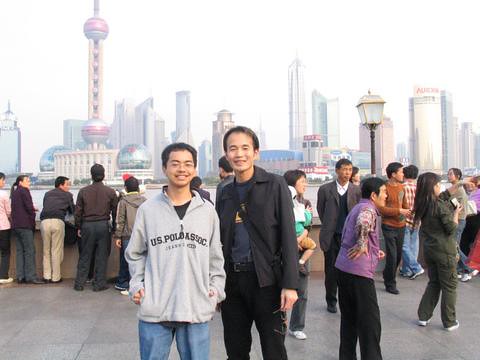
By popular demand, here are some pictures of Shanghai! Click on the photo to go to the photo album. Special thanks to Joe (above) and Ed for lending their cameras to the cause.
Monday, January 23, 2006
Shipped to Shanghai! Vol. 11 -- Money Matters
"The saving man becomes the free man."
--Chinese proverb
My Mom predicted that I wouldn't be able to save money during my first two months in China. I was sure she'd be wrong. With such favorable exchange rates, I couldn't lose. She said that didn't matter. The first two months in a new place always require heavy spending. Alas, she was right. Because everything seemed so cheap, I couldn't stop myself from buying whatever I wanted.
It took discipline, but I was able to save up a tidy amount. Now I needed to put it somewhere safe. Not that I worried too much about getting robbed. Shanghai is safe in the same way Las Vegas is safe: the government makes sure criminals don't scare away the money, I mean the investors.
I turned to the experts, my students. Which bank should I use? I thought Bank of China or Industrial and Commercial Bank of China would be best, since they had the most ATMs. The survey turned up the same answer:
"State-owned banks bad service, very bad service," they said. They cited long waits in line, unprofessional tellers, and outdated technology.
"Which ones are the state-owned banks?" I asked.
"All of them."
"D'oh!" I should have know it wouldn't be easy. Nothing in China is easy, except finding cheap DVDs. "There has to be at least one good bank in this country."
"Well, there is one."
"Yes?"
"China Merchants Bank. Very good service."
"Why is that?" I wondered.
"Is not state bank. Is private bank." Ah, free enterprise at work.
Opening the account was relatively simple. I brought my passport and temporary residency permit. The teller filled out an application and gave me an ATM card.
I came back the next day to make my first deposit. I got a ticket from the ticket machine: #500. The display on the teller windows said it was serving customer #300. Damn! I was in for a long wait.
"Hello?"
I turned around. It was a pretty young Chinese woman. She was dressed in a jacket, jeans, and high-heeled boots that go up to the knees. Very popular with Shanghai girls.
"Marcus! It is you. Do you remember me? I'm Lucy."
"Of course!" I nodded. Meanwhile, my mind was racing: where did I meet this girl?! A party? In class? Friend of a friend?
"You do a transaction in the bank?" Lucy asked.
"Yes, I need to put in money," I said.
"Oh, you needn't talk to the teller." Lucy took me past the ATMs to a jumbo-sized ATM. "This is a special machine. You can put in money."
Just like a regular ATM, I put in my card and typed my PIN. I selected DEPOSIT. A metal plate slid away, revealing a cash tray.
"Put your money in there," she instructed.
I arranged the bills neatly. The lid snapped shut, almost biting my hand off. A loud whirring sound powered up. It sounded like it was eating my money!
"Don't worry, it's just counting it," Lucy said.
The whirring stopped and the screen showed several options, asking me to select which account to deposit the money to. I chose CURRENT ACCOUNT. Lucy said to ask for a receipt. The machine spat out the paper. I was now solvent in China!
"That's amazing! We don't have deposit machines like that in America," I said. "We have machines to take money out, but not to put money in."
"Really? Chinese always save money [30-50% of their income]. Don't Americans save money?" Lucy asked.
"Uh, not so much," I said. Statistics said that Americans save between 0-1% of their income.
Later, I read this headline in the Nov. 2005 issue of Insight: the Journal of the American Chamber of Commerce in Shanghai:
U.S. URGES CHINESE TO SAVE LESS, SPEND MORE
Appendix 1: Living Costs in Shanghai
What does it cost to live in Shanghai? Mercer Human Resources Consulting compiles a list of the world's most expensive cities every year. There's a link to the complete list over at CNN.
Shanghai ranked #30 overall. This list is skewed, though. Companies hire Mercer to calculate compensation packages for the American executives they send abroad. The Director of China Operations for a multinational corporation will demand a higher standard of living than a poor college graduate on a student budget. Shanghai can be very expensive or very cheap, depending on the person.
Enough talk. Time to show you the money!
My Monthly Expenses (estimates in RMB):
1400 Rent
1200 Food
200 Utilities
64 Bus
80 Taxi
80 Subway
300 Clubbing (Drinking and Cover Charges)
80 DVDs
300 Books
50 Mobile phone
+100 Long-distance phone calls
3854 RMB TOTAL $477.58 a month, using the Universal Currency Converter
Comments on Costs
Rent -- Housing is the biggest expense, just like it would be anywhere else. Executive expats live in country club-style communities that can cost over $10,000 a month. Serviced apartments, which are basically long-stay hotel rooms, cost almost as much.
Younger expats usually share apartments. Asia Expat is the best to look for apartments (and jobs). Smart Shanghai, Shanghai Expat, and Craig's List Shanghai are also worth a look. If you are fluent in Chinese, you can find some spectacular deals on Anjia.
If you have one roommate and a 2-bedroom apartment in the city, your rent shouldn't cost more than 2500 RMB ($310). If you live further from the city, that much could get you your own 1-bedroom apartment. 3-bedroom apartments can be had for less than 8000 RMB ($1000). For more info, check out this rental chart.
The bigger the apartment, the better the value. 1-bedroom apartments are usually bad and overpriced. 2-bedroom apartments range from okay to somewhat nice. 3-bedroom apartments are huge, new, and are well-located. Not to mention cheaper, because the rent is split among three people. The difference in price between 2-bedroom and 3-bedroom apartments is not that much sometimes. One of my friends said, "When it comes to apartments, 3 is the magic number."
Emoo is an expat services company that has excellent move-to-Shanghai packages. For one price, they'll pick you up at the airport, put you in a hotel, find you an apartment, and even toss in an international phone card. They also help with visas. Click on "Traveling." The special offers aren't there now, but should be back up soon. You can probably find a cheaper apartment on your own, but I think Emoo is the most convenient way to move to Shanghai for the first time.
Food -- Good news for people like me who are too lazy to cook. I average 40 RMB ($5) a day on food, eating out three times a day. If you stick to water and stuffed steam buns (baozi), could spend less than $1 a day. I tend to mix Western and Asian food. Pizza is expensive, so most of my friends eat Hello Pizza, a cheap local chain.
The bad news is cheese. There's no cheese in China! Carrefour (Jialefu in Chinese) is one of the few places that carry a decent selection, because they're like the French version of Costco. The Chinese I talk to say they don't like cheese, it smells too bad. Ironic, since one whiff of their stinky doufu could knock out a rampaging elephant.
Utilities -- These usually don't amount to much, but paying them can be a pain in the ass. You have to go to a convenience store like KEDI or Lawson's. You give them the bill, they scan it, and you pay. Some of the clerks can be anal about only accepting utility bills at certain times of the day. I get the best service when I pay at the post office, so now I do all my business there.
Bus -- on old buses (no air-conditioning), it costs 1 RMB for a one-way bus ticket. New buses cost 2 RMB. An old woman will come along the aisle with a dirty purse, collecting money, making change, and handing out bus tickets. The newer buses have coin machines and card scanners
Taxi -- The base fee is 10 RMB ($1.25) for the first kilometer and 2 RMB each kilometer afterwads. After 11:00PM, the base fee is 13 RMB ($1.61) There's a ton of taxis in Shanghai, and the drivers are very professional. Typically, they wear suits, ties, and white driving gloves. They don't speak English, so you'll have learn a little Chinese. Lu ("loo") means road. Nanjing Road becomes Nanjing Lu. Give the driver the street and cross-street, and you'll be fine.
Taxis come in different colors (each with a different company), but 99% of them are Volkswagen Santanas. Volkswagen was one of the first companies to enter the China market, so their cars are everywhere. The Santana is relatively cheap and super-reliable. But it's almost impossible to get a taxi when it's raining.
The taxi companies are all pretty good. Always keep the taxi receipt, you can use it to recover lost belongings or complain about a taxi driver. You can call the taxi company, and they can use the receipt to resolve any problems. Stay away from abnormal-looking taxis. They're private taxis and generate the most complaints.
Subway -- Shanghai's subway system is clean and efficient, but there's only 4 lines right now. The good news is that they're planning to add 8 lines.
It's highly recommended to get a Shanghai Public Transportation Card. It can be used on the subway, taxi, and some buses. The lines at subway ticket booths can be really long during peak times. It's faster to just pass the card over the scanner at the turnstiles. The scanners are powerful; I've seen women hold huge handbags over the scanner and it still detected the card.
Clubbing -- Drinking is expensive compared to other living costs, especially if you drink in the trendy Xintiandi area. The clubs I've gone to so far charge about 60 RMB ($7.44) for entry and about 50 RMB ($6.20) for mixed drinks. That's why my friends and I always end up at Windows Too, which has 10 RMB ($1.25) drinks. So far, my favorite club is Guandii. It was founded by Hong Kong media stars and has good hip-hop music. The place is always packed with overseas Chinese and ABCs (American-Born Chinese).
Here are some of the main clubbing areas:
Tongren Road
Hengshan Road
Fuxing Park
Maoming Road
SH Magazine is a free weekly publication that has all the latest restaurant and clubbing info. You can pick it up at most Starbucks and Western restaurants. Smart Shanghai is another great source.
DVDs -- China is heaven for movie lovers, since pirated DVDs are everywhere. DVDs in shops go for about 10 RMB ($1.25). On the street, they can go as low as 5 RMB ($0.62). I got a Philips DVD player for 400 RMB ($50) at Gome, a big electronics store. It's best to stay away from the newest Hollywood movies. Many times they're bad because the movie was recorded with a home video camera someone snuck into a movie theater. The annoying thing is that they often don't have the special features, like deleted scenes, director commentary, etc.
Books -- Books are relatively expensive. Paperback copies of literary classics are the best bargains at about 18 RMB ($2.25). Any other book can cost over 200 RMB ($24.81). Thanks to government censorship, there is a lack of variety, except for books about learning the Chinese language and doing business in China. Most bookstores will have a small section of English-language books, usually guidebooks and classic literature. The best bookstore is the Foreign Languages Bookstore, on Fuzhou Road.
Mobile Phone -- They say "mobile phone" more than "cell phone" here. Good ones usually cost more than 1000 RMB ($124.03). I got a Motorola for about 500 RMB ($62.01). One of my Chinese friends took me to a mobile phone store at Middle Henan Road subway station, Exit 1. You can sign up with China Mobile and pay a monthly fee. My friends and I buy phone cards and add credit as we go. Phone cards come in 50 RMB or 100 RMB. Since I mostly send text messages instead of talk, a 50 RMB card can last me a month.
Long-Distance Calls -- Just like with mobile phone cards, long-distance ones come in denominations of 50 RMB or 100 RMB. Try to buy them off the street from the shabbiest operator you can find. Normally you can buy for 50% or 66% off the face value. If you look Caucasian, you'll probably end up paying full price. A 100 RMB card lasts 45-50 minutes when calling America.
Appendix 2: Average Salaries in Shanghai
After talking to some people, here's what I came up with. Strictly word-of-mouth, no statistics to back these up. All numbers are monthly figures.
1000-3000 RMB ($124-$372) Recent College Graduate
5000-7000 RMB ($620-$868) Mid-level Employee
10,000 + RMB ($1240) Executive
Looking at this list, I can see why Western companies are in such a rush to send jobs overseas. You could pay a Chinese CEO half of what an American high school student makes at McDonald's. Note that factory workers make even less. Since rents are often higher than starting salaries in Shanghai, many young professionals live with their parents.
English is in such demand that I make more as an English teacher than many of my students. People are paid monthly here, rather than biweekly like the U.S. Some employers do direct deposits to bank accounts, while many still pay in cash.
Appendix 3: Exchanging Money
The yuan is a closed currency, meaning it is difficult to change. There's all sorts of exchange controls to let money come into China, but not go out. For example, when you change money at the airport or a bank, you are given an exchange memo. You always have to show that exchange memo before you can change yuan back into dollars. You can't get back more dollars than you first exchanged. Exchange memos are only valid for 6 months. Customs regualations prohibit carrying more than $5000 or 20,000 RMB in cash out of the country.
The best of all worlds is to have an American employer who pays you in dollars. Executive-level expats usually have their main salary wired to their U.S. bank account, while taking living allowances in cash for daily expenses.
Then there's the black market. Outside the main Bank of China headquarters near the Bund, there's street currency traders who will happily change as many dollars as you want. If they're blatant, they might run away with your money. If they have some subtlety, they'll yell "Police!" and then run away with your money. Or they will be totally professional: once back at your hotel, you'll discover you got carefully cut pieces of newspaper, even if you swear the money never left your hands.
The Hong Kong Dollar is freely convertible, so one of my friends proposed opening a bank account there if I ever visit Hong Kong to buy a Chinese visa. Wire the money to Hong Kong, then America. Or carry bundles of cash to Hong Kong. Some of the other schemes expats have come up with are too crazy to mention here.
--Chinese proverb
My Mom predicted that I wouldn't be able to save money during my first two months in China. I was sure she'd be wrong. With such favorable exchange rates, I couldn't lose. She said that didn't matter. The first two months in a new place always require heavy spending. Alas, she was right. Because everything seemed so cheap, I couldn't stop myself from buying whatever I wanted.
It took discipline, but I was able to save up a tidy amount. Now I needed to put it somewhere safe. Not that I worried too much about getting robbed. Shanghai is safe in the same way Las Vegas is safe: the government makes sure criminals don't scare away the money, I mean the investors.
I turned to the experts, my students. Which bank should I use? I thought Bank of China or Industrial and Commercial Bank of China would be best, since they had the most ATMs. The survey turned up the same answer:
"State-owned banks bad service, very bad service," they said. They cited long waits in line, unprofessional tellers, and outdated technology.
"Which ones are the state-owned banks?" I asked.
"All of them."
"D'oh!" I should have know it wouldn't be easy. Nothing in China is easy, except finding cheap DVDs. "There has to be at least one good bank in this country."
"Well, there is one."
"Yes?"
"China Merchants Bank. Very good service."
"Why is that?" I wondered.
"Is not state bank. Is private bank." Ah, free enterprise at work.
Opening the account was relatively simple. I brought my passport and temporary residency permit. The teller filled out an application and gave me an ATM card.
I came back the next day to make my first deposit. I got a ticket from the ticket machine: #500. The display on the teller windows said it was serving customer #300. Damn! I was in for a long wait.
"Hello?"
I turned around. It was a pretty young Chinese woman. She was dressed in a jacket, jeans, and high-heeled boots that go up to the knees. Very popular with Shanghai girls.
"Marcus! It is you. Do you remember me? I'm Lucy."
"Of course!" I nodded. Meanwhile, my mind was racing: where did I meet this girl?! A party? In class? Friend of a friend?
"You do a transaction in the bank?" Lucy asked.
"Yes, I need to put in money," I said.
"Oh, you needn't talk to the teller." Lucy took me past the ATMs to a jumbo-sized ATM. "This is a special machine. You can put in money."
Just like a regular ATM, I put in my card and typed my PIN. I selected DEPOSIT. A metal plate slid away, revealing a cash tray.
"Put your money in there," she instructed.
I arranged the bills neatly. The lid snapped shut, almost biting my hand off. A loud whirring sound powered up. It sounded like it was eating my money!
"Don't worry, it's just counting it," Lucy said.
The whirring stopped and the screen showed several options, asking me to select which account to deposit the money to. I chose CURRENT ACCOUNT. Lucy said to ask for a receipt. The machine spat out the paper. I was now solvent in China!
"That's amazing! We don't have deposit machines like that in America," I said. "We have machines to take money out, but not to put money in."
"Really? Chinese always save money [30-50% of their income]. Don't Americans save money?" Lucy asked.
"Uh, not so much," I said. Statistics said that Americans save between 0-1% of their income.
Later, I read this headline in the Nov. 2005 issue of Insight: the Journal of the American Chamber of Commerce in Shanghai:
U.S. URGES CHINESE TO SAVE LESS, SPEND MORE
Appendix 1: Living Costs in Shanghai
What does it cost to live in Shanghai? Mercer Human Resources Consulting compiles a list of the world's most expensive cities every year. There's a link to the complete list over at CNN.
Shanghai ranked #30 overall. This list is skewed, though. Companies hire Mercer to calculate compensation packages for the American executives they send abroad. The Director of China Operations for a multinational corporation will demand a higher standard of living than a poor college graduate on a student budget. Shanghai can be very expensive or very cheap, depending on the person.
Enough talk. Time to show you the money!
My Monthly Expenses (estimates in RMB):
1400 Rent
1200 Food
200 Utilities
64 Bus
80 Taxi
80 Subway
300 Clubbing (Drinking and Cover Charges)
80 DVDs
300 Books
50 Mobile phone
+100 Long-distance phone calls
3854 RMB TOTAL $477.58 a month, using the Universal Currency Converter
Comments on Costs
Rent -- Housing is the biggest expense, just like it would be anywhere else. Executive expats live in country club-style communities that can cost over $10,000 a month. Serviced apartments, which are basically long-stay hotel rooms, cost almost as much.
Younger expats usually share apartments. Asia Expat is the best to look for apartments (and jobs). Smart Shanghai, Shanghai Expat, and Craig's List Shanghai are also worth a look. If you are fluent in Chinese, you can find some spectacular deals on Anjia.
If you have one roommate and a 2-bedroom apartment in the city, your rent shouldn't cost more than 2500 RMB ($310). If you live further from the city, that much could get you your own 1-bedroom apartment. 3-bedroom apartments can be had for less than 8000 RMB ($1000). For more info, check out this rental chart.
The bigger the apartment, the better the value. 1-bedroom apartments are usually bad and overpriced. 2-bedroom apartments range from okay to somewhat nice. 3-bedroom apartments are huge, new, and are well-located. Not to mention cheaper, because the rent is split among three people. The difference in price between 2-bedroom and 3-bedroom apartments is not that much sometimes. One of my friends said, "When it comes to apartments, 3 is the magic number."
Emoo is an expat services company that has excellent move-to-Shanghai packages. For one price, they'll pick you up at the airport, put you in a hotel, find you an apartment, and even toss in an international phone card. They also help with visas. Click on "Traveling." The special offers aren't there now, but should be back up soon. You can probably find a cheaper apartment on your own, but I think Emoo is the most convenient way to move to Shanghai for the first time.
Food -- Good news for people like me who are too lazy to cook. I average 40 RMB ($5) a day on food, eating out three times a day. If you stick to water and stuffed steam buns (baozi), could spend less than $1 a day. I tend to mix Western and Asian food. Pizza is expensive, so most of my friends eat Hello Pizza, a cheap local chain.
The bad news is cheese. There's no cheese in China! Carrefour (Jialefu in Chinese) is one of the few places that carry a decent selection, because they're like the French version of Costco. The Chinese I talk to say they don't like cheese, it smells too bad. Ironic, since one whiff of their stinky doufu could knock out a rampaging elephant.
Utilities -- These usually don't amount to much, but paying them can be a pain in the ass. You have to go to a convenience store like KEDI or Lawson's. You give them the bill, they scan it, and you pay. Some of the clerks can be anal about only accepting utility bills at certain times of the day. I get the best service when I pay at the post office, so now I do all my business there.
Bus -- on old buses (no air-conditioning), it costs 1 RMB for a one-way bus ticket. New buses cost 2 RMB. An old woman will come along the aisle with a dirty purse, collecting money, making change, and handing out bus tickets. The newer buses have coin machines and card scanners
Taxi -- The base fee is 10 RMB ($1.25) for the first kilometer and 2 RMB each kilometer afterwads. After 11:00PM, the base fee is 13 RMB ($1.61) There's a ton of taxis in Shanghai, and the drivers are very professional. Typically, they wear suits, ties, and white driving gloves. They don't speak English, so you'll have learn a little Chinese. Lu ("loo") means road. Nanjing Road becomes Nanjing Lu. Give the driver the street and cross-street, and you'll be fine.
Taxis come in different colors (each with a different company), but 99% of them are Volkswagen Santanas. Volkswagen was one of the first companies to enter the China market, so their cars are everywhere. The Santana is relatively cheap and super-reliable. But it's almost impossible to get a taxi when it's raining.
The taxi companies are all pretty good. Always keep the taxi receipt, you can use it to recover lost belongings or complain about a taxi driver. You can call the taxi company, and they can use the receipt to resolve any problems. Stay away from abnormal-looking taxis. They're private taxis and generate the most complaints.
Subway -- Shanghai's subway system is clean and efficient, but there's only 4 lines right now. The good news is that they're planning to add 8 lines.
It's highly recommended to get a Shanghai Public Transportation Card. It can be used on the subway, taxi, and some buses. The lines at subway ticket booths can be really long during peak times. It's faster to just pass the card over the scanner at the turnstiles. The scanners are powerful; I've seen women hold huge handbags over the scanner and it still detected the card.
Clubbing -- Drinking is expensive compared to other living costs, especially if you drink in the trendy Xintiandi area. The clubs I've gone to so far charge about 60 RMB ($7.44) for entry and about 50 RMB ($6.20) for mixed drinks. That's why my friends and I always end up at Windows Too, which has 10 RMB ($1.25) drinks. So far, my favorite club is Guandii. It was founded by Hong Kong media stars and has good hip-hop music. The place is always packed with overseas Chinese and ABCs (American-Born Chinese).
Here are some of the main clubbing areas:
Tongren Road
Hengshan Road
Fuxing Park
Maoming Road
SH Magazine is a free weekly publication that has all the latest restaurant and clubbing info. You can pick it up at most Starbucks and Western restaurants. Smart Shanghai is another great source.
DVDs -- China is heaven for movie lovers, since pirated DVDs are everywhere. DVDs in shops go for about 10 RMB ($1.25). On the street, they can go as low as 5 RMB ($0.62). I got a Philips DVD player for 400 RMB ($50) at Gome, a big electronics store. It's best to stay away from the newest Hollywood movies. Many times they're bad because the movie was recorded with a home video camera someone snuck into a movie theater. The annoying thing is that they often don't have the special features, like deleted scenes, director commentary, etc.
Books -- Books are relatively expensive. Paperback copies of literary classics are the best bargains at about 18 RMB ($2.25). Any other book can cost over 200 RMB ($24.81). Thanks to government censorship, there is a lack of variety, except for books about learning the Chinese language and doing business in China. Most bookstores will have a small section of English-language books, usually guidebooks and classic literature. The best bookstore is the Foreign Languages Bookstore, on Fuzhou Road.
Mobile Phone -- They say "mobile phone" more than "cell phone" here. Good ones usually cost more than 1000 RMB ($124.03). I got a Motorola for about 500 RMB ($62.01). One of my Chinese friends took me to a mobile phone store at Middle Henan Road subway station, Exit 1. You can sign up with China Mobile and pay a monthly fee. My friends and I buy phone cards and add credit as we go. Phone cards come in 50 RMB or 100 RMB. Since I mostly send text messages instead of talk, a 50 RMB card can last me a month.
Long-Distance Calls -- Just like with mobile phone cards, long-distance ones come in denominations of 50 RMB or 100 RMB. Try to buy them off the street from the shabbiest operator you can find. Normally you can buy for 50% or 66% off the face value. If you look Caucasian, you'll probably end up paying full price. A 100 RMB card lasts 45-50 minutes when calling America.
Appendix 2: Average Salaries in Shanghai
After talking to some people, here's what I came up with. Strictly word-of-mouth, no statistics to back these up. All numbers are monthly figures.
1000-3000 RMB ($124-$372) Recent College Graduate
5000-7000 RMB ($620-$868) Mid-level Employee
10,000 + RMB ($1240) Executive
Looking at this list, I can see why Western companies are in such a rush to send jobs overseas. You could pay a Chinese CEO half of what an American high school student makes at McDonald's. Note that factory workers make even less. Since rents are often higher than starting salaries in Shanghai, many young professionals live with their parents.
English is in such demand that I make more as an English teacher than many of my students. People are paid monthly here, rather than biweekly like the U.S. Some employers do direct deposits to bank accounts, while many still pay in cash.
Appendix 3: Exchanging Money
The yuan is a closed currency, meaning it is difficult to change. There's all sorts of exchange controls to let money come into China, but not go out. For example, when you change money at the airport or a bank, you are given an exchange memo. You always have to show that exchange memo before you can change yuan back into dollars. You can't get back more dollars than you first exchanged. Exchange memos are only valid for 6 months. Customs regualations prohibit carrying more than $5000 or 20,000 RMB in cash out of the country.
The best of all worlds is to have an American employer who pays you in dollars. Executive-level expats usually have their main salary wired to their U.S. bank account, while taking living allowances in cash for daily expenses.
Then there's the black market. Outside the main Bank of China headquarters near the Bund, there's street currency traders who will happily change as many dollars as you want. If they're blatant, they might run away with your money. If they have some subtlety, they'll yell "Police!" and then run away with your money. Or they will be totally professional: once back at your hotel, you'll discover you got carefully cut pieces of newspaper, even if you swear the money never left your hands.
The Hong Kong Dollar is freely convertible, so one of my friends proposed opening a bank account there if I ever visit Hong Kong to buy a Chinese visa. Wire the money to Hong Kong, then America. Or carry bundles of cash to Hong Kong. Some of the other schemes expats have come up with are too crazy to mention here.
Wednesday, December 21, 2005
Shipped to Shanghai! Vol. 10 -- No Shitting in the Toilet
I found the note on the kitchen table:
"Marcus,
The loo is clogged! You can't throw loo roll down the loo in China! The plumbing can't handle it. I've spent many an hour with the plunger. I'll talk to the landlady and get her to fix it straight away.
Until then, no shitting in the toilet!
Elizabeth"
So that was why the bathroom smelled so bad nowadays.
I maintained discipline for a few days, taking advantage of the facilities at work. There was a price to pay for that. The apartment took on the fresh aroma of a sewer. The bowl itself assumed the color of Jif Extra Creamy peanut butter.
One night we were eating takeout Chinese food. She had a vegetarian dish. I was pigging out on the shredded fish-flavored pork and steamed white rice.
At the end of the meal, it happened. My intestines were filled to capacity and had to unload immediately. Except our toilet wasn't functioning anymore.
Think man, think. I need somewhere to shit. Maybe I should take a risk and use the forbidden toilet. No, Elizabeth would never forgive me. I had to think like my hero.
What would MacGyver do?
I bolted out of my chair and ran into my room. I snatched up an old plastic shopping bag. This was a good start. I zoomed past a puzzled Elizabeth and grabbed a big red plastic bucket from under the sink.
"What are you doing?" Elizabeth asked.
"Drastic times call for drastic measures." I hugged the bucket to my chest and barricaded myself in the bathroom.
Elizabeth gasped.
I played the MacGyver theme song in my head as I went to work. The plastic bag went into the bucket, lining it perfectly.
Now to assume the proper stance. I couldn't sit right on it, putting my full weight on the bucket. Otherwise, I'd get up and have the imprint of the bucket on my ass.
The new obstacle was balance. I had to summon Superman strength and hold myself up. I held the sides of the bucket in my kung-fu grip. I was as solid as a statue. This was going to work.
My hand slipped off and I almost fell down, nearly crapping all over the floor. Motherfucking gravity!
I righted msyelf, this time distributing some of the weight to my feet. My aim had to be pinpoint-accuarate. I only had one shot. I had to remember all my hours of playing Virtua Cop 2 in junior high.
There! My aim was perfect. Everything landed inside the bag, nothing fell outside. I cleaned up and tied the bag with a tight knot.
I avoided Elizabeth's eyes as I made my escape from the apartment. While I was out on the street, I had the horrible suspicion that everyone knew what I was carrying. I held the bag with two fingers and as far away from me from possible, like it was a bag of . . . a bag of . . . my own shit.
I tossed my shame into a trash can, damning it to Hell for good measure. Now to face Elizabeth.
I burst into the apartment. She opened her mouth to speak. Before she could say anything, I blurted, "I'm so sorry! I had to go! The pork made me do it!" My breathing was ragged. "Okay, what do you have to say?"
Uncomfortable silence. Finally,
"Could you spare another bag?" Elizabeth asked.
"Marcus,
The loo is clogged! You can't throw loo roll down the loo in China! The plumbing can't handle it. I've spent many an hour with the plunger. I'll talk to the landlady and get her to fix it straight away.
Until then, no shitting in the toilet!
Elizabeth"
So that was why the bathroom smelled so bad nowadays.
I maintained discipline for a few days, taking advantage of the facilities at work. There was a price to pay for that. The apartment took on the fresh aroma of a sewer. The bowl itself assumed the color of Jif Extra Creamy peanut butter.
One night we were eating takeout Chinese food. She had a vegetarian dish. I was pigging out on the shredded fish-flavored pork and steamed white rice.
At the end of the meal, it happened. My intestines were filled to capacity and had to unload immediately. Except our toilet wasn't functioning anymore.
Think man, think. I need somewhere to shit. Maybe I should take a risk and use the forbidden toilet. No, Elizabeth would never forgive me. I had to think like my hero.
What would MacGyver do?
I bolted out of my chair and ran into my room. I snatched up an old plastic shopping bag. This was a good start. I zoomed past a puzzled Elizabeth and grabbed a big red plastic bucket from under the sink.
"What are you doing?" Elizabeth asked.
"Drastic times call for drastic measures." I hugged the bucket to my chest and barricaded myself in the bathroom.
Elizabeth gasped.
I played the MacGyver theme song in my head as I went to work. The plastic bag went into the bucket, lining it perfectly.
Now to assume the proper stance. I couldn't sit right on it, putting my full weight on the bucket. Otherwise, I'd get up and have the imprint of the bucket on my ass.
The new obstacle was balance. I had to summon Superman strength and hold myself up. I held the sides of the bucket in my kung-fu grip. I was as solid as a statue. This was going to work.
My hand slipped off and I almost fell down, nearly crapping all over the floor. Motherfucking gravity!
I righted msyelf, this time distributing some of the weight to my feet. My aim had to be pinpoint-accuarate. I only had one shot. I had to remember all my hours of playing Virtua Cop 2 in junior high.
There! My aim was perfect. Everything landed inside the bag, nothing fell outside. I cleaned up and tied the bag with a tight knot.
I avoided Elizabeth's eyes as I made my escape from the apartment. While I was out on the street, I had the horrible suspicion that everyone knew what I was carrying. I held the bag with two fingers and as far away from me from possible, like it was a bag of . . . a bag of . . . my own shit.
I tossed my shame into a trash can, damning it to Hell for good measure. Now to face Elizabeth.
I burst into the apartment. She opened her mouth to speak. Before she could say anything, I blurted, "I'm so sorry! I had to go! The pork made me do it!" My breathing was ragged. "Okay, what do you have to say?"
Uncomfortable silence. Finally,
"Could you spare another bag?" Elizabeth asked.
Monday, December 12, 2005
Shipped to Shanghai! Vol. 9 -- Undercover with the Fashion Pirates
"Good drums do not require hard beating."
--Chinese proverb
"Where can I buy fake goods?" Rose asked me.
We'd met on the subway when she asked if we were on Line 2. She had wanted to see the Bund. Rose came from Istanbul, Turkey. Ah, yes. I'd go there for the kebabs alone. The Blue Mosque and Topkapi Palace would be a bonus.
Back to her question. That was easy to answer: the Xiangyang Fashion and Gift Market at the corner of Huaihai Rd. and Xiangyang Rd. Take the subway to Shanxi Rd. station.
As we got out of our taxi, hawkers besieged us with offers. They all shouted the same thing: "Watch? DVDs? Bags?" Any white person has to fend off armies of hustlers looking to sell to the rich foreigner. Since I look Chinese (read: poor), I can walk through a gauntlet of them without that much hassle.
Rose had fair skin and brown hair, so she was a prime target. There were so many of them that we couldn't even walk all the way to Xiangyang Market. She chose the only hustler wearing a suit and tie. He wanted to take us somewhere else.
"C'mon, let's check it out," she said.
"Uh, I don't think that's a good idea."
She won, so we followed the hustler into the underworld. He took us behind the Mason Hotel Shanghai into a maze of dark alleys. No people, no lights.
"Is this safe?" Rose asked.
I wish she had thought of that sooner. "We'll see."
The hustler unlocked a door that looked like a rusty bank vault. He led us into a dingy apartment complex. Inspired by Soviet architecture, circa Cold War. Grim gray concrete and cracked walls.
Far away, in a backroom, was another world entirely. Soft lighting emanated from the ceiling. Polished wooden shelves gleamed under the burden of so much merchandise. We could have been in any designer store on Nanjing Rd.
Mountains upon mountains of handbags! Louis Vuitton, Prada, Gucci, all of them were represented. The hustler said that the LV bags were the most popular. He said I'd even see the poorest woman on street, wearing tattered clothes, but clutching an LV bag.
Rose dived into the fray, shuffling through the bags.
I walked over to the Prada shelf. To my untrained eye, they looked real. There was a tag dangling from a bag. I flipped it over: "Certificate of Authenticity." They get it down to the last detail, these Chinese bootleggers.
* * *
Later on, I checked things out with my class. They wanted to know what the hustler said the Prada bag cost. I conferred with one of my students, who's an expert on handbags. She's the housewife of a rich man. Here is the price breakdown for a Prada handbag:
Hustler's price for a fake: 300 RMB ($37)
Fair price for a fake: 70-100 RMB ($9-$12)
Price for a real Prada: 8000 RMB ($1000)
Chinese for Shopping
Rose asked for some useful phrases for shopping in China. Here's what I taught her:
How much? = Duo shao "dwoe shau"
Don't want it! = Bu yao "boo yow" = use this to fend off vendors
Too expensive! = Tai gui "tai gway"
I want one = Wo yao yi ge "woe yow ee guh"
When you ask them the price, they'll answer in Chinese. Make the motion of pressing buttons on a calculator. The vendor will punch the numbers into a calculator and show it to you.
--Chinese proverb
"Where can I buy fake goods?" Rose asked me.
We'd met on the subway when she asked if we were on Line 2. She had wanted to see the Bund. Rose came from Istanbul, Turkey. Ah, yes. I'd go there for the kebabs alone. The Blue Mosque and Topkapi Palace would be a bonus.
Back to her question. That was easy to answer: the Xiangyang Fashion and Gift Market at the corner of Huaihai Rd. and Xiangyang Rd. Take the subway to Shanxi Rd. station.
As we got out of our taxi, hawkers besieged us with offers. They all shouted the same thing: "Watch? DVDs? Bags?" Any white person has to fend off armies of hustlers looking to sell to the rich foreigner. Since I look Chinese (read: poor), I can walk through a gauntlet of them without that much hassle.
Rose had fair skin and brown hair, so she was a prime target. There were so many of them that we couldn't even walk all the way to Xiangyang Market. She chose the only hustler wearing a suit and tie. He wanted to take us somewhere else.
"C'mon, let's check it out," she said.
"Uh, I don't think that's a good idea."
She won, so we followed the hustler into the underworld. He took us behind the Mason Hotel Shanghai into a maze of dark alleys. No people, no lights.
"Is this safe?" Rose asked.
I wish she had thought of that sooner. "We'll see."
The hustler unlocked a door that looked like a rusty bank vault. He led us into a dingy apartment complex. Inspired by Soviet architecture, circa Cold War. Grim gray concrete and cracked walls.
Far away, in a backroom, was another world entirely. Soft lighting emanated from the ceiling. Polished wooden shelves gleamed under the burden of so much merchandise. We could have been in any designer store on Nanjing Rd.
Mountains upon mountains of handbags! Louis Vuitton, Prada, Gucci, all of them were represented. The hustler said that the LV bags were the most popular. He said I'd even see the poorest woman on street, wearing tattered clothes, but clutching an LV bag.
Rose dived into the fray, shuffling through the bags.
I walked over to the Prada shelf. To my untrained eye, they looked real. There was a tag dangling from a bag. I flipped it over: "Certificate of Authenticity." They get it down to the last detail, these Chinese bootleggers.
* * *
Later on, I checked things out with my class. They wanted to know what the hustler said the Prada bag cost. I conferred with one of my students, who's an expert on handbags. She's the housewife of a rich man. Here is the price breakdown for a Prada handbag:
Hustler's price for a fake: 300 RMB ($37)
Fair price for a fake: 70-100 RMB ($9-$12)
Price for a real Prada: 8000 RMB ($1000)
Chinese for Shopping
Rose asked for some useful phrases for shopping in China. Here's what I taught her:
How much? = Duo shao "dwoe shau"
Don't want it! = Bu yao "boo yow" = use this to fend off vendors
Too expensive! = Tai gui "tai gway"
I want one = Wo yao yi ge "woe yow ee guh"
When you ask them the price, they'll answer in Chinese. Make the motion of pressing buttons on a calculator. The vendor will punch the numbers into a calculator and show it to you.
Friday, December 2, 2005
Shipped to Shanghai! Vol. 8 -- Naming Names
"It is always easier to solve someone else's problem."
--Chinese proverb
My newest student wanted me to give her a name. While this seems unusual, it is a common request for foreign English teachers in Asian countries. Most foreigners find Chinese names unpronounceable, so they give their students "English names."
The catch is that most Chinese get their English names as children. As they grow up, Chinese people start to change their English names as frequently as they change shoes. Since I taught adults, all my students already had English names by the time they entered my class. Except this one.
Her name was Liang Lin. I wrestled with the naming process, because I thought it was such a huge responsibility. After we batted around a few possibilities, she chose Lillian. That one had the closest pronunciation to Chinese name.
My friends who teach English to children don't sweat this process. They've done it dozens of times by now. But I still saw it as a big responsibility. I've met Chinese girls with names like "Yo Yo" and "Moe" (as in the Three Stooges). They'll be humiliated mercilessly when they study abroad in English-speaking countries. The cruel foreigners who named these innocent Chinese need a severe beating.
Like many of my classes with new students, we spent the session getting to know each other. Lillian had spent time studying in Japan. Now she worked for a business consulting firm that helped Japnese companies enter the Chinese market.
After English, Japanese is the most popular language for Chinese to learn. China's biggest trade partners speak those languages, so that's very practical (European businesspeople use English as the default language). In fact, there's a Japanese language school next door to my English school.
I've met several women who've followed Lillian's career path. Get an undergrad degree in China, study Japanese in Japan, then come back to China as a translator. In the 1980s, around the time China started opening up, there was a big push to increase trade with Japan. Studying nihongo became a big fad. Being a translator was a hot job.
My translator students say it's a paradox: it's really hard to become a translator, but once you learn the language, the job gets boring. At first it's great, because translating is easy once you're fluent. But then reality sets in. Other executives get to work in production, marketing, and strategic planning, where all the action is. Translators do nothing but translate all day, all the time.
There's another danger. Translators accompany senior executives on business trips. Executives are often older men; translators are often younger women. They're stuck together in a hotel in another country, no prying wives in sight. That's a recipe for a soap opera.
I wrapped up the lesson, eager to get lunch from BreadTalk, the European-style bakery nearby. It's the Starbucks of bakeries. They have this awesome sandwich called "Crouching Tiger, Hidden Bacon." [insert sex joke here]
But Lillian had another request. She took out her name card (that's what the Chinese call business cards) and presented to me with both hands.
I accepted it with both hands. Name cards are usually bilingual, with Chinese writing on one side and English on the other. I turned it over. Blank. No English. Huh?
"Can you make an English name for my company?" Lillian asked.
I was dumbfounded. Naming a person was one thing. A company was something else. This career woman was going to place the fate of her company in the hands of a 22-year-old who almost flunked an economics class.
Not wanting to cause someone else's bankruptcy, I tried to talk her out of it. There are professionals who are much better at this sort of thing, I said.
Nothing would shake her. I was the right person for the job. Sometimes I'm too good at acting like I know what I'm doing.
We got down to work. The Chinese name of her company was "Zhiyou," (jee-yo) which meant "Intelligent Friend" in English. While this was good in her language, she thought it would not work in English. I agreed. Then she asked the impossible: to create a name in English that still had the Chinese sound and Chinese meaning.
How was I going to do that? I worked over endless iterations. She rejected every single one. I wanted to give up.
Finally, I decided to split the English name into two parts. One part would have the Chinese sound and the other part would have the Chinese meaning.
This was what I came up with: "Geo Knowledge Partners."
"What does mean?" Lillian asked.
"It means, 'Your friends that know the land,'" I said. My brain was fried by this point.
"That is perfect! Because we are business consultants! I love this name!" Lillian gushed. She promised to tell the CEO as soon as he got back from his business trip in Tokyo.
I imagined how he'd react: "Who came up with this piece of shit name?! If he worked here, I'd fire him!"
She made me give her my mobile number (like in Europe, the Chinese call it mobile phone instead of cell phone). Lillian wanted to invite me to meet the big boss as soon as he embraced my fabulous idea. I doubted that, but gave her my number anyway.
* * *
Later on, I told this story to David, one of my students. I thought he'd be interested, since he's an advertising manager.
"So how much did she give you?" David asked.
"Nothing. Why?"
"You did for free?!" He exclaimed.
"What? What?" I asked, worried.
"The name is the most important thing! It is the face of the company! Our clients give us a lot of money to give them names," David said.
So she hadn't thought I was capable, just gullible. A fortune in yuan (yoo-un, Chinese money) just slipped out of my grasp! I had pulled a major Homer Simpson.
Outside the classroom, students were booking classes at the front desk and using the computers. Suddenly, a sound ripped through the whole English school:
"D'OH!"
--Chinese proverb
My newest student wanted me to give her a name. While this seems unusual, it is a common request for foreign English teachers in Asian countries. Most foreigners find Chinese names unpronounceable, so they give their students "English names."
The catch is that most Chinese get their English names as children. As they grow up, Chinese people start to change their English names as frequently as they change shoes. Since I taught adults, all my students already had English names by the time they entered my class. Except this one.
Her name was Liang Lin. I wrestled with the naming process, because I thought it was such a huge responsibility. After we batted around a few possibilities, she chose Lillian. That one had the closest pronunciation to Chinese name.
My friends who teach English to children don't sweat this process. They've done it dozens of times by now. But I still saw it as a big responsibility. I've met Chinese girls with names like "Yo Yo" and "Moe" (as in the Three Stooges). They'll be humiliated mercilessly when they study abroad in English-speaking countries. The cruel foreigners who named these innocent Chinese need a severe beating.
Like many of my classes with new students, we spent the session getting to know each other. Lillian had spent time studying in Japan. Now she worked for a business consulting firm that helped Japnese companies enter the Chinese market.
After English, Japanese is the most popular language for Chinese to learn. China's biggest trade partners speak those languages, so that's very practical (European businesspeople use English as the default language). In fact, there's a Japanese language school next door to my English school.
I've met several women who've followed Lillian's career path. Get an undergrad degree in China, study Japanese in Japan, then come back to China as a translator. In the 1980s, around the time China started opening up, there was a big push to increase trade with Japan. Studying nihongo became a big fad. Being a translator was a hot job.
My translator students say it's a paradox: it's really hard to become a translator, but once you learn the language, the job gets boring. At first it's great, because translating is easy once you're fluent. But then reality sets in. Other executives get to work in production, marketing, and strategic planning, where all the action is. Translators do nothing but translate all day, all the time.
There's another danger. Translators accompany senior executives on business trips. Executives are often older men; translators are often younger women. They're stuck together in a hotel in another country, no prying wives in sight. That's a recipe for a soap opera.
I wrapped up the lesson, eager to get lunch from BreadTalk, the European-style bakery nearby. It's the Starbucks of bakeries. They have this awesome sandwich called "Crouching Tiger, Hidden Bacon." [insert sex joke here]
But Lillian had another request. She took out her name card (that's what the Chinese call business cards) and presented to me with both hands.
I accepted it with both hands. Name cards are usually bilingual, with Chinese writing on one side and English on the other. I turned it over. Blank. No English. Huh?
"Can you make an English name for my company?" Lillian asked.
I was dumbfounded. Naming a person was one thing. A company was something else. This career woman was going to place the fate of her company in the hands of a 22-year-old who almost flunked an economics class.
Not wanting to cause someone else's bankruptcy, I tried to talk her out of it. There are professionals who are much better at this sort of thing, I said.
Nothing would shake her. I was the right person for the job. Sometimes I'm too good at acting like I know what I'm doing.
We got down to work. The Chinese name of her company was "Zhiyou," (jee-yo) which meant "Intelligent Friend" in English. While this was good in her language, she thought it would not work in English. I agreed. Then she asked the impossible: to create a name in English that still had the Chinese sound and Chinese meaning.
How was I going to do that? I worked over endless iterations. She rejected every single one. I wanted to give up.
Finally, I decided to split the English name into two parts. One part would have the Chinese sound and the other part would have the Chinese meaning.
This was what I came up with: "Geo Knowledge Partners."
"What does mean?" Lillian asked.
"It means, 'Your friends that know the land,'" I said. My brain was fried by this point.
"That is perfect! Because we are business consultants! I love this name!" Lillian gushed. She promised to tell the CEO as soon as he got back from his business trip in Tokyo.
I imagined how he'd react: "Who came up with this piece of shit name?! If he worked here, I'd fire him!"
She made me give her my mobile number (like in Europe, the Chinese call it mobile phone instead of cell phone). Lillian wanted to invite me to meet the big boss as soon as he embraced my fabulous idea. I doubted that, but gave her my number anyway.
* * *
Later on, I told this story to David, one of my students. I thought he'd be interested, since he's an advertising manager.
"So how much did she give you?" David asked.
"Nothing. Why?"
"You did for free?!" He exclaimed.
"What? What?" I asked, worried.
"The name is the most important thing! It is the face of the company! Our clients give us a lot of money to give them names," David said.
So she hadn't thought I was capable, just gullible. A fortune in yuan (yoo-un, Chinese money) just slipped out of my grasp! I had pulled a major Homer Simpson.
Outside the classroom, students were booking classes at the front desk and using the computers. Suddenly, a sound ripped through the whole English school:
"D'OH!"
Subscribe to:
Posts (Atom)


 Posts
Posts

