Update: There's a new policy requiring applicants to leave China to get a Z visa. I was wary of further hassles and expenses, so I ended up getting an F visa. That means in six months, I might go to Hong Kong!
"Thin ice is only a problem for those who choose to go skating."
--Chinese Proverb
Once I did get a job, getting a visa became the main priority. I absolutely had to get one before my tourist visa ran out. My employer offered two options: an F visa or a Z visa. The F visa is the business visa, which lets someone stay in China for 6 months as a "consultant." Not strictly legal, but I've heard of many people getting these and having no problems. The Z visa is the true work visa. It can easily be renewed for up to 5 years, making it a favorite for longer-term expats. For those who want the complete lowdown, I've written a detailed comparison at the bottom of this post.
Although the Z visa grants more rights, it's much more of a pain in the ass to get. In order to get one, I had to do a full medical examination. One English teacher told me not to worry: "You'll only fail it if you have AIDS."
My usual doctor in Hawaii got me scared about going to a hospital in China. She had warned me that I should have taught in Japan instead, because it's cleaner there. My worst nightmare was that the Chinese hospital would look like a biohazard zone, littered with the dead bodies of SARS victims.
I shouldn't have worried. Medical exams for foreigners and overseas Chinese (usually from Taiwan and Hong Kong) take place at the Shanghai International Travel Healthcare Center, a state-of-the-art facility on the west side of Shanghai.
Thinking I was smart, I made an appointment in advance. I also made sure of what I had to bring: passport, photocopy of passport and Chinese visa, 3 passport-sized photos, and a letter of introduction from my employer. (Hot Tip: bring a lot of 2 x 2 photos of yourself before going abroad to work)
I was totally prepared when the receptionist asked for my documents, one by one. When she was supposed to ask for the letter of introduction, she said something else:
"Where's the photocopy of your employer's business license?" she asked.
"The what?" I said. She never said to bring that when I called her.
She repeated the question.
I whipped out my cell phone and called the company office. Michelle was the one in charge of visas for employees. When someone got on the line, I asked for Michelle. Guess what happened. Yes, it happened to be her day off.
Time to think fast. I asked the person on the line to transfer me to someone who spoke better English. While he was doing that, I whispered to the hospital receptionist, "Could I get your fax number?"
A minute later, my company's business license sputtered out of the fax machine. I'd get to be a human lab rat after all.
I was surprised at how hi-tech the hospital was. While a nurse entered the info from my forms into a computer, she took my photo with a webcam. The weight scale was completely electronic. I stepped on it for a second and stepped off. When I get on a scale in Hawaii, I still have to wait for the nurse to balance the fulcrum by hand.
After that, I was shuffled from one room to the next. A blood sample here, a chest X-ray there. The EKG was the most fun. They strapped these bands of electrodes around my wrists and ankles. It was like I was Frankenstein! The one I didn't get was why I had to do an ultrasound. I knew I wasn't pregnant. Or was I?
* * *
The Visa Report
Disclaimer: Although I've read a lot of John Grisham novels, I am not a lawyer. The following information may be incorrect and is subject to change. A lot of it depends on the company sponsoring the visa and how good their connections are. Look for changes to this report if I get more updated information.
F Visa -- Business Visa
Pros: Easy to get, fast processing (about 1 week), and costs only 600 RMB. Very little paperwork. Just provide the passport, 2 photos, and temporary residence form (it's yellow).
Cons: Lasts only 6 months, unsure legal status, only 2 entries back into China, and cannot be renewed within China. That means a "visa run." It's only a 2-hour flight to Hong Kong, making it the most popular place to get a new visa.
Z Visa -- Work Visa
Pros: Full rights, official status, multiple entries, lasts for 1 year, easily renewed for up to 5 years.
Cons: Paperwork. Must provide passport, 10 photos, temporary residence form, original college degree, resume, employer's business license. Takes 3 weeks to process. Costs 2000 RMB. Requires a full medical exam, which costs another 702 RMB.
There is a third option: a 12-month, multiple-entry, business visa. With the rush of foreigners pouring into China to strike it rich, a lot of "visa assistance" companies have sprung up to meet the demand. They use their connections to get visas for foreigners. Or they set up dummy corporations that will hire foreigners as consultants, when the foreigners are really working somewhere else. Many of them have a more boring approach: they'll fill out the necessary forms in Chinese for you and hand them on to a myriad of government offices. One of my friends got a 12-month business visa. She said it was really expensive, much more than a Z visa would have cost.
Even Z visas aren't quite what they seem. Some of my friends were surprised when they got back their passports and checked their visas. Instead of seeing their ESL company, they saw the name of a Chinese school they'd never heard of. What some ESL companies do is partner with government-affiliated schools that have the authority to issue visas. They add their ESL teachers to the school roster when they're really working for a totally separate company.
Wednesday, October 19, 2005

Wednesday, October 12, 2005
Shipped to Shanghai! Vol. 3 -- Job Search
"The gem cannot be polished without friction, nor man perfected without trials."
--Chinese proverb
"Marcus, we can't give you a job," Andy said. He rubbed his forehead and leaned back in his office chair.
The weight of failure crashed on my shoulders again.
"It's not you," he added. "Your teaching was fine."
I had done a demo lesson at the elementary school earlier that week. Several of the school staff sat in to observe and evaluate me. The way a lot of ESL companies work was that they recruit the ESL teachers, develop the course materials, and send the teachers to local schools. The local schools make the final hiring decision.
"I remember some of the people observing me," I said. "Which one was the principal again?"
Andy sighed. "You won't remember her because she didn't watch your demo lesson."
"What?!"
"I know, it's balls. She saw you for like 2 seconds outside her office before the demo lesson. She based her judgment on your appearance."
"Oh."
I really wanted to work for this company. Andy and Mr. Chen would have been such cool bosses. They actively hired young, creative types as teachers. Three of the teachers were actors, one was a writer, and another did graphic design. I would have fit right in.
"We're going to take care of you, Marcus," Andy said. "We're not just going to boot you out. You have full access to this office: computer, printer, phone, everything you need to find another job. If you need anything translated, our Chinese staff will help you. You can use me as a job reference. The apartment with Elizabeth is yours to keep."
His generosity only made me more ashamed. They were bailing me out, and I was robbed of the chance to make money for them.
It was demoralizing to go back and look for a job again. By the time I had gotten that previous crappy job in Hengmin Xinzhen, I was almost at my wit's end. I had already been rejected by over 30 employers in 5 countries. I should have taken that as a hint to quit. Believe me, I came close a bunch of times. But I couldn't shake that need to travel. I knew if I stayed at home, I'd regret it. I didn't want to spend the rest of my life wondering "What if I had gone abroad?"
I didn't trust the websites I'd used to find my former job. Instead, I went on Asia Expat: Shanghai. Interested employers often reply within the same day, or by the next day. One of the few smart things I did before I came here was to scan all my job documents and save them in my e-mail account. That way, I could access them from any computer and still apply for jobs.
I sent out so many resumes that I lost track of the different employers. So when Maggie, the manager of a school, e-mailed me about coming in for an interview, I couldn't remember which job was the one she was offering. I hurriedly said I'd do it.
When reporters talk about Shanghai being the center of China's business and commerce, they're talking about Pudong New Area. Specifically, the Lujiazui District of Pudong. That's where the Shanghai Stock Exchange is, as well as exchanges for diamonds, real estate, and practically everything else.
My first surprise was discovering my prospective school was there. What was an English school doing in a business district?
I got off at Dongchang metro station, and went out Exit 4 like Maggie had said. That exit put me on Pudong Road and Century Avenue. I came face to face with one looming skyscraper after another. I checked my directions again: the Pufa Tower, 12th Floor, Room B. I looked up and couldn't believe it: the Pufa Tower was the tallest building I'd ever seen!
I'm trying to get a job there? I've never felt so small as when I had to cross an 9-lane street to get to the Pufa Tower. Inside the lobby, the decor was cutting-edge modern: gray marble, steel, and glass.
I was wearing a button-down shirt from Costco and held a briefcase donated by my Mom. I felt very much like Willy Loman in Death of a Salesman. I'd need an MBA from Harvard to work in a building this nice.
Maggie was a pleasant young Chinese woman who spoke excellent English. She ushered me into a spotless conference room and got me a cup of water. Showing me a textbook, Maggie explained that I would be teaching one of her Chinese employees a demo lesson on the importance of music.
15 minutes later, I was teaching Sophie, one of the office staff. I talked about music as national identity, music as emotional expression, and its educational value. Sophie liked the way I explained things, and we moved beyond the parameters of the text book. She was eager to learn different styles of American music.
I told her about rap and rock. Sophie wanted some examples of performers. I named Public Enemy and Rage Against The Machine, since two of my favorite songs are "Fight The Power" and "Guerrilla Radio." I stopped myself. What was I doing teaching radical music in Communist China? Would I get shot for this?
The lesson in music for revolutionaries seemed to work. After the lesson, Sophie took me over to meet Mr. Kim, the owner of the school. She said I was young, energetic, and spoke excellent English. Mr. Kim smiled and approved the decision. I was employed!
Maggie gave me a quick orientation. The school specialized in teaching English and Mandarin to business executives in one-on-one sessions. When she said "business executives" I wondered if she really meant that, or if she was talking about regular office workers.
"And sometimes your lessons will be interrupted," Maggie said.
"Why is that?" I asked.
"They often have sudden business trips," she said.
That clinched it. The students would be middle management, maybe even upper management. The file clerk doesn't get to travel on company funds.
Since the executives were all working professionals, they couldn't be full-time students. That meant the school could only offer me part-time work. I said that would be fine. I felt lucky to have any job. She wrapped up the briefing and said I would start next week.
I was at home "cooking" microwave noodles when the phone rang. It was Maggie. Word had broken out about my English skills, and she said there were two students who wanted to start immediately. One managed the Shanghai branch of the third-largest bank in South Korea. The other was a Chinese woman who handled mergers and acquisitions in Japan. Would I be able to start tomorrow? I stumbled out a yes.
I hung up the phone. If someone told me I'd get a job like this, I would've thought they were nuts. I was amazed at how fast things were happening. Is it just me, or does everything in China zoom at warp speed?
Update: I later found a full-time job, also teaching adults. Visa sponsorship at last!
Sunday, September 4, 2005
Shipped to Shanghai! Vol. 1 -- How NOT To Be an Expat
"May you live in interesting times."
--ancient Chinese curse
I've learned the hard way that traveling abroad and living abroad are two totally different things. When you travel abroad, your problems end when your vacation does. When you live abroad, problems are thrown at you constantly with no end in sight.
If I were smarter, I would have done it like this:
--Come to Shanghai without a prearranged job. Stay in a hostel for a couple weeks.
--Talk to other travelers for job leads and advice.
--Go out on interviews, check out employers in person, and pick the best job available.
--Find an apartment myself, rather than take housing provided by an employer. Get the employer to subsidize all or part of the rent after getting hired, which is common. That way, I can change jobs without becoming homeless.
I didn't do any of these things, so my crash landing in Shanghai was all my fault. I took an ESL teaching job over the Internet. I had no way of checking out my future boss. I didn't have a backup plan in case the job turned out to be a disaster.
The school I was going to work at said it was in Shanghai. Actually, it was 90 minutes away from the city. The house I lived in was dirty, rundown, and full of insects out for blood. There was no kitchen to cook food. The electricity didn't work.
I wasn't able to sleep the first week I was there. I would just lie awake, convinced that I'd made the worst mistake of my life.
Jason, an Australian from near Sydney, arrived at the school the day after I did. He was as appalled as I was. We immediately made a pact to get out together. There was still a few days left before the school year started.
We took a bus into Shanghai. As soon as we got off, we hit every real estate agency we could find. If we passed a window with photos of properties, we barged right in. Naturally, none of them spoke English.
Fear drove us forward. If the school found out about our plans, or if we failed to secure an apartment in time, the results would be unthinkable. There was a real chance we'd end up homeless.
While we were waiting in the conference room of real estate agency number God-knows-what, Jason turned to me and said: "We have no place to stay, no jobs, in a foreign city where we don't speak the language. Fuck! This shit is hard."
All I could think about was that I'm fresh out of college: I don't know anything, I've never done any of this real-world stuff before. We didn't even have work visas! How did I react to such overwhelming odds?
I WAS SCARED SHITLESS.
The last real estate agency, Whale Realty Co. Ltd., had an English-speaking staff (sort of). They looked like college students, young Chinese kids clad in t-shirts and jeans. We told them what we wanted: two bedrooms, close to the city center, with a monthly rent of 3500 RMB and below. Jason and I would split the rent.
They assigned a girl who barely spoke English to take us out to visit properties. The first apartment was off of Shaanxi Road. One grim, gray, crumbling tower after another. It looked like a place apartments go to die. I still have the image of the lobby stuck in my mind: I imagined a bomb had gone off in that building twenty years ago and no one bothered to clean it up. We got in the elevator. I looked up at the ceiling of it and had instant regrets: the ceiling was patched up with band-aids.
Traffic in Shanghai was insane, so we had to walk to each property. Jason and I trudged around for hours. We got depressed after seeing each new dilapidated apartment. They all looked like they were seconds away from a date with a wrecking ball. We thought we might actually have to stick with our original jobs out in the middle of nowhere.
Then we got to the last apartment. It was around the corner from Huai Hai Road, one of the major shopping streets in Shanghai. A smiling middle-aged Chinese businessman let us in. It was beautiful! Polished wood floors, two bedrooms, a small bathroom, a small kitchen, and a dining area (which we would convert into a TV room). About the only thing wrong with it was the view: we could look out at the bastard buildings we'd rejected. Seeing that we were young men, the businessman offered to get us two armchairs and a TV, no extra charge. The capper? This was the cheapest apartment of the ones we'd visited. On the spot, Jason and I told the realtor we'd take it! We had an appointment at the real estate office the next day. We could move in right away.
We left to go back to our original school for one last night. I told Jason, "I think that was their strategy all along."
Startled, Jason asked, "What do you mean?"
I explained. "They partner us with a girl who doesn't speak English, run us ragged around the whole city until we can't think straight, show us one architectural atrocity after another, then save the best apartment for last. We jump on it straight away. Pure genius."
He thought about it and nodded. "You're right, we got played by pros."
We just got schooled in the Art of War by teenagers! The lesson: wear down your target with frustration, then sell him the solution to all his problems. My Mom told me that the Chinese were outstanding merchants. They owned most of the businesses in the Philippines and Southeast Asia. I had a feeling I'd be learning a lot from them in my year here.
Moving day. I'd committed the greatest traveler's sin: packing too much. Jason was a real trooper when we were moving. He helped me haul my stuff into taxis and on trains. Here he was, lugging around a ton of junk that wasn't even his. Jason should get a medal for Best Travel Partner Ever. I actually told him, "We only met days ago and we're about to go through so much shit together. We don't even know each other!"
Jason laughed and said, "That's the way it is!"
Traditionally, what we were doing was called a "Midnight Run." Jason said that in Australia they called it "Doing a Runner." Same thing. We left on a day our Chinese employer was out of town. We didn't feel too guilty, since we both had paid our own airfare. The school hadn't lost any money. I'm not proud of what we did, but I felt we didn't have a choice. Staying would only make me bitter about travel.
Getting from Hengmin Xinzhen to Shanghai was a challenge of endurance. We jumped into taxis, trains, dodged lethal traffic on foot, and wrestled with the foreign language. It was like the TV show The Amazing Race, except we'll never be famous.
An eternity later, we staggered into the office of Whale Realty: exhausted, sweating by the gallon, and smelling like foul gym socks. The employees smiled and cheered for us like we'd crossed the finish line. I'd felt like I'd won the Olympics! We broke into big grins, waving triumphantly to the Chinese realtors.
They took us to our new apartment, where the businessman gave us the keys. He had another gift: a pair of furry house slippers for both of us! I was beginning to think I was dreaming this and I'd wake up in Hengmin Xinzhen.
We found out later that we were lucky to get an apartment at all. Most Chinese landlords are wary of renting to foreigners, since they have a tendency to disappear without warning. Not that we'd know anything about that . . .
Me and Jason went to the Allday convenience store nearby to celebrate with Vanilla Cokes. I still had to find a job, but this was a major step in the right direction. We stood outside the store, basking in our new, improved, and better located neighborhood.
Jason held his bottle aloft and said, "Phase 1 of Operation: Get the Fuck Out of Shithole is now complete!"
We toasted to that.
Tuesday, August 30, 2005
Marcus Gets Lost in Tokyo!
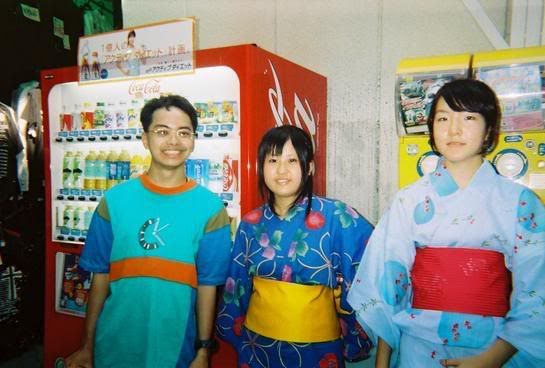
I actually tried to go to Japan through the JET program, but that fell through. Totally my own fault; I failed in spite of getting a ton of help from my awesome college professors. That made it easy to choose where to go for my last trip. If I couldn't go as a teacher, I'd go as a tourist.
Since Tokyo recently topped a list of the most expensive cities in the world, my choice of accommodation was critical. I felt I had too much luggage to risk staying in a hostel, so I looked for the cheapest hotel I could find. I finally settled on the Asia Center of Japan after reading a review in Frommer's. Although the review described it as college dormitory-style, the recent renovations made it nice enough to qualify as a real hotel. The review was right in how small the single rooms were. My room was about as big as my walk-in closet at home!
Before I went to the more Blade Runner-esque parts of Tokyo, I wanted see the old Japan. So my first stop was the Meiji-jingu Shrine.
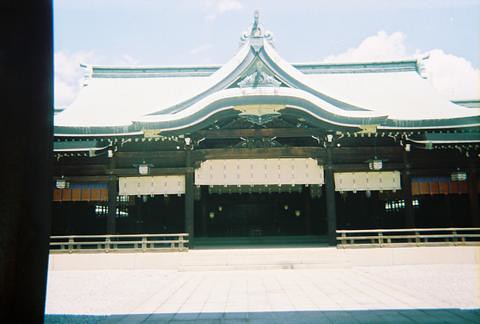
It's in Yoyogi park on the west side of the city. I washed my hands in a big stone basin, walked up the steps to wooden offering boxes that blocked the inner sanctum of the shrine. I had to watch other people to figure out what to do: throw a coin into the offering box, bow twice, clap twice, and then bow once more. There was a gift shop that sold charms for every occasion: good luck, recovery from illness, etc. The most expensive charms were these: "Charm for Passing an Entrance Exam."
The receptionist at my hotel told me about an international festival that would be going on in Azabu Juban, a big embassy district full of foreign representatives. During the subway ride there, I met Reiko, a Japanese girl on her way to the same festival. I complimented her on her excellent English. She was an American Studies major and had studied abroad in America for a year. Now Reiko worked as an advisor to foreign students studying in Japan.
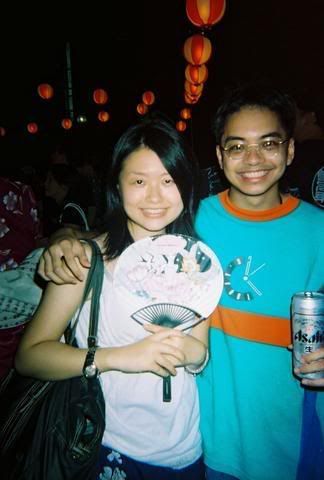
The streets of Azabu Juban were crowded with celebrants that night. A good portion of the people were dressed in traditional kimonos. Everybody had fans to keep themselves cool. All kinds of food were on display: fish heads on sticks, Turkish kebabs, Indian cuisine, etc. I drank Asahi beer while Reiko looked for something. I met her under the stage where taiko drummers were performing. She brought back Japanese food. I was so hungry I started eating immediately.
"This tastes pretty good," I said. "What is this?"
"Takoyaki," Reiko answered.
"What's that?" I asked, munching away happily.
"Octopus balls."
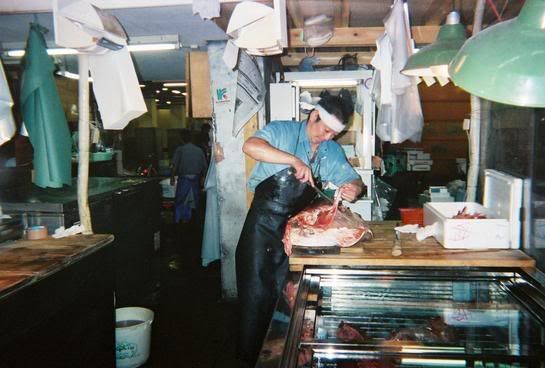
I guess that wasn't enough seafood for me, since I visited the Tokyo Central Wholesale Market. It's a tourist attraction and it's not. There's no gleaming displays and a path set aside for visitors. I was just thrown into the chaotic, noisy, stinking real deal. Men whizzed by in little motorized loading carts. Fisherman carved up giant fish on cutting boards. Water spilled from wash basins.
I had met Estelle, a blonde American girl, when we were both trying to find the market.
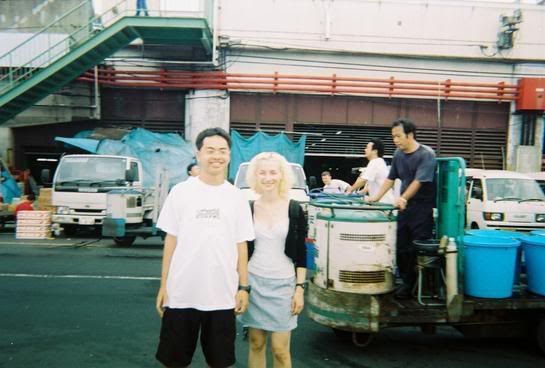
We went around to all the booths, amazed at the variety. A couple of times we couldn't recognize the animal we were looking at.
At one fish display, Estelle said, "Look at how fresh this fish is!" She started poking at it.
I heard a burst of yelling. I looked up. Nearby, a big Japanese man with a big knife was cursing us.
As calmly as possible, I tapped Estelle on the shoulder.
"What?" she asked.
"That man over there, he says to stop touching his fish," I said.
Estelle caught sight of him, and we both quickly moved on.
After we'd escaped, she asked, "Wow! Do you understand Japanese?"
"Not really. His knife did all the translating."
On my last day, I went to Shinjuku. This was the full-on Tokyo I'd imagined: it was packed with neon lights, pachinko parlors, giant TV screens on buildings, and a tourist attraction I wasn't expecting.
As usual, I had gotten lost. Always happens when I'm in a new city. I wound through side streets trying to get back onto the main drag. I stumbled onto an alley where a bunch of Japanese men in suits were standing outside a run-down doorway.
At first, I thought they were just salarymen. When I took a closer look, I noticed that they seemed too big for the suits they were wearing. Bouncers at a club? I checked my watch: only 6:00pm. Too early for them to be throwing out troublemakers. Maybe they were Yakuza. I tried to see if they had cut-off fingers.
I stared for too long. One of them, a chunky one with an unshaven face, looked right at me. Oh shit! I did an awkward about-face and got the hell out of there. Your fearless reporter in action.
That's it for Tokyo. I have some disappointing news. This won't be the start of an all-out blitz through Asia like I did through Europe. Have to start working and saving some money! So the next country I visit will be a longer stay. I've never worked abroad before, so a lot of things can go wrong. I hope everything works out.
Take care,
Marcus
WARNING: GRAPHIC CONTENT
I had just completed my latest bowel movement when I noticed a row of controls on the side of the toilet. At random, I pushed the blue button. A jet of hot water shot into my ass! I was so shocked I almost leaped out of the seat. I didn't think my hotel room was expensive enough to have one of those hi-tech toilets.
END OF GRAPHIC CONTENT
Friday, June 11, 2004
Marcus Meets Europe! -- The Balearic Islands

I arrived in Ibiza homeless. There are reckless adventurer backpackers who take pride in never booking accommodation in advance; I'm not one of them. It's because I've seen the consequences of winging it: backpackers going from hostel to hostel at 7 in the morning, freaked out that they don't have a safe place to sleep at night. They waste time moving around that they should be spending on seeing the sights.
I wish I could say I was homeless because I went the spontaneous route. Alas, it was a case of good old-fashioned stupidity. I've gotten used to just printing out the e-mails from my airlines and hostels, then using them to check-in. I booked a hotel in Ibiza, because there were no hostels in Ibiza. Hotels do things a little differently, knowledge I've since filed under "Things I Learned Too Late." I printed out the e-mail from the travel website without reading it, which was the mistake that got me into that mess. The e-mail had my hotel reservation info, but also said that I had to log into my online account and print out a hotel voucher.
I presented the e-mail to the front desk clerk. He looked at it and said, "Okay, where the voucher?"
"Where's the what?" I asked.
He explained that I had paid my money to the travel website, not the hotel. The hotel needed that voucher to get their money from the website company. A lesson in e-commerce the hard way.
When good things happen in your travels, they feel 100 times better, because you won't get those experiences back home. Life being a zero-sum game, however, means that the reverse is also true. Small problems--Shit! I'm out of socks!--can become one man's international crisis. At home, you know where to go and who to see when things go wrong. It's a luxury I've missed dearly while travelling. My fiction professor in England warned me, "You have to be prepared for those days when everything just seems to go wrong." She could have been talking of my first day in Ibiza.
The hotel clerk directed me to an Internet Cafe across the street. The problem would have been solved right then if their printer hadn't been broken. The clerk gave me directions to another Internet Cafe, further away. I found it and said, "No way in hell is my luck this bad." Internet Cafe #2 had gone out of business. Workmen were taking apart the inside of it. The third cafe was far, far away from the hotel. I tried to find Internet Cafe's along the way, but there were none to be found. Finally found one. I went in, logged on, found the voucher online, moved the cursor over to the File menu and . . . nothing. The computer froze on me. That was okay. The next computer printed out my voucher. Triumphant, I stepped outside the Internet Cafe to realize I was totally lost. I'd forgotten my map of Ibiza Town at the hotel. It took me 45 minutes to do a 10 minute walk back to my hotel. The interesting thing was that I found three Internet Cafe's on the way there. It's easy to get what you want when you don't need it.
In retrospect, I'm glad that fiasco happened when it did, instead of at the beginning of my trip. Back then, I was still the old Marcus that had to have everything taken care of in advance. Because once you're in a foreign country, you're helpless. I was very suspicious of simple faith in the past; I'll take hard planning and reservations, thank you very much. Then have a heart attack once something went off track. I've become more adaptable. Now, I just believe that I'll figure out a solution and things will always turn out all right in the end.
The first mission I assigned myself was to buy clubbing clothes. My long-sleeved shirts wouldn't cut it in Ibiza's hip discotheques. The area in front of my hotel turns into a cool sidewalk market at night. There were lots of boutiques to choose threads from. I saw a slime green sleeveless shirt on a rack. It was so ugly it had to be cheap. I flipped the price tag over: 83 euros ($100.45). A hundred dollars to scare away every fashion-conscious girl in the club?! No deal. At another store, I saw a simple white cotton button-down shirt hanging outside. It was an Eivissa (Spanish for Ibiza) Collection shirt made in a rough cotton weave, and almost transparent, like a Filipino barong. The price: 25 euro ($30). Style on a budget.
The clubs in Ibiza go from the a.m. to sunrise. Many clubs didn't even open until 1am and didn't really get going until 3am. A far cry from Norwich, England, where the clubs closed at midnight. This forced me to change to a Batman schedule of sleeping in the afternoon and haunting the clubs at night. I'm used to paying my entrance at the door. Ibiza was different. To get cheaper prices, it's common to buy tickets from a music store or bar before going out. I was relieved to find this out. I was worried about tight door policies. Like having to look like a Calvin Klein underwear model to get in. With a ticket in hand, entrance was guaranteed.
My first night clubbing wasn't that great. I was still recovering from jet lag and I didn't dig the music. As I left the club, I passed by the front counter. There was a stack of handbills advertising the next night's theme. The Spanish girl behind the counter saw my interest and pressed one into my hand. It showed a black guy in disco-era clothes, holding an M-16 in one hand and a cigar in the other. There was a gleaming white Cadillac next to him. Here's what it said:

When I walked in that night, there was a big white sheet stretched across the top of the dance floor to show the movies. I caught the tail end of Cleopatra Jones and the first half of Truck Turner. The techno remixes of funk songs were off the hook! The music was at such odds with El Divino's location, which is on a marina surrounded by yachts.
The surprising thing I learned was that the big seven clubs in Ibiza were spread out from each other across the island. Pacha and El Divino were in Ibiza Town on the east side of the island. Eden and Es Paradis were in Sant Antoni in the west. Space was by itself down in Platja d'en Bossa beach. Privilege and Amnesia were between Sant Antoni and Ibiza Town. I had come before the high season of July to August, which had its pros and cons. The pros: shorter lines at the door, more space to dance, less tourists. The cons: the night Discobus wasn't running yet (expensive taxis were the only option), the best DJ's were still to come, and the crowds of young European partiers hadn't descended in full force.
Space was my favorite club. Huge dance floor, excellent house music, effective light set-ups. The big draw was the crowd. This was the first club in a long time where I've seen more guys on the floor than girls. Moreover, the guys were better dancers than the girls too. I didn't know that was possible. They were busting out Latin American-style moves like no tomorrow. Salsa, meringue, and samba at the speed of techno. I'm more comfortable dancing to techno now. Either I'm finally doing it right, or I've stopped caring if I'm doing it wrong. Still, I was intimidated by these guys. How can so many of them dance so well? Then I saw two guys holding each other close and dancing. Oh.
The person doing the spinning can make or break your night. At Pacha, the DJ was really bad when I went. She would try to bring the audience up and down by manipulating the volume of the music. The problems were when she lowered the volume. She would lower the treble and the bass, leaving us dancers stranded with nothing to move to. The DJ at Space always left the treble in when he did that, which increased the audience's anticipation for when he would crank it all up to full blast again.
I left Pacha and hung out at an Internet Cafe for a while. It was called "Cafe's Ibiza." Soon, two guys and a girl showed up together. We struck up a conversation of why the DJ at Pacha sucked. They were all from Montreal, Canada. I asked them about something curious I saw at Space. There were a lot of guys sucking on lollipops. Was that the latest fad? The girl explained that Ecstasy pills cause you to grind your teeth hard without you knowing it. Lollipops keep you from chewing up your gums and cheek. The things you learn travelling. It's been an Education for Outlaws.
Monday, June 7, 2004
Marcus Meets Europe! -- Austria

Here's how I did Vienna in 24 hours. I didn't have that tight a schedule, but the friend I made there did. We were both taking a train from Linz to Vienna (RyanAir flew into Linz but not Vienna). Dan was from Minnesota and volunteering at a homeless shelter in London. He was only here for a short weekend, so he wanted to cram as much as he could into his first day in-country. I got swept along.
Wombat's was one of the nicest hostels I've stayed in, second only to The Circus in Berlin. Clean, colorful, modern, and with a lively hostel bar. I met up with Dan at the reception area our first morning and started our Vienna-at-Mach-speed tour.
Breakfast was at a traditional kaffehaus. Although Paris gets all the press, Vienna is a top place for getting your caffeine fix. We both got coffee with milk. Dan had a croissant. I sampled the sacher torte, a gooey chocolate cake. The German girls I'd met in Lisbon said it was the thing to eat in Vienna. Dan's guidebook had some facts on Viennese coffeehouse etiquette:
--Only order pastries with coffee, anything else is an insult.
--You must linger at the table. No quick in and out American nonsense.
Every big city has one cathedral to see. Vienna's was the Stephansdom. We took an elevator to the top for a view of the city's skyline. The ceiling was a surprise. From the bottom, the church has a dark brown black ancient feel. The ceiling had bright green and yellow tiles.

We were walking in front of the State Opera House when a man in a Mozart costume approached us. Would we be interested in seeing a concert in one of the great cities of classical music? He gave us two choices. The first was a Wagner opera for only 2 euro. The catch: it was for standing only, no seats, and the opera was 5 hours long. I could already feel the blisters forming. The other option was a 90-minute Johan Strauss concert, with seats, and ballroom dancers would perform too. We'd have something to entertain our eyes as well as our ears. The catch: it was 26 euro for a Section C ticket, the cheapest he had. Dan asked him if he could confer with me alone for a minute. We went about 15 feet away. Money or comfort? That was the key issue. We knew we'd be doing a lot of walking today. Ending the day by standing for 5 hours was not appealing. We went back and bought two Strauss tickets from the man in the Mozart costume.

Schonbrunn Palace was Vienna's answer to the Palace of Versailles in France. It felt smaller and brighter than Versailles. We got there late because it took forever to find a place to get lunch in the area. By the time we got in, there was only time to see the gardens. We saw a private garden that was just for the royals, a hedge maze, and hiked up to a building on a hill. The top of that building offered the best view of the palace and gardens.

We went to Kursalon, where the Strauss concert was. As we got in line, I noticed how out of place we were. The average customers were couples that had qualified for Social Security ten years ago. They were also better dressed, while we were in the standard backpacker uniform of t-shirts and jeans. Dan said not to worry, the important thing was that we were paying customers too. We entered a grand hall with five crystal chandeliers, one at each corner and a huge one hanging in the center. The seats were already filled with affluent older people. It took a long time to find Section C. We had to walk all the way to the back of the room. There, behind the acres of gray hair, were young backpackers! They were straining their necks around to get a view of the musicians.
"Got the Section C tickets, huh?" I asked.
They all cracked up laughing. Yes, we were that poor.
On the way back to our hostel, Dan and I took a wrong turn out of the U-bahn station and got lost in a bad neighborhood. Poorly lit, strip clubs, the whole deal. We turned around to walk back where had come from. As I was saying something to Dan, a man in black clothes jumped out from a corner and came at us. I instantly threw myself at Dan to push him out of danger. I brought up my weapon, an empty plastic bottle of Lipton Iced Tea. I'd been scared this would happen. My mind went blank, I was operating totally on instinct. I figured that the last thing attackers expect from a victim was speed. Victims are supposed to freeze up when confronted. I was about to throw the bottle in the guy's face and run like hell. It wasn't necessary, because the guy ran past us. Just a guy in a hurry. Dan, however, was really impressed. He said I'd moved really fast. I wondered if he thought I was from the mean streets of Honolulu now.
Travel may seem like it's full of adventure, but a lot of time is spent waiting. Waiting at the airport, waiting on a train, waiting for laundry, etc. A popular feature in most hostels are book exchanges. There'll be a shelf full of used paperbacks. Instead of buying new books and lugging them around, you just trade in your book for a new one.
I didn't discover how much my reading habits have been changed by Europe until I bought my latest book at Stansted airport. I was down to two contenders. The first book was "Chopper" by Mark Brandon Read. It was an autobiography of a homicidal psychopath who terrorized gangsters, sort of a real-life The Punisher, except he's Australian. Right up my alley.
The second book was "Globalization and its Discontents" by Joseph Stiglitz. This was going to be a boring economics book, I suspected. I skimmed through it and found it more fascinating than I thought. When I walked out of the bookstore, I couldn't believe I'd bought an economics book over an action-packed biography. What happened to the old Marcus?
Thursday, June 3, 2004
Marcus Meets Europe! -- Portugal

I didn't expect to find the ancient version of San Francisco in Europe. Lisbon has a couple of things in common with SF: twisting streets going up steep hills, trolleys, and being coastside. I was interested in going to Portugal because it seemed like the little brother of Spain that gets overlooked.

Lisbon postcard of the city center
I've been forced to get creative with Lisbon and my next destination. RyanAir and EasyJet, my two usual low-cost airlines, didn't have direct flights to these places. I flew into Faro on EasyJet and took an EVA expresso bus for four hours to Lisbon. It was a pain in the ass, literally. But sacrifices are necessary.
The individual neighborhoods are landmarks in themselves. Baixa, the big people center, is laid out in a strict grid pattern. It's almost boring because I was walking in perfect rectangular routes. Lisbon is a bit dirtier than the other cities I've visited. It hasn't quite caught up to the rest of Europe. Certain parts reminded me of Los Angeles. The funny thing about the Alfama area was that I knew I was there because I had gotten lost. The Alfama is San Francisco's Lombard Street, blown up to an entire neighborhood. Streets snarl upwards and disappear. Old men sit on benches and chat. Half of the people who walked by me were old women with shawls wrapped around their heads.
After visiting this many cities, I got kind of tired of cathedrals and museums. There´s always one must-see church and museum everywhere I've gone. Since I was going through to the Alfama, I couldn't help but come across the Castelo de Sao Jorge. Might as well check it out. The interior was nothing special. The prize was in a small room off to the left of the entrance. There was a glass case about 10 feet fall and 6 feet wide. In it was a meticulously crafted model depicting a long train of people coming to make offerings to the baby Jesus in a manger. The lady at the desk told me it was called the Christmas Crib. A royal procession rode down a hill. Cherubs and angels smile down from the ruins above the manger. Villagers lined up with food in their hands.
I didn't bring my guidebook, so I've had to come up with all sorts of tricks to substitute for one. Getting a map from the airport, hostel, and/or tourist information office is one. A quick way to get a feel for what the popular sights are is to make the rounds of the postcard stands. Certain pictures will pop up over and over again. One that caught my attention was a castle-type thing near the sea. The great thing about this method is that I can use the postcard to ask how to get there. No language fluency required. I showed the postcard to the man behind the cash register. He said it was the Torre de Belem (Tower of Belem).
I took a bus to Belem from my hostel, Pousade de Juventude de Lisboa, the official HI hostel, the first and last HI I've stayed in. The bus dropped me off in front of the Monasteiro dos Jeronimos, a monstery I'd seen on a lot of postcards too. The Cloisters were beautiful. It's a gorgeous courtyard used by the monks for relaxation and meditation. A fountain was in the middle, with four paths radiating from it in each direction. Benches around the courtyard were carved into the rock. I sat there for a while, reading a book I'd bought at Copenhagen airport, "The Best Democracy Money Can Buy" by Greg Palast.
Next up was the Torre de Belem. It was a stone tower on the sea.

I think it was used as a naval defense post. I had to walk across an overpass over the train tracks to get there. Once inside, I peeked out through the windows. Cannons were laid at each window. I went to use the bathroom. I reached for the toilet paper, and horror of horrors, there was no toilet paper. I hurried up and talked to one of the employees.
"Excuse me, there's no toilet paper," I said.
"Toilet, yes. It's there," He pointed down the stairs.
"I know where the toilet is. There's no toilet paper." I made a motion of pulling a roll down and ripping off a tissue.
"No understand English." The last words I wanted to hear.
I went back to the bathroom. I paced around. Think man think! I searched my pockets. I found some napkins from the snack bar where I'd gotten a ham and cheese baguette for breakfast. It wasn't toilet paper, but I was going to make this work . . .
That night I made friends with two cute blonde German girls. I met them up on the top floor of the hostel, a meeting area that's always empty because it's far up. I went there on a whim and discovered them. They looked really young, so I made sure to act as a total gentleman. From talking, I found they had just graduated from high school and doing some traveling. We made plans to explore Lisbon together the next day. Downstairs in the TV lounge, one of the finals soccer games was going on. The Portugal team from Porto and Monaco. One girl wondered aloud who won. Just then, a cacophony of car horns and joyous shouts came from the streets below. Porto had won! The shouts lasted all through the night, ruining any chance of sleep. Lisbon is hosting the European Football Championchips later this month. This place will be soccer city then. Craziness.
We went to the Museum of Modern Art first. Some of the stuff was cool, like the collages of paper shapes, other stuff was just weird, like a wall projection of a photo of hands. My favorite place we visited was Parque das Nacoes, a park that Lisbon built for the World Expo. For 1996, I think. There was a huge shopping center, a botanical garden, a zoo, an aquarium, and rows of restaurants. We rode on a sky car that went over the entire complex from above.

Laura (Germany)

Kirstin (Germany)
That night I met Chris, from Melbourne, Australia. He was a really cool guy. Australians are the hard-core travelers. He had just arrived from Thailand after going through Southeast Asia. He was doing Europe, then going to South America. Wow. I really am a rookie at this travel stuff. Chris was doing 3 continents and I was only doing one. We went out to sample Portugal's famed seafood cuisine. I ate a seabass and he got grilled salmon. The fish was excellent. Only in Europe could I get world-class food at common restaurants.
Subscribe to:
Posts (Atom)


 Posts

