My dream was to become a paid writer when I first went to college. By the time I graduated, I had given up, because it seemed like all the cool creative jobs were
A) Too difficult to get
and/or
B) Really low-paying
The irony of life is that after I gave up on writing professionally, I get a job as a copy editor at a newspaper. As a bonus, the salary is enough to save money to chip away at my Great Wall of Student Loans.
I'm learning that writing for journalism is a lot different than writing fiction. Having to stick to the facts is so restricting! I can't put in cool plot twists, snappy dialogue or spectacular John Woo-style action sequences like I would with my own material. Everything needs to backed up.
Only half my job is actually moving words around. The other half is harassing writers to fact-check everything they've written and doing research myself. My rudimentary Chinese skills are really holding me back on this front, so I need to study if I want to get to the next level.
The funnest part of my job is coming up with the headlines. I love puns and wordplay, so it's a great creative outlet. The front page tends to be serious, so those headlines are pretty dry. But with the other pages, I just go crazy. You have idea how dorky I can be when I have too much time on my hands and nothing but words to work with. Below are some of my favorite headlines, linked to the actual articles I edited. They'll give you a taste of what Taiwan is like:
Nation closes chapter on publishing ban
Companies work the late shift to serve insomniac customers
Kung fu dishes hit New Year dinner tables
Wedding photos and Taiwan are a picture-perfect match
Banks lay down their bets on running the national lottery
Local video game companies free their Seoul from Korea
Kinmen takes sweeping action against China's wave of trash
Taipei's jazz bars keep music fans from feeling blue
I remember one headline in particular that I'm proud of. The article was about how Taiwan was planning test trials of unmanned convenience stores, which ran without needing human employees. I think I wrote something like "Taiwan tests out automated convenience stores."
That headline was too boring, so I tried to dream up something better. I imagined giant convenience stores with cybernetic arms and legs running amok in a big city, stomping on buildings and shooting lasers out of their eyes. That would be awesome! I tried to capture the feel of that scene in a headline.
There was no way the editor-in-chief would run it, I thought as I handed it to him. The editor took one look, burst out laughing, and called the other writers over to take a look. The headline said:
Robot convenience stores invade the island
Thursday, September 27, 2007

Sunday, September 9, 2007
Taiwan Times Vol. 2 -- Living & Working
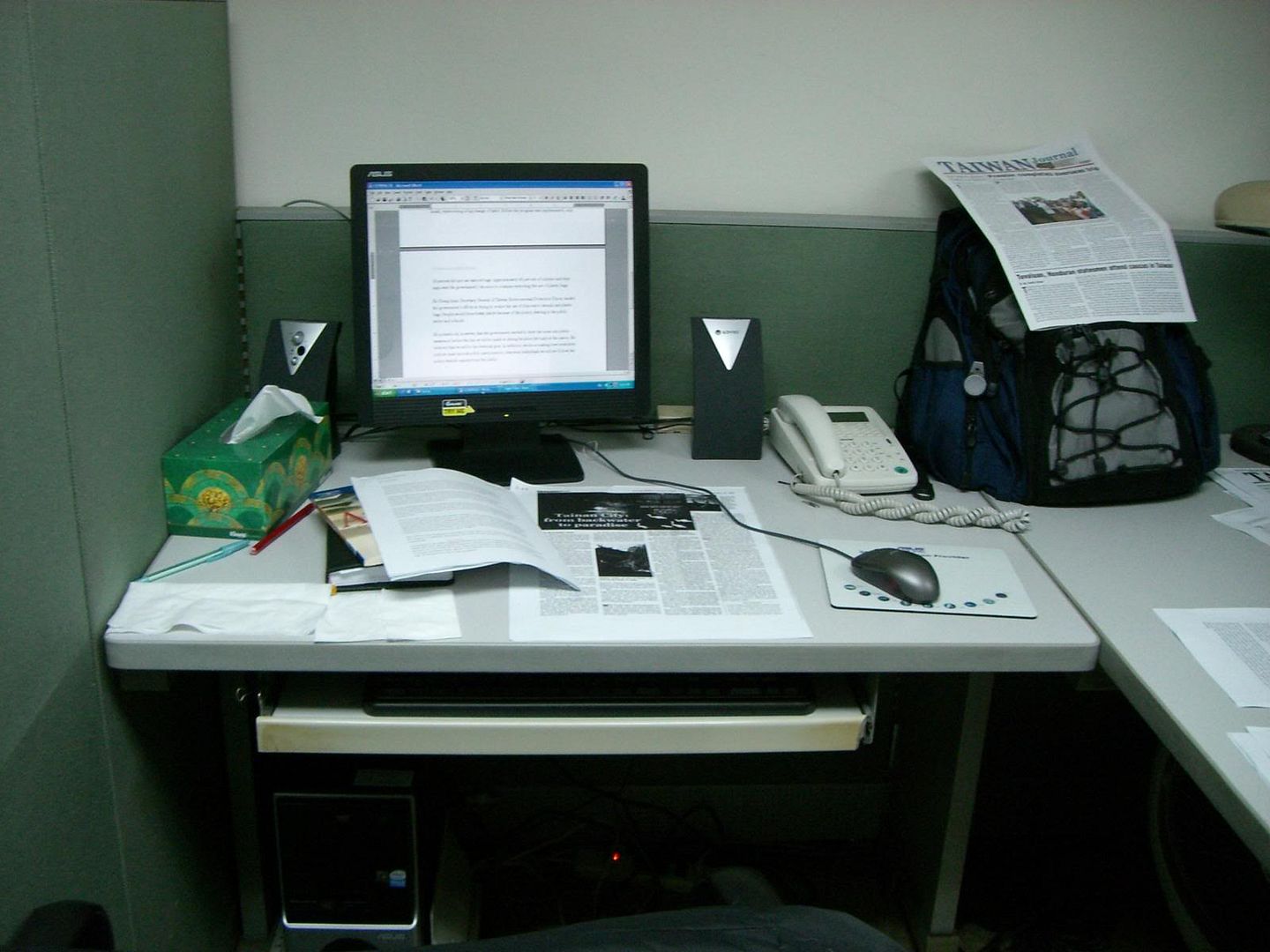
Now that the crisis period has passed, and I can take some time to give you guys an update.
Luckily, everything worked out! I got the Taiwan visitor visa in Bangkok, and I got the newspaper editor job in Taipei.
This is the first 'normal' job I've ever had, so it was kind of strange. When I taught English in Shanghai, I worked from 1:30 p.m. to 9:30 p.m. Waking up at noon was routine. Now I had the same 9 a.m. to 5 p.m. schedule everyone else does. Instead of standing up and talking to students all day, I'm isolated in a cubicle with a computer. At an English school, there's a high turnover of students and teachers, so there's always new people to meet. Wow, I sound like I miss teaching English! Most English teachers would kill to get out of that racket and do something more professional.
With spoken English, you can mess around and there's a lot of room for error. As an editor, I deal with written English and when you make a mistake, everyone who reads the paper will see it. With teaching, you leave your work at school. With the newspaper, I'm constantly working overtime and sometimes on weekends to make the deadlines. Everyone reads over your work and comments on it before it gets printed. In a lot of ways, working at a newspaper is much more stressful than I imagined.
Then there's the actual editing itself. I have to revise and polish English-language articles written by Taiwanese reporters. I sometimes get handed articles that are abominations of English. Some of my friends think my job is just moving around commas and correcting spelling. It's a lot more complicated than that. I spend countless hours questioning writers and making sure my edited drafts match the stories they were trying to tell. There's a lot of communication needed, you can't just rearrange words on the computer and avoid talking to people. Cultural differences, historical background, and other factors make it more complicated than I realized when I first took the job.
One of my favorite things about working at a newspaper is that I get paid to learn about Taiwan. Now that I've been doing this job for almost a year, I feel like an expert on the place compared to fresh-off-the-plane English teachers. For example, an interesting fact about Taiwan's economy is that over 90% of the businesses here are small and medium-sized enterprises. So Taiwanese people will do almost anything that makes money. As a result, Taiwan excels at the most random industries, like bicycles, umbrellas, wedding planning and laptop computers.
Taiwanese are very outward-looking, so almost all my co-workers have worked or studied abroad. They're all fluent in English. Being around Asians all the time who speak English, I sometimes get lulled into thinking I'm back in Hawaii. I got a shock, however, the first time I attended a staff meeting. It was all conducted in Mandarin Chinese! I was completely lost and had no idea what anyone was saying. In Shanghai, my meetings were always with other English teachers, so English was spoken.
One thing I got confused by was how the boss called out to each writer by number; I understood enough Chinese to get that much. I asked a reporter why the boss did that. The others heard and burst out laughing. "The boss isn't calling us numbers, just the pages we write for!"
Managing these kinds of cross-cultural issues will be great material if I need to write an admission essay for grad school or talk about my experiences abroad in a job interview.
Now that I had a job, it was time to get an apartment. I'd lived at a hostel for five months, and I should have moved out a long time ago. I kept putting it off for various reasons: I'll wait until I get a job, I'll do it after my probation period at work ends, I'll save money for a deposit first. One of the big ones was having the opportunity to meet travelers from all over the world on a regular basis.
Eventually, it was the noise that drove me out. While I love World Scholar House, it's not really good for people who have to get up in the morning and need their sleep. Although I had my own room, I could still hear the noise from the common area. I have some great friends there, and I still go by to visit every week to round up people to go clubbing.
It's easier to get an apartment in China and Taiwan than Japan and South Korea. Landlords are more willing to rent to foreigners and they don't require ridiculously huge deposits. In Japan and Korea, your employer needs to be the guarantor and 6-month deposits are not unheard of.
I'd learned in Shanghai not to judge apartments by their buildings. The outside may look ripe for demolition, but often the apartments themselves are reasonably nice. That said, I saw a lot of hellholes during my apartment search. I had to watch my costs, too. Since Taipei is the capital of Taiwan, it's the most expensive city. At first, I wanted to get the lowest rent I could, in the NT$5,000 range (US$150) for shared housing. I quickly discarded that goal after I saw a few places. Since I was making a decent salary, I decided to go it alone without roommates and get my own studio.
This is a trivial point, but it was really important for me to find an apartment that had a dryer. In China, I'd gone for a year without a dryer. I was overjoyed when I first discovered that my hostel in Taipei had a dryer. If I moved out, I wasn't going to give up that luxury.It took a lot of time before I found a nice studio in the middle of a university district. The rent is NT$12,000 (US$360). Besides deciding whether to have roommates, the other big decision is location. Get a smaller place in a central area or get a bigger place further away? When I was in college, an alumni told my class, "Live as close to work as you can. It's easier to work overtime when you have to and you get home that much sooner when you want to relax."
Commuting is the most stressful time of day for a lot of people, so I wanted to avoid that. My apartment is close to the MRT (Taipei's subway) and my office is only 3 stops away. I get to work in 15 minutes. My apartment is also convenient for getting to restaurants and nightclubs where young people hang out. I can't believe I was considering living further away to save a few bucks on rent. Cutting down my travel time is paying off in so many ways. When friends want to meet up, I can be there straight away.
When the landlord handed me the keys, I felt like I had finally become an adult. Now I had a real job and my own apartment at last.
Tuesday, June 26, 2007
Fast Break to Bangkok
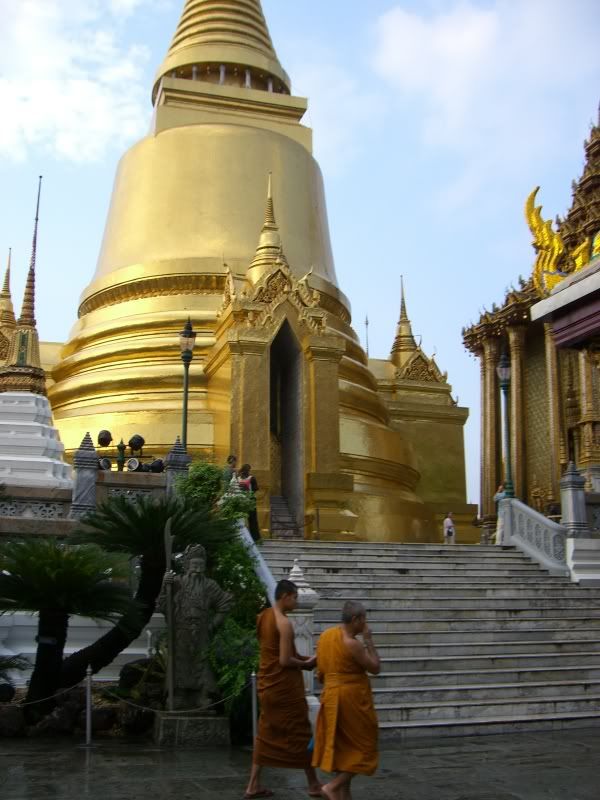
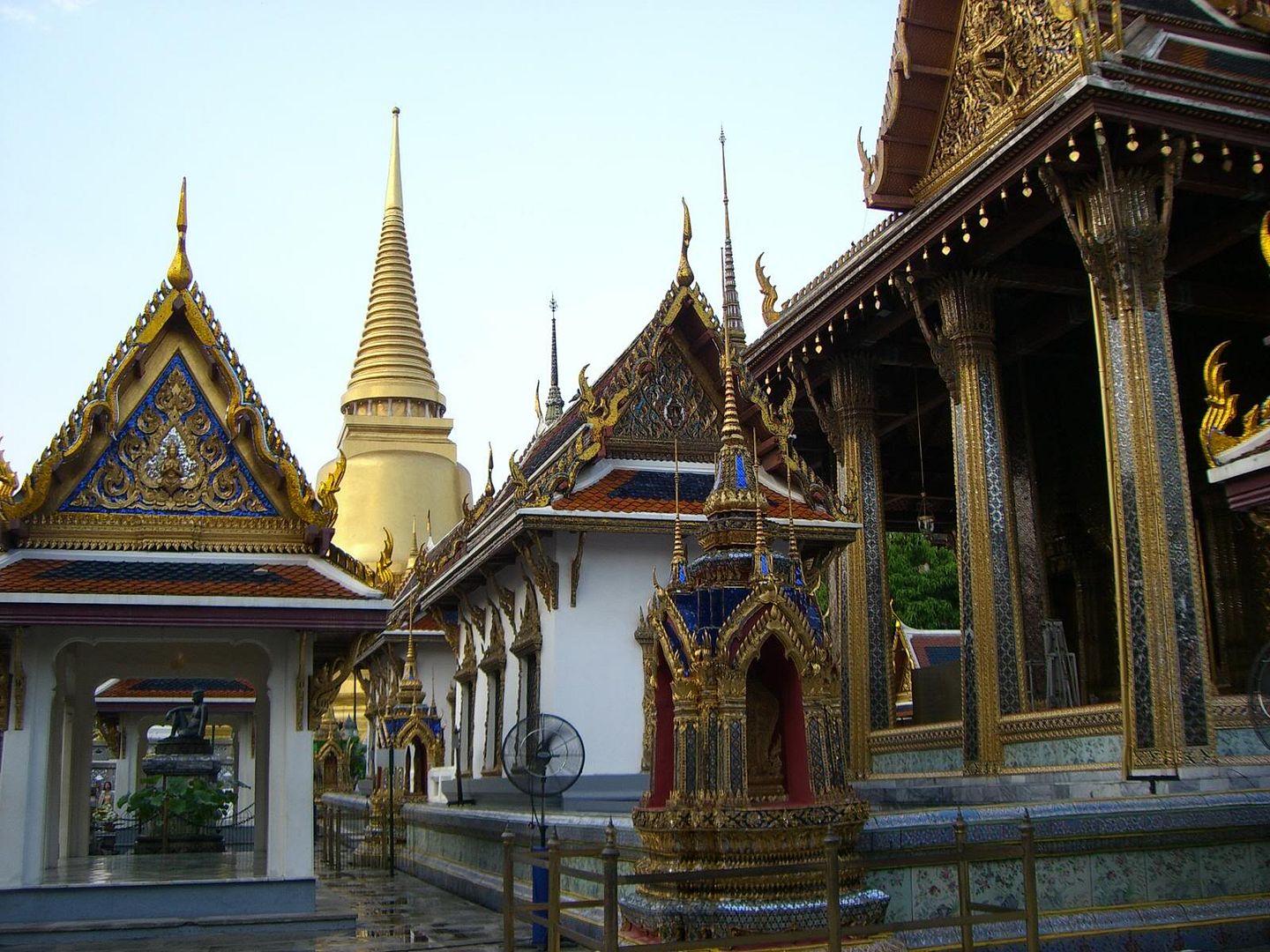
Monks strolling past a golden stupa in the Grand Palace complex. Click on the picture to view the photo album.
The first thing I noticed was that traffic in Bangkok was a nightmare. Endless cars lined the streets and moved at a snail's pace. Public transportation was inconvenient as well. Although there was a metro and the Skytrain, they still didn't go to all the important parts of the city.
My flight was pretty cheap, about US$200, but the downside is that I arrived at 10:30 p.m. The airport bus I was supposed to take to my hostel had stopped running by then, so I had to take a different one. I got off at what I thought was my stop, then realized I had made a mistake and was lost. I hailed a taxi and got in.
I started to give the driver directions in Chinese before it hit me: Thailand was the first non-Chinese place I'd visited in a long time. Since leaving China, I'd been to Singapore and Taiwan, which still have huge Chinese influences. I resorted to hand motions and the driver understood. I was surprised at how calm I was, despite being lost in a foreign country. Dealing with unexpected problems is part of travel, so I wasn't bothered anymore.
I stayed at HI Sukhumvit, a part of the Hostelling International association. I usually prefer to stay at independent hostels because they have more character. HI hostels are good in the sense that they're as dependable as McDonald's; most HI hostels are pretty clean and standard. The hostel was in Sukhumvit, a relatively upper-class neighborhood. I'd been warned to avoid staying at Khao San Road, the main venue for backpackers. I'd heard it was a chaotic circus there. While the hostel was very nice, I think I'll try to find somewhere more central, like Siam Square, the next time I visit Bangkok.
Like I mentioned before, traffic is terrible. The best way to see the main sights, like Wat Pho and the Grand Palace, is to go there by boat taxi. Take the Skytrain to Saphan Taksin station, then walk to the pier and take a boat taxi.
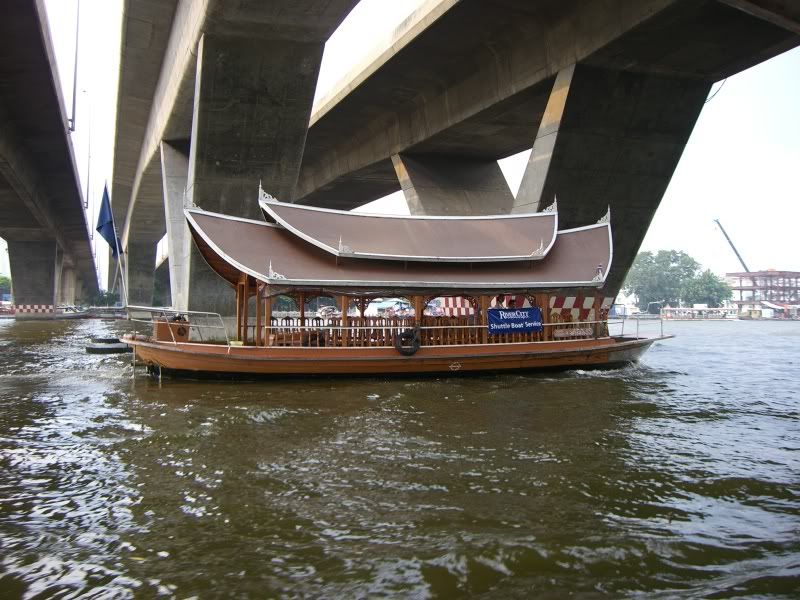
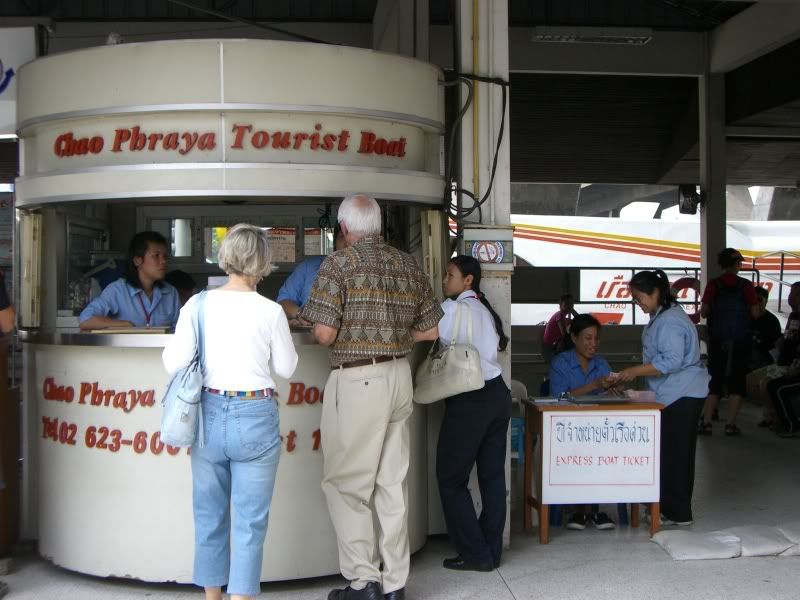
Don't go to the main ticket booth. They only sell all-day boat passes, which you don't need. Instead, buy single-journey tickets from the woman at the little wooden table next to the official-looking ticket booth. A ticket costs 13 baht (USD$0.41)
Despite being a big city, I found Bangkok people to be much more relaxed and laidback. People in Shanghai seemed much more driven and charging forward, always on the lookout for a better job, the next opportunity.
Thai food took some getting used to, as it's much more spicy and flavorful than Chinese food. Thai cooks like to put in exotic spices that aren't as widely used in China. Food is usually eaten with a spoon and fork, no knife, which reminded me of the Philippines, where it's the same. It must be a Southeast Asian thing.
Coming from the West, I'm used to people criticizing their leaders. Thai people are different in that they truly love their king, even wearing special yellow t-shirts on designated days. You'd never get Americans to wear presidential t-shirts without enormous protest.
I'm used to Chinese temples by now, so it was cool to see Thai architecture, which is radically different. Much more flamboyant, colorful and flashy. Lots of bright colors and interwoven gold. I imagined what the first Westerners to visit Thailand must have thourght. They must have believed they had stumbled into another world.
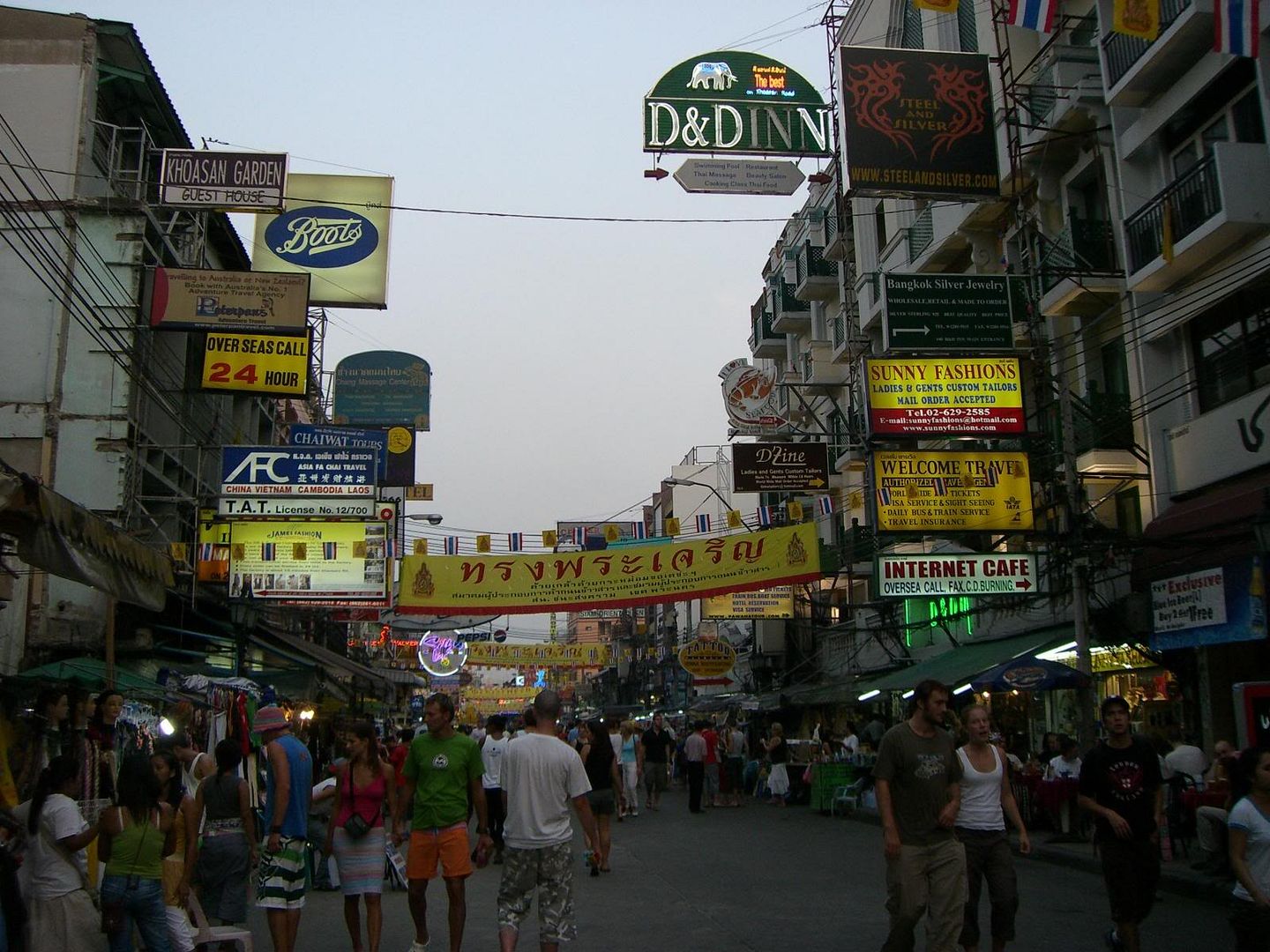
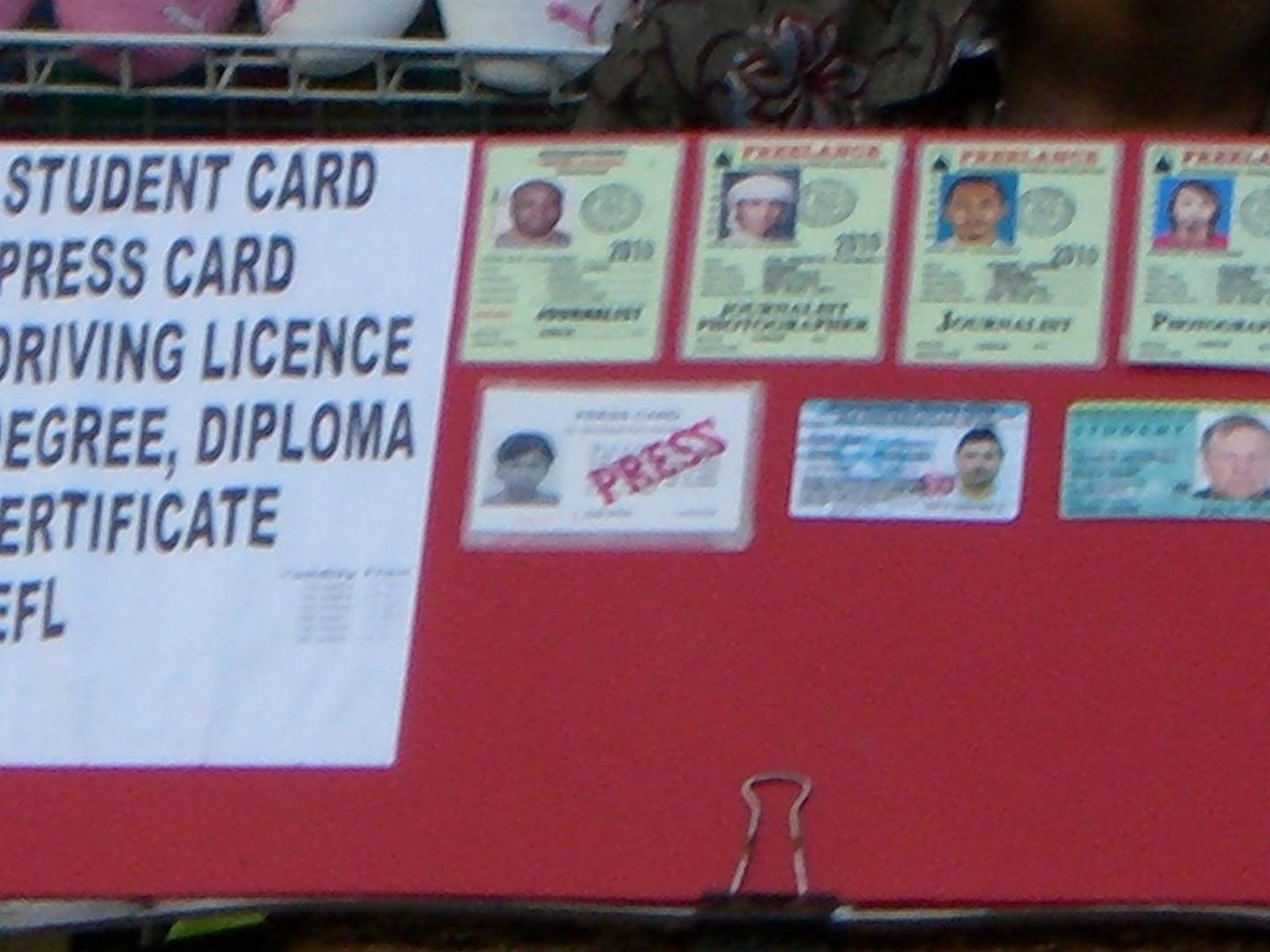
To see how the other half lives, I went to Khao San Road, the backpackers' mecca. It was as much of a freak show as I'd been told, a riot of guesthouses, restaurants, travel agencies and other businesses devoted to backpackers. I saw more Westerners and heard more European langauges there than anywhere I've been in Asia. Khao San was like a massive international flea market. I got to see the fake college degrees Khao San is notorious for.
One of the coolest things that happened to me in Bangkok was when I was at a skytrain station near MBK, a huge shopping center. I heard some hip-hop music playing, so I followed my ears to the source. I stumbled onto a Thai breakdancing crew!
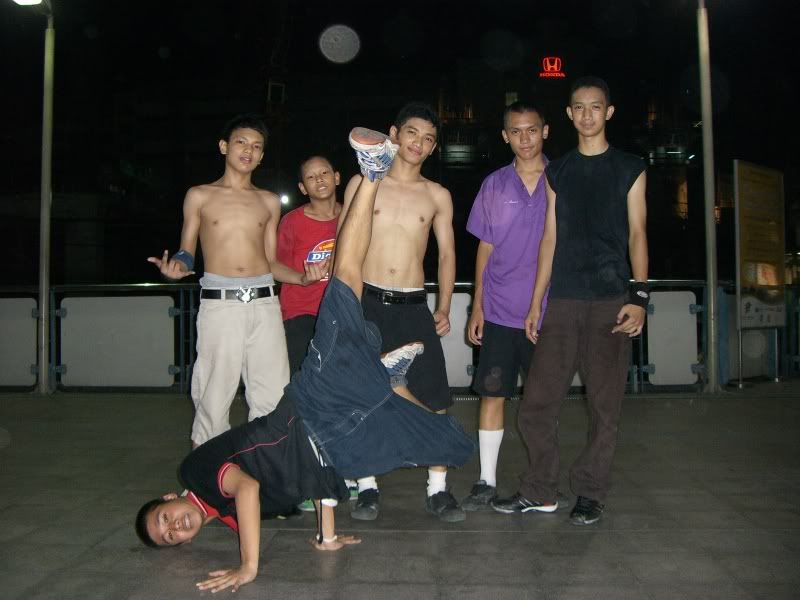
Although they didn't speak English, I was able to use body language to ask if I could take photos and videos of them. They cheerfully agreed. Click on the picture to see the video.
Thailand was so different from my previous experience that I actually felt homesick for China. I went over to Chinatown. The tacky electric signs and dirty streets seemed familiar. I went into a dim sum shop and ordered my dinner using Mandarin. The waitress handed me a fork and spoon, the usual Thai utensils, but I used chopsticks instead. Eating Chinese food, using chopsticks, speaking Mandarin, I finally felt at home.
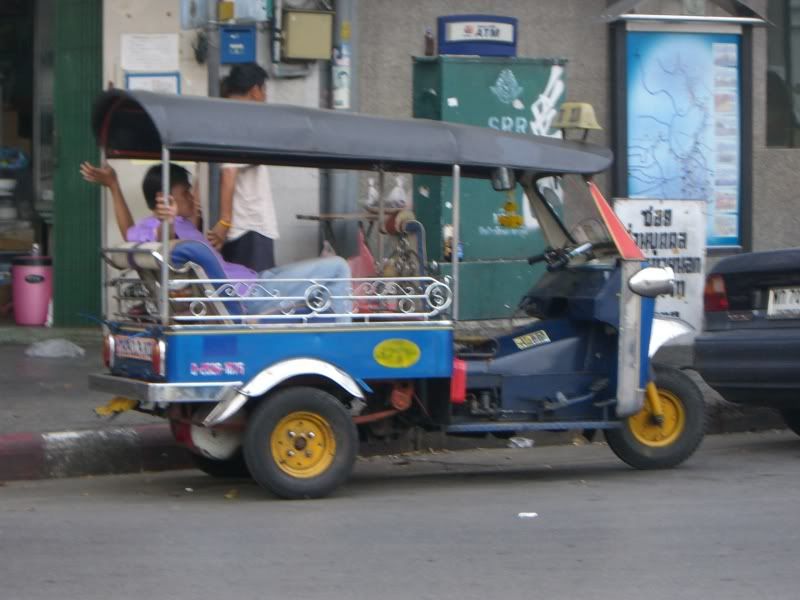
A tuk-tuk, Thailand's alternative to taxis.
Inside Information
Getting into town
By bus: If you're arriving at Suvarnabhumi airport, here are the main airport bus routes. Here's the basic overview.
AE1: Silom
AE2: Khao San Road
AE3: Sukhumvit
AE4: Hualamphong Railway Station and MBK Mall
Where to stay
Khao San Road is the backpackers' ghetto. The best deals are for places that are around or nearby, not on Khao San itself. One place that gets consistent good reviews from backpackers is Bella Bella House.
A worthy alternative to Khao San Road is Soi Kasem San 1, near MBK mall and BTS Skytrain National Stadium. It has a fantastic location in the city center with the best budget guesthouses in the area. Siam Square and the major shopping centers are only one stop away by Skytrain.
The A-One Inn is my favorite place to stay in Bangkok. Comfortable, clean, and has a good Internet cafe. The private bathrooms are tiny, but they have the best high-pressure showers! The White Lodge is my backup choice. Quite social in the evenings, when guests sit at the outside tables to chat.
Another place I like is Take a Nap. It's a budget hotel and hostel in Silom, a major business area. Close to BTS Sala Daeng and the notorious Patpong red-light district. One of the nicest hostels I've seen in Southeast Asia. Very colorful and full of personality. The dorm rooms have regular beds, not bunk beds! Dorm rooms have their own bathroom and shower. There's even an elevator, although it's the smallest I've ever seen.
For people who can't help being hip, here are two "designer hostels": Lub D and HQ Hostel. If you need a hostel near Suvarnabhumi airport, check out Refill Now.
You can read a detailed overview with this Travelfish article, "What is a good guesthouse in Bangkok?"
Getting around
The Skytrain and Metro lines go to all the business areas. Great, if you weren't planning on seeing the sights!
The best way to get to the sights in Banglamphu, in the western part of Bangkok, is to go by Chao Praya Express Boat. "Boat buses" frequently leave from the Central Pier. Take the Skytrain to Saphan Taksin station. Don't buy an all-day ticket from the official-looking ticket booth. Buy a single-journey ticket from the woman at the little wooden table.
For Wat Pho, get off at "N8 Tha Thien." For the Grand Palace, get off at "N9 Tha Chang." Khao San Road is close to "N13 Phra Arthit."
Need to get to Khao San Road from the city center? Hop on a Khlong Saen Saep Express Boat. For photos and details, check out the Thai Mass Transport Systems blog. Long boats run along the khlong (canal) through east to west parts of the city.
Go to BTS Skytrain National Stadium. Go to "Hua Chang Bridge" canal stop. Take the boat to the end of the line at "Tha Phanfa" stop. Walk toward the Democracy Monument on Ratchadamnoen Klang and keep walking past it. Turn right on to Tanao Road. Turn left at the Burger King and cross Tanao Road to enter Khao San Road.
Where to party
Khao San Road is the classic hangout for foreigners. Lots of restaurants for international foods, bars all over the place, and there are vendors for everything you might need (legal and otherwise).
Bed Supperclub is the most famous nightspot in Bangkok. Mingle with the jetset fashionable crowd there.
My favorite place to go is Royal City Avenue. It's a street filled with cool clubs, bars, and hangouts. Young Thais like university students go there for a night on the town. Best way to get there is by taxi. Just tell the taxi driver, "RCA."
The clubs play a wide range of music and the bars cater to different crowds. There's even an art-house cinema, House RCA. So you'll probably find a joint that suits your style.
Killer combination of designer venues, young upbeat crowd, and a lack of foreigners. Go there soon before the tourists discover it.
Getting visas for Southeast Asia
As a hub for travel in the region, Bangkok is a popular place to get visas. At the time of writing, you could get a visa on arrival for Laos and Cambodia, so it's not necessary to apply for visas in advance. Vietnam is the exception.
Vietnam Embassy in Bangkok
83/1 Wireless Road
Lumpini, Pathumwan
Bangkok 10330, Thailand
Phone: (662) 267 9602
Consular: 251 5837/ 115 / 116
For additional info, see this Travelhappy article.
Directions (from Travelhappy):
"Get a taxi or Skytrain to Wireless Road (Soi Wittayu) in the centre of Bangkok. On the Skytrain you get off at the Phloen Chit stop.
Walk out through the elevated skywalk and then down the stairs onto Wireless Road going towards All Seasons Place, which is a huge mall and office block. (There is a big map on a board in the BTS station - check it before you go out through the exits to ensure you know where you're going)."
Getting a Myanmar visa
Myanmar (a.k.a. Burma) is one of the most exotic and fascinating destinations in Southeast Asia. Click here for an amazing photo essay, The Spirit of Burma. Although it suffers from a brutal military regime, international isolation, and extreme poverty, it is a magical place. Air Asia has daily flights from Bangkok to Yangon. But you have to apply for a visa in advance.
Myanmar Embassy in Bangkok
132 Sathorn Nua Road
Bangkok 10500 Thailand
Phone: (662) 233-2237, 234-4698, 233-7250, 234-0320, 637-9406
For addtional info, see this Travelhappy article.
Directions (from Travelhappy):
"It is very near to Surasak BTS Skytrain station. From Surasak station, go to Exit 3. Walk down onto street level and then turn right when you get to the bottom of the stairs so that you are walking along the pavement underneath the Skytrain station. You will pass the Skytrain's escalator entrance. If you don't, you are walking the wrong way down Sathorn Road!
Continue walking up the busy Sathorn Road for about 200 metres. You will arrive at a forbidding grey looking wall with big spikes on top at the corner of Sathorn Road and Thanon Pan. This is the Myanmar Embassy. Walk a few metres down the side road Thanon Pan and you will find the entrance to the Myanmar Embassy's Visa section. It is a unmarked steel door with no handle."
Getting into town
By bus: If you're arriving at Suvarnabhumi airport, here are the main airport bus routes. Here's the basic overview.
AE1: Silom
AE2: Khao San Road
AE3: Sukhumvit
AE4: Hualamphong Railway Station and MBK Mall
Where to stay
Khao San Road is the backpackers' ghetto. The best deals are for places that are around or nearby, not on Khao San itself. One place that gets consistent good reviews from backpackers is Bella Bella House.
A worthy alternative to Khao San Road is Soi Kasem San 1, near MBK mall and BTS Skytrain National Stadium. It has a fantastic location in the city center with the best budget guesthouses in the area. Siam Square and the major shopping centers are only one stop away by Skytrain.
The A-One Inn is my favorite place to stay in Bangkok. Comfortable, clean, and has a good Internet cafe. The private bathrooms are tiny, but they have the best high-pressure showers! The White Lodge is my backup choice. Quite social in the evenings, when guests sit at the outside tables to chat.
Another place I like is Take a Nap. It's a budget hotel and hostel in Silom, a major business area. Close to BTS Sala Daeng and the notorious Patpong red-light district. One of the nicest hostels I've seen in Southeast Asia. Very colorful and full of personality. The dorm rooms have regular beds, not bunk beds! Dorm rooms have their own bathroom and shower. There's even an elevator, although it's the smallest I've ever seen.
For people who can't help being hip, here are two "designer hostels": Lub D and HQ Hostel. If you need a hostel near Suvarnabhumi airport, check out Refill Now.
You can read a detailed overview with this Travelfish article, "What is a good guesthouse in Bangkok?"
Getting around
The Skytrain and Metro lines go to all the business areas. Great, if you weren't planning on seeing the sights!
The best way to get to the sights in Banglamphu, in the western part of Bangkok, is to go by Chao Praya Express Boat. "Boat buses" frequently leave from the Central Pier. Take the Skytrain to Saphan Taksin station. Don't buy an all-day ticket from the official-looking ticket booth. Buy a single-journey ticket from the woman at the little wooden table.
For Wat Pho, get off at "N8 Tha Thien." For the Grand Palace, get off at "N9 Tha Chang." Khao San Road is close to "N13 Phra Arthit."
Need to get to Khao San Road from the city center? Hop on a Khlong Saen Saep Express Boat. For photos and details, check out the Thai Mass Transport Systems blog. Long boats run along the khlong (canal) through east to west parts of the city.
Go to BTS Skytrain National Stadium. Go to "Hua Chang Bridge" canal stop. Take the boat to the end of the line at "Tha Phanfa" stop. Walk toward the Democracy Monument on Ratchadamnoen Klang and keep walking past it. Turn right on to Tanao Road. Turn left at the Burger King and cross Tanao Road to enter Khao San Road.
Where to party
Khao San Road is the classic hangout for foreigners. Lots of restaurants for international foods, bars all over the place, and there are vendors for everything you might need (legal and otherwise).
Bed Supperclub is the most famous nightspot in Bangkok. Mingle with the jetset fashionable crowd there.
My favorite place to go is Royal City Avenue. It's a street filled with cool clubs, bars, and hangouts. Young Thais like university students go there for a night on the town. Best way to get there is by taxi. Just tell the taxi driver, "RCA."
The clubs play a wide range of music and the bars cater to different crowds. There's even an art-house cinema, House RCA. So you'll probably find a joint that suits your style.
Killer combination of designer venues, young upbeat crowd, and a lack of foreigners. Go there soon before the tourists discover it.
Getting visas for Southeast Asia
As a hub for travel in the region, Bangkok is a popular place to get visas. At the time of writing, you could get a visa on arrival for Laos and Cambodia, so it's not necessary to apply for visas in advance. Vietnam is the exception.
Vietnam Embassy in Bangkok
83/1 Wireless Road
Lumpini, Pathumwan
Bangkok 10330, Thailand
Phone: (662) 267 9602
Consular: 251 5837/ 115 / 116
For additional info, see this Travelhappy article.
Directions (from Travelhappy):
"Get a taxi or Skytrain to Wireless Road (Soi Wittayu) in the centre of Bangkok. On the Skytrain you get off at the Phloen Chit stop.
Walk out through the elevated skywalk and then down the stairs onto Wireless Road going towards All Seasons Place, which is a huge mall and office block. (There is a big map on a board in the BTS station - check it before you go out through the exits to ensure you know where you're going)."
Getting a Myanmar visa
Myanmar (a.k.a. Burma) is one of the most exotic and fascinating destinations in Southeast Asia. Click here for an amazing photo essay, The Spirit of Burma. Although it suffers from a brutal military regime, international isolation, and extreme poverty, it is a magical place. Air Asia has daily flights from Bangkok to Yangon. But you have to apply for a visa in advance.
Myanmar Embassy in Bangkok
132 Sathorn Nua Road
Bangkok 10500 Thailand
Phone: (662) 233-2237, 234-4698, 233-7250, 234-0320, 637-9406
For addtional info, see this Travelhappy article.
Directions (from Travelhappy):
"It is very near to Surasak BTS Skytrain station. From Surasak station, go to Exit 3. Walk down onto street level and then turn right when you get to the bottom of the stairs so that you are walking along the pavement underneath the Skytrain station. You will pass the Skytrain's escalator entrance. If you don't, you are walking the wrong way down Sathorn Road!
Continue walking up the busy Sathorn Road for about 200 metres. You will arrive at a forbidding grey looking wall with big spikes on top at the corner of Sathorn Road and Thanon Pan. This is the Myanmar Embassy. Walk a few metres down the side road Thanon Pan and you will find the entrance to the Myanmar Embassy's Visa section. It is a unmarked steel door with no handle."
Sunday, June 24, 2007
Taiwan Times Vol. 1 -- Beat the Clock
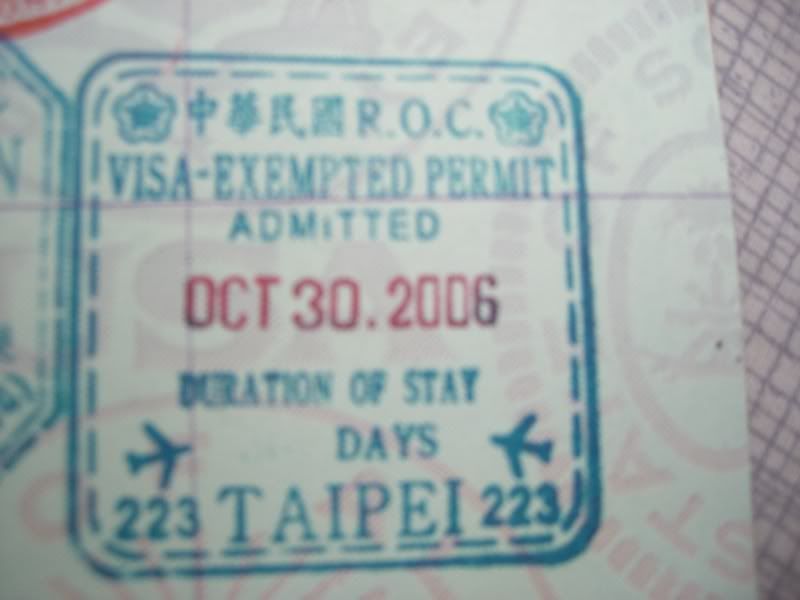
The dreaded "visa-exempt entry" stamp in my passport. Read on for details.
From the moment I first stepped into Taipei back in April 2006, I felt at home. It was hard to go back to Shanghai.
Now, I was in Taiwan to stay. But that wouldn't be easy, due to the country's onerous visa laws. I had tried to apply for a Taiwan visitor visa in Singapore before my arrival in Taiwan. A visitor visa lasts 60 days and can be converted into a one-year resident visa. If you get a visitor visa that allows extensions, you can extend it twice, making it last 6 months in total.
Unfortunately, the Taiwan embassy in Singapore rejected my visa request. They wanted a ridiculous amount of documentation and even said I had to have a letter of invitation from a Taiwanese citizen! If I always had to have a friend in a country before I could visit it, I'd never be able to travel anywhere!
So instead, I came into Taiwan on the dreaded "visa-exempt entry" that you get on arrival at the airport. It meant I only had 30 days to find a job and I had to leave the country at the end of that period. No extensions, no conversions, no nothing because there was no visa to extend or convert, just a stamp in my passport. Basically, the message was to get the hell out after 30 days.
I almost felt like giving up, before I even got started. There was no way I could find a job in 30 days! I've faced some challenges as a traveler before, but I wasn't a miracle worker.
Nevertheless, I threw myself into it. I actually made a list of the things I should have done when I first arrived in China. That way, I wouldn't repeat my mistakes in Taiwan. Some examples:
--Stay in a hostel for the first few weeks and talk to other backpackers. This is by the far the best thing a newly arrived English teacher can do. In a short time, you can get up to speed on what the job market is like, employers to call and to avoid, how to do visa runs, etc. The knowledge gained is invaluable. I stayed at World Scholar House and highly recommend it.
--Get a local phone number. Either get a new mobile phone or a SIM card as soon as you arrive in the country. Employers, friends, and other people all need a way to contact you.
--Research the visa situation before arriving in the country. Sometimes, it's easier to apply for a visa in your home country instead of abroad.
--Get a medical examination at a local hospital to get a health clearance certificate. This is often required to get a work permit. In Taipei, my hospital took a week to process a health clearance, so I had to act fast.
--Find the local expat website. Most countries with a significant expat population will have at least one website where expats can find jobs, apartments, etc. You'll be checking it a lot when you first arrive. Here are a few in Asia:
Taiwan: Tealit
Japan: Gaijin Pot
China: Asia Expat (especially Shanghai)
Korea: ESL Cafe
Now on to the job search. Since I had experience in Shanghai, it was relatively easy to secure interviews. The maddening part was that Taiwanese English school directors could be just as racist as their counterparts in China. The difference was that Chinese bosses were more direct, saying, "You can't be American, you look Chinese." Taiwanese bosses generally spoke better English and were more subtle, asking, "So, where are your parents from?"
I also had some liabilities that were instant dealbreakers: I wanted to be in Taipei City, I wanted to teach adults, and worst of all, I was Asian-American. If I could have given up one of the first two (the third was impossible), I would have had more of a chance to get a job. But I didn't want to make too many concessions, otherwise my time in Taiwan would be miserable. Also, Taiwan had been opened up to the West for longer than China, so many adult professionals could already speak English, driving down demand for teachers.
I was facing racism, a decline in the adult-teaching market and competition from other English teachers who wanted to live in Taipei. The battle was wearing me down.
Elizabeth, my British flatmate in Shanghai, threw me a lifeline by contacting a friend of hers. Petula had majored in Chinese with Elizabeth at the same university and worked in Taipei as a translator. She found out that an English-language newspaper in Taipei was looking for a copy editor and e-mailed me the info.
When I read the job ad from Petula, I was excited and depressed. The job sounded really cool, like getting paid to learn about Taiwan. The downside was that it required two years of experience and journalism qualifications I didn't have. This was the dream job I was guaranteed not to get.
So I applied and kept an eye on the newspaper while I kept going after English-teaching jobs. As the rejections from English schools piled up, I noticed that the newspaper job seemed to keep progressing. I got invited to take a writing test, then to come in for an interview. I started to have some hope. The 30-day visa limit loomed and the editor job was the only one that was going anywhere.
Then the hammer fell. I got an e-mail from the newspaper, thanking me for applying and saying I was the "second reserve candidate." What was that, like being third place?
Game over, I thought. The grand adventure of living abroad will end, and I'll go back to Hawaii. Strangely, I wasn't as sad as I expected. I think it was because I had survived a year in China. At least I had proven to myself I could live abroad. I knew I could have handled Taiwan too, if I had been given the chance.
I quit job-hunting and started making preparations to go home. I'd taken my best shot and lost, time to cut my losses. Now that the burden of finding a job was off, I concentrated on enjoying the time I had left with my new friends.
The most prominent was Colin, an English teacher from Montreal, Canada. We had hit it off right away, because we both had been to China and Singapore. He'd worked for a TV network in Beijing and had studied abroad in Singapore.
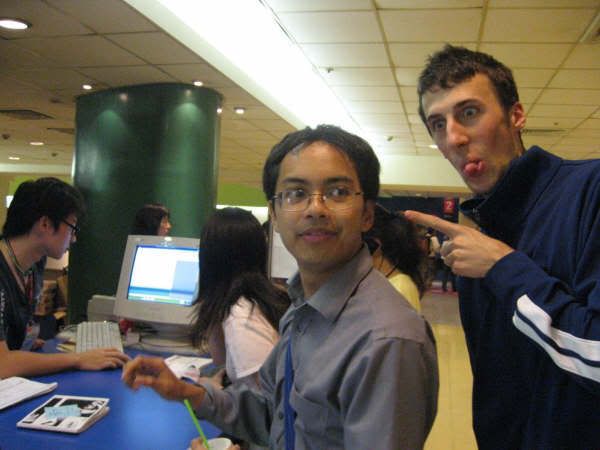
Colin took me around on a tour of the The Ghetto. While we were walking on the street, my cell phone vibrated.
"Yes?" I said.
"Marcus, this is Edwin--" He was a writer for the newspaper! I couldn't make out the rest, because scooters were whining all over the place. I ducked into a convenience store.
"Sorry, what did you say?" I asked.
"I said, 'We are still considering you for the editor position."
Huh?! "Oh, that's great! What do you want me to do?"
"Can you produce your college degree?" Edwin asked.
"Sure. I can come by the office this afternoon."
I forgot to mention, you have to bring your college degree with you when you apply for English teaching jobs in Asia. Before, a photocopy authenticated by an embassy was enough, but too many backpackers have used fake degrees purchased off Khao San Road in Bangkok, Thailand, so now employers are more careful.
After I showed Edwin the degree, he said I might have the copy editor job. The problem I was, I couldn't wait longer to find out, since my visa-free entry was about to expire.
Time for a visa run.
Saturday, June 2, 2007
Slacking off in Singapore
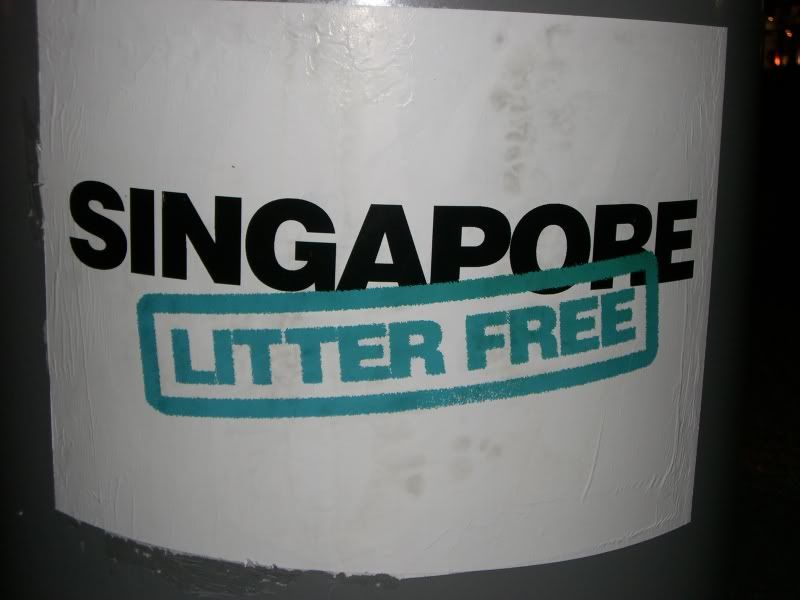
A trash can in Singapore. Click on the photo to see the album.
Although I found it difficult to live in China, it was hard for me to actually leave. I was close to staying in Shanghai for another year. I'd made some awesome friends while I was there and I loved being where all the action was. People read about China in the news everyday, but I was actually living there.
Eventually, I felt it was time to go. I already knew where I wanted to live next. Ever since my visit I had been talking to friends nonstop on how great it was and how much I wanted to go back.
Before I could move there, I had to get a visa in another country before I entered. I went to Singapore because it was exactly what I was looking for: clean, modern and convenient, as different from China as I could get. Flying on China Eastern Airlines would have been cheaper, but I decided to splurge on a flight with Singapore Air. After a year in China, I was going to reward myself with a comfortable flight to a country with one of the highest standards of living in the world.
People say how great Singapore Air is--believe it. I've never had such good food on an airplane before. Japan Airlines had good food too, especially the cold noodles they serve after the main meal. I've heard good things about the Korean airlines too. In general, I'd say the East Asian airlines are far superior to U.S. carriers. Better service, better food, and prettier stewardesses (that's because of discriminatory hiring practices, though). If any of you are flying within China, I'd recommend Hainan Airlines, that was the nicest of the Chinese airlines I used. China Eastern often has the cheapest tickets, though.
The Singapore airport was magnificent! It could have been a luxury shopping center. There were computer terminals offering free Internet access. Getting through immigration was amazingly fast, too. The final surprise was when I got to baggage claim--my bags had beaten me to the arrival area, despite the fast immigration process. I swear, this whole country ran as well as a fine Swiss watch.
The other big reason to go with Singapore was to see my friends there. In Beijing, I'd met a bunch of European students studying abroad in Singapore. They were so cool that I was happy to have an excuse to go visit them.
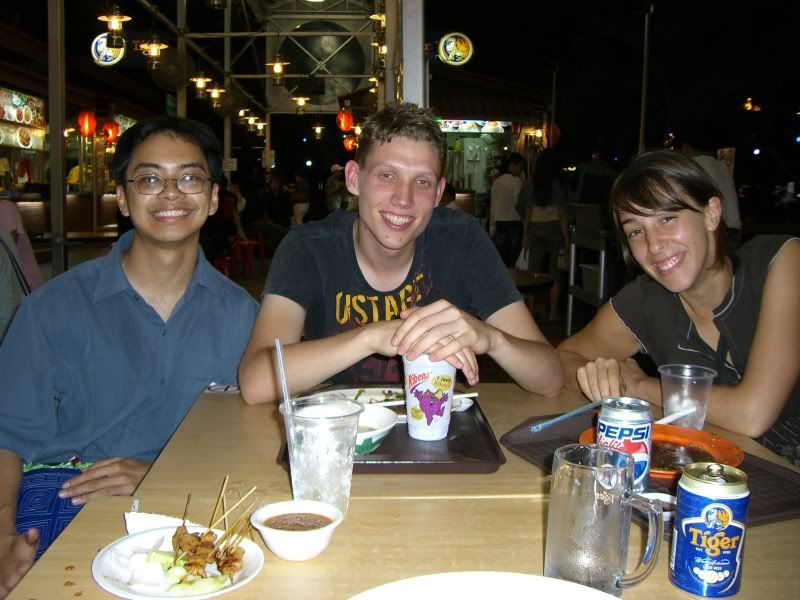
Having dinner at a hawker center with Colin and Caroline.
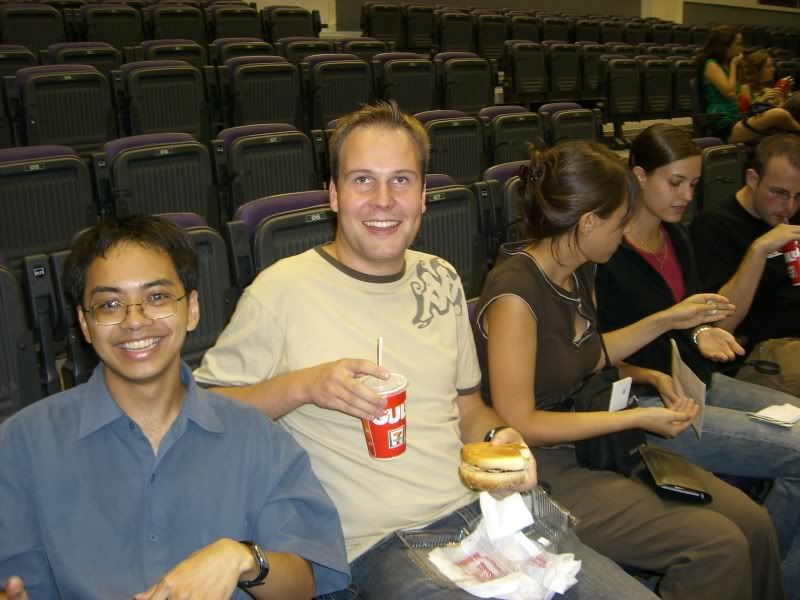
At a basketball game with Miikka.
I didn't realize how much I'd adapted to China until I went to Singapore. I had major culture shock. Everything's in English! It's so clean! Cars don't try to run me down! The list was endless. I felt so stupid, my first instinct was to speak to people in Mandarin, because many of the people in Singapore are ethnic Chinese, but then they'd speak back to me in English. The problem was, I'd gotten used to Chinglish, but Singlish was new to me. A bastard mix of English with an Indian/Malaysian accent. So although everyone spoke English, it wasn't quite as perfect as I expected. Why do they end every sentence with "lah"?
A pleasant surprise was how affordable things were. Friends had told me horror stories about how expensive Hong Kong was, so I expected Singapore to be the same. Luckily, public transportation was extensive and the food was great. Singapore has "hawker centers," open-air food courts where you can get a meal on the cheap. Chinese food dominated, along with Indian, Malaysian and Southeast Asian cuisines. The roast duck I had at a hawker center near my hostel rivaled anything I had in Beijing. I never spent more than 5 Singapore dollars on a meal.
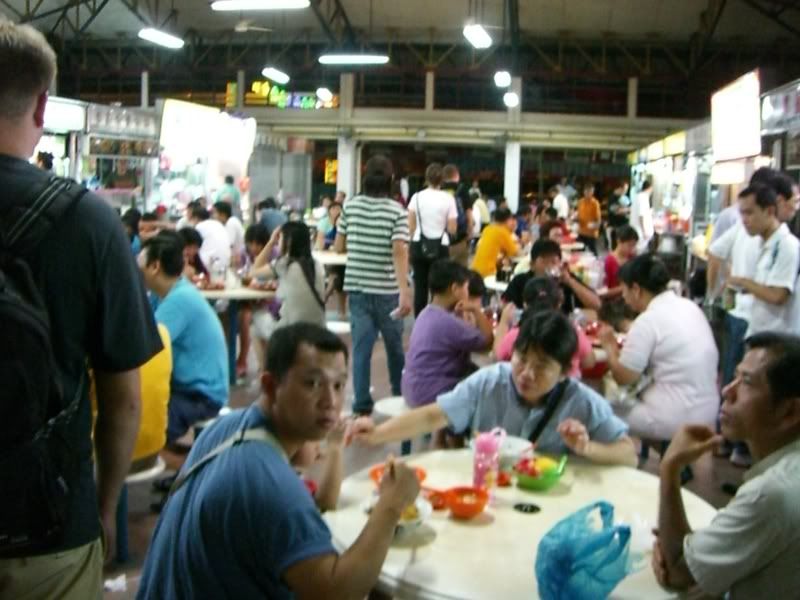
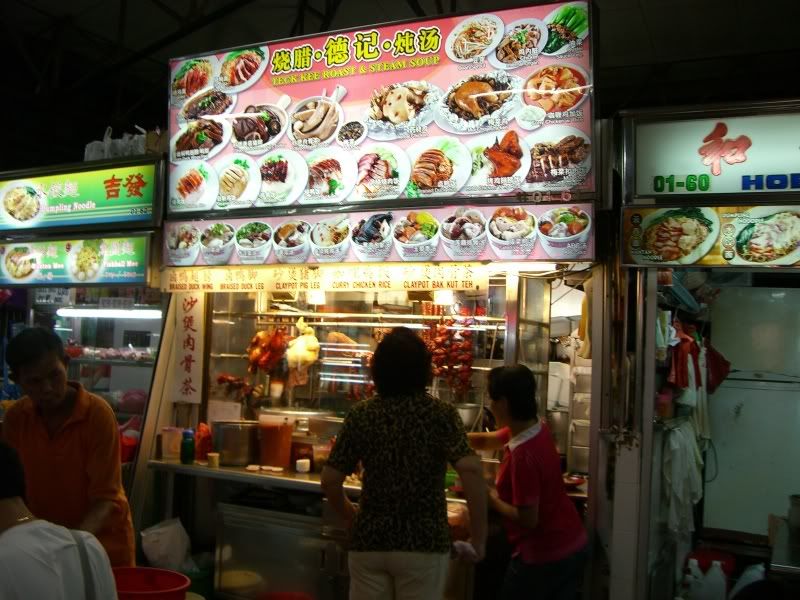
Photos of a typical hawker center.
Colin, an engineering student from Scotland, took me to the ethnic enclaves: Chinatown, Little India and Arab Street. I haven't been to India or the Middle East, so I can't say how "authentic" they were. But if the Chinatown is any indication, they're highly sanitized versions of the actual countries. China was way more gritty and real. In fact, Singapore has the only clean Chinatown I've ever seen! Here are photos of Little India, Chinatown and Arab Street:
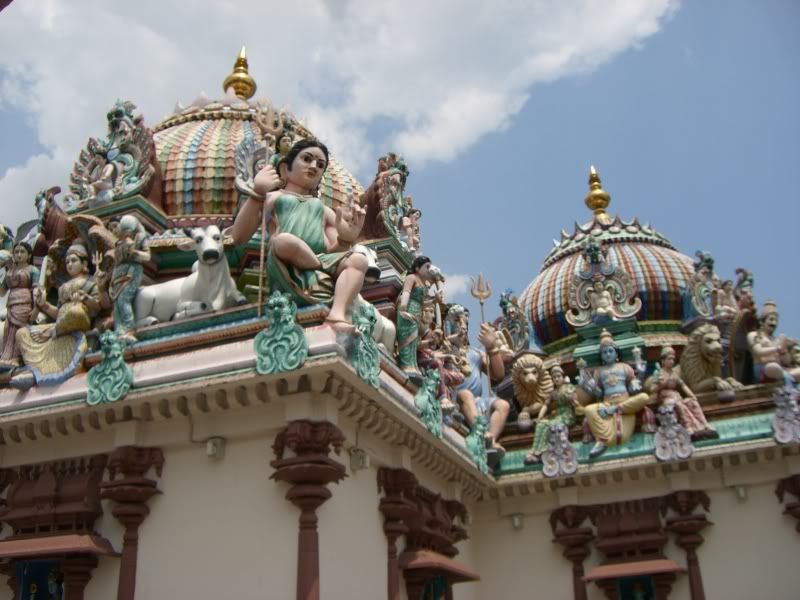
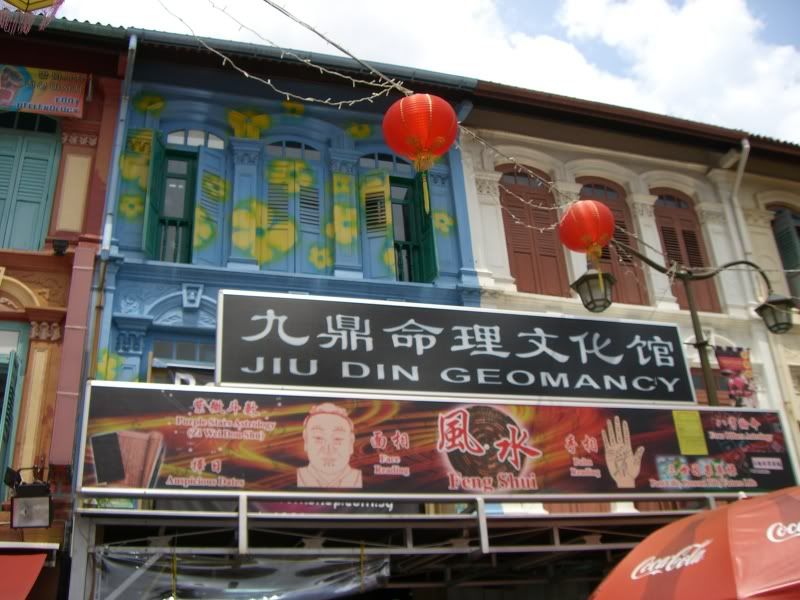
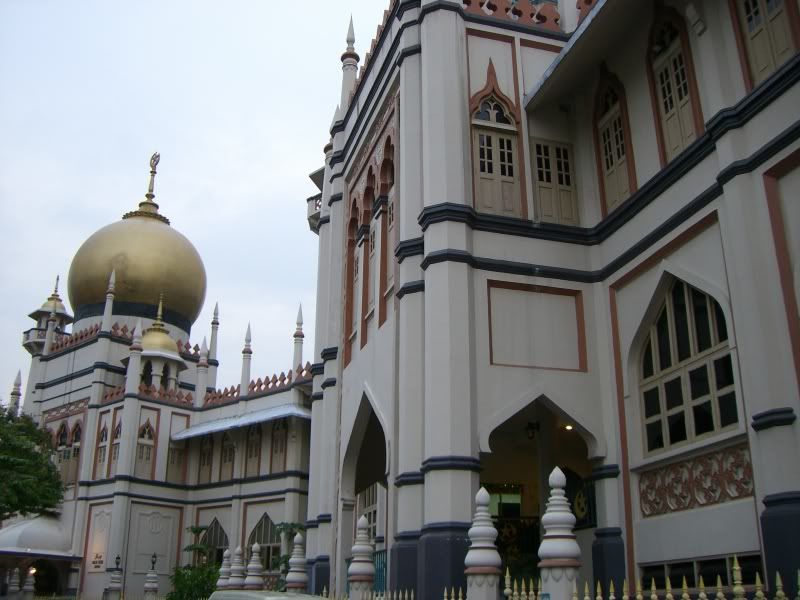
I liked how mutlicultural Singapore was. Lots of Chinese, Malaysians and Indians coexisting. Asian countries tend to be homogeneous, where everyone has similar backgrounds. I was glad to be in a place that had more kinds of people. Singapore reminded me of Hawaii in that way.
There's a stereotype that Singapore is boring. I was glad this wasn't true. There's always lots of public events going on, and Singapore has some of the best nightclubs I've danced in. They also recently started issuing 24-hour licenses for clubs and allowed dancing on top of bars, in an effort to make Singapore more fun.
Another friend I looking forward to reuniting with was Aurore, a girl from Switzerland. When we were in Beijing, she was responsible for chartering a bus to the Great Wall. Although I wasn't a member of their group, Aurore kindly invited me to come along with them. In Singapore, I thanked her again and showed her some of my dance moves when we went out clubbing.
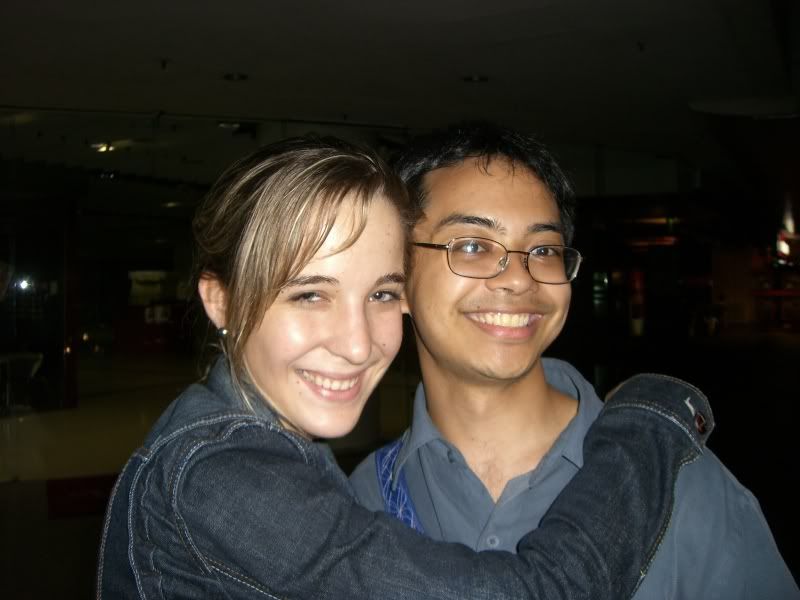
Before, I used to travel in order to see famous places. Now, I travel to make new friends. While it's cool to have photos of world-famous landmarks, it's the people photos that I look at again and again. They're the true reward of the journey.
Sunday, February 25, 2007
Last Days of Shanghai
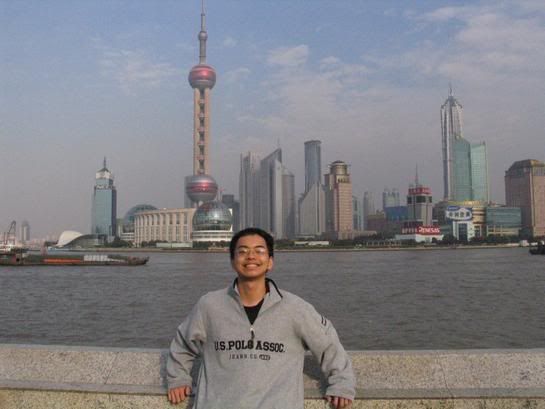
Goodbye, Shanghai.
What a difference a year makes. When I first arrived in China, I had never worked abroad, never lived on my own and knew no Chinese. Now I feel like I've adapted to one of the biggest cities in the world.
I feel proud of myself for not giving up, since everything went to hell my first month here. To protect against that possibility, I came to China with an open-ended return ticket. My friends were amazed that I stuck it out. It wasn't like I stayed in China because I ran out of money. Most of my friends said if things had gone as badly for them as it did for me, they would definitely have gone home. Especially if home was Hawaii!
This might be melodramatic, but I felt I had to stay in China for a year. If I had gone home, I think my spirit would have been broken, and I'd never have the confidence to travel on my own again.
Now that I've been able to survive for a year, the world has opened up to me. I feel like I can go anywhere and actually live there, not just travel through like a tourist. I think the first year in a developing country is the hardest experience; after that, things become more bearable. Shanghai is actually not bad, after hearing from friends who've been to places like Africa and India.
The key thing that kept me sane was my friends. I was lucky to hang out with a wonderful group of people. Since the world is coming to do business in Shanghai, my friends came from everywhere. So many of my friends were English, it was like I was back studying abroad in England. China, Europe, Canada, Australia and the United States were also well-represented in my social circle. All the people I met were so supportive, giving me the encouragement I needed just when I was ready to quit and go home.
I'm not big on throwing parties in my own honor. I usually let my birthday slip by without telling anyone. This time, I threw a farewell party, just so I could see my friends before I left.
I chose to have it at Cotton's Bar, because it's my favorite bar in Shanghai. It's a house, so it feels cozy and comfortable. There's outdoor seating on wooden furniture amidst leafy greenery, which makes for a beautiful backdrop for lazy conversations. Cotton's is also the site for one of the best parties I'd ever been to, for New Year's 2006. My friends and I totally destroyed that place, dancing on chairs, tables, going totally nuts. Like trashing someone's house at a house party, except for not having to clean up.
People came and went at different times, so it was a weird dynamic. It was like being at several different parties. Richard and Andy were the first to show up, and they had known me since I first came to Shanghai. It was fun to reminisce about the old days.
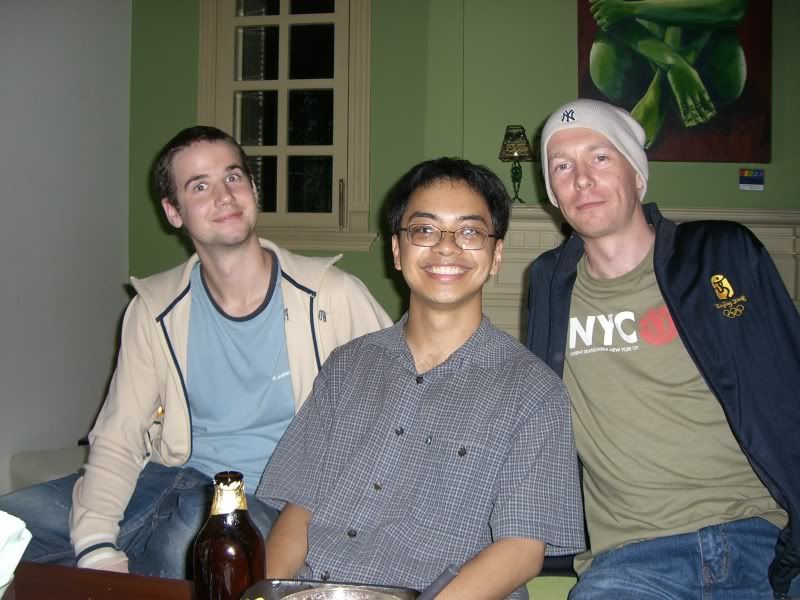
Richard and Andy at my farewell party at Cotton's Bar.
They left early, and the rest of my friends came later. Looking at all of these awesome people, I felt blessed. I hadn't even left yet, and I was already planning to come back and visit them.
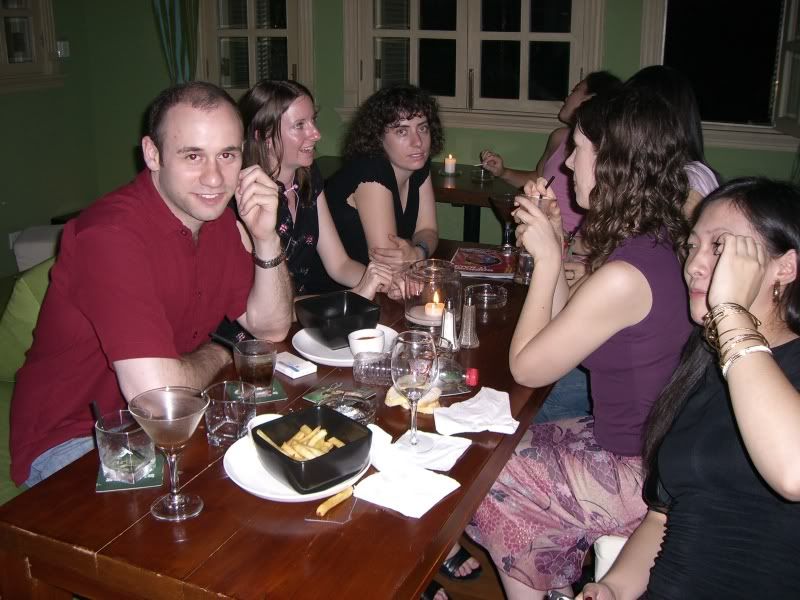
The Shanghai Gang. So many parties, so many memories.
The popular conversation topic was taking the next step. Melissa and Shauna moved up to teaching at international schools. My roommate Elizabeth was looking into working for a multinational company. Some of our friends had gone home to attend grad school. Others stayed to study Chinese, which would improve their career prospects.
As for me, I was going to move to a new country. Staying in China would have been so easy, since I had friends and knew my way around. But I wanted to keep moving, to see what else was out there. If I ever changed my mind, there was always Shanghai.
Inside Information
Getting into the city
Arrival: Most international flights land in Pudong airport. The Maglev train is not convenient for getting into the city. It's difficult to transfer from the airport to the Maglev, and it goes to Longyang metro station, which is still on the outskirts of Shanghai.
Airport buses are a better choice. Bus #2 is the most useful, as it goes directly to Jing'an Temple.
Where to stay
I stayed at Le Tour Travelers Rest. Nice hostel, and a great location near Jing'an Temple. Convenient for bars, clubs, and restaurants. Mingtown ETour Hostel has a super-central location near People's Square, a hub for the metro lines. It has gotten good reviews in guidebooks and online, but I haven't stayed there.
Captain Hostel (Bund branch) is one of the oldest hostels in Shanghai. Even if you don't stay there, it's worth going to the rooftop bar. Great views of the skyline in Pudong, at a fraction of the cost of other bars on the riverfront.
The information below is accumulated from my time living in Shanghai. Good for if you've decided to move there.
Appendix 1: Living Costs in Shanghai
What does it cost to live in Shanghai? Mercer Human Resources Consulting compiles a list of the world's most expensive cities every year. There's a link to the complete list over at CNN.
Shanghai ranked #30 overall. This list is skewed, though. Companies hire Mercer to calculate compensation packages for the American executives they send abroad. The Director of China Operations for a multinational corporation will demand a higher standard of living than a poor college graduate on a student budget. Shanghai can be very expensive or very cheap, depending on the person.
Enough talk. Time to show you the money!
My Monthly Expenses (estimates in RMB):
1400 Rent
1200 Food
200 Utilities
64 Bus
80 Taxi
80 Subway
300 Clubbing (Drinking and Cover Charges)
80 DVDs
300 Books
50 Mobile phone
+100 Long-distance phone calls
3854 RMB TOTAL US$477.58 a month, using the Universal Currency Converter
Comments on Costs
Rent -- Housing is the biggest expense, just like it would be anywhere else. Executive expats live in country club-style communities that can cost over $10,000 a month. Serviced apartments, which are basically long-stay hotel rooms, cost almost as much.
Younger expats usually share apartments. Smart Shanghai is the best to look for apartments (and jobs). Shanghai Expat, and Craig's List Shanghai are also worth a look. If you are fluent in Chinese, you can find some spectacular deals on Anjia.
If you have one roommate and a 2-bedroom apartment in the city, your rent shouldn't cost more than 2500 RMB ($310). If you live further from the city, that much could get you your own 1-bedroom apartment. 3-bedroom apartments can be had for less than 8000 RMB ($1000). For more info, check out this rental chart.
The bigger the apartment, the better the value. 1-bedroom apartments are usually bad and overpriced. 2-bedroom apartments range from okay to somewhat nice. 3-bedroom apartments are huge, new, and are well-located. Not to mention cheaper, because the rent is split among three people. The difference in price between 2-bedroom and 3-bedroom apartments is not that much sometimes. One of my friends said, "When it comes to apartments, 3 is the magic number."
Emoo is an expat services company that has excellent move-to-Shanghai packages. For one price, they'll pick you up at the airport, put you in a hotel, find you an apartment, and even toss in an international phone card. They also help with visas. Click on "Traveling." The special offers aren't there now, but should be back up soon. You can probably find a cheaper apartment on your own, but I think Emoo is the most convenient way to move to Shanghai for the first time.
Food -- Good news for people like me who are too lazy to cook. I average 40 RMB ($5) a day on food, eating out three times a day. If you stick to water and stuffed steam buns (baozi), could spend less than $1 a day. I tend to mix Western and Asian food. Pizza is expensive, so most of my friends eat Hello Pizza, a cheap local chain.
The bad news is cheese. There's no cheese in China! Carrefour (Jialefu in Chinese) is one of the few places that carry a decent selection, because they're like the French version of Costco. The Chinese I talk to say they don't like cheese, it smells too bad. Ironic, since one whiff of their stinky doufu could knock out a rampaging elephant.
Utilities -- These usually don't amount to much, but paying them can be a pain in the ass. You have to go to a convenience store like KEDI or Lawson's. You give them the bill, they scan it, and you pay. Some of the clerks can be anal about only accepting utility bills at certain times of the day. I get the best service when I pay at the post office, so now I do all my business there.
Bus -- on old buses (no air-conditioning), it costs 1 RMB for a one-way bus ticket. New buses cost 2 RMB. An old woman will come along the aisle with a dirty purse, collecting money, making change, and handing out bus tickets. The newer buses have coin machines and card scanners
Taxi -- The base fee is 10 RMB ($1.25) for the first kilometer and 2 RMB each kilometer afterwads. After 11:00PM, the base fee is 13 RMB ($1.61) There's a ton of taxis in Shanghai, and the drivers are very professional. At least compared to what I experienced in Beijing. Typically, they wear suits, ties, and white driving gloves. They don't speak English, so you'll have learn a little Chinese. Lu ("loo") means road. Nanjing Road becomes Nanjing Lu. Give the driver the street and cross-street, and you'll be fine.
Taxis come in different colors (each with a different company), but 99% of them are Volkswagen Santanas. Volkswagen was one of the first companies to enter the China market, so their cars are everywhere. The Santana is relatively cheap and super-reliable. But it's almost impossible to get a taxi when it's raining.
My favorite taxi company is Da Zhong Taxi, they're turquoise in color. They're part of a state-owned enterprise that enforces professional standards. Qiansheng taxis, which are yellow, are pretty good too. I thought the worst taxis were the maroon-colored ones, I forget the name. Old cars and the drivers didn't know where anything was.
Always keep the taxi receipt, you can use it to recover lost belongings or complain about a taxi driver. You can call the taxi company, and they can use the receipt to resolve any problems. Stay away from abnormal-looking taxis. They're private taxis and generate the most complaints.
Subway -- Shanghai's subway system is clean and efficient, but there's only 4 lines right now. The good news is that they're planning to add 8 lines.
It's highly recommended to get a Shanghai Public Transportation Card. It can be used on the subway, taxi, and some buses. The lines at subway ticket booths can be really long during peak times. It's faster to just pass the card over the scanner at the turnstiles. The scanners are powerful; I've seen women hold huge handbags over the scanner and it still detected the card.
Clubbing -- Drinking is expensive compared to other living costs, especially if you drink in the trendy Xintiandi area. The clubs I've gone to so far charge about 60 RMB ($7.44) for entry and about 50 RMB ($6.20) for mixed drinks. That's why my friends and I always end up at Windows Too, which has 10 RMB ($1.25) drinks. So far, my favorite club is Guandii. It was founded by Hong Kong media stars and has good hip-hop music. The place is always packed with overseas Chinese and ABCs (American-Born Chinese).
Here are some of the main clubbing areas:
The New Factories
The Bund
Tongren Road
Hengshan Road
Fuxing Park
Maoming Road
SH Magazine is a free weekly publication that has all the latest restaurant and clubbing info. You can pick it up at most Starbucks and Western restaurants. Smart Shanghai is another great source. Their venue listings also have the useful option of printing out directions in Chinese for a taxi driver.
There's a great service called Guanxi. If you send a text with the name of a bar, restaurant, or nightclub, it will reply with the address and contact info of that venue. You can also get Guanxi to translate those details into Chinese, so you can show it to a taxi driver.
DVDs -- China is heaven for movie lovers, since pirated DVDs are everywhere. DVDs in shops go for about 10 RMB ($1.25). On the street, they can go as low as 5 RMB ($0.62). I got a Philips DVD player for 400 RMB ($50) at Gome, a big electronics store. It's best to stay away from the newest Hollywood movies. Many times they're bad because the movie was recorded with a home video camera someone snuck into a movie theater. The annoying thing is that they often don't have the special features, like deleted scenes, director commentary, etc.
Books -- Books are relatively expensive. Paperback copies of literary classics are the best bargains at about 18 RMB ($2.25). Any other book can cost over 200 RMB ($24.81). Thanks to government censorship, there is a lack of variety, except for books about learning the Chinese language and doing business in China. Most bookstores will have a small section of English-language books, usually guidebooks and classic literature. The best bookstore is the Foreign Languages Bookstore, on Fuzhou Road.
Mobile Phone -- They say "mobile phone" more than "cell phone" here. Good ones usually cost more than 1000 RMB ($124.03). I got a Motorola for about 500 RMB ($62.01). One of my Chinese friends took me to a mobile phone store at Middle Henan Road subway station, Exit 1. You can sign up with China Mobile and pay a monthly fee. My friends and I buy phone cards and add credit as we go. Phone cards come in 50 RMB or 100 RMB. Since I mostly send text messages instead of talk, a 50 RMB card can last me a month.
Long-Distance Calls -- Just like with mobile phone cards, long-distance ones come in denominations of 50 RMB or 100 RMB. Try to buy them off the street from the shabbiest operator you can find. Normally you can buy for 50% or 66% off the face value. If you look Caucasian, you'll probably end up paying full price. A 100 RMB card lasts 45-50 minutes when calling America.
Appendix 2: Average Salaries in Shanghai
After talking to some people, here's what I came up with. Strictly word-of-mouth, no statistics to back these up. All numbers are monthly figures.
1000-3000 RMB ($124-$372) Recent College Graduate
5000-7000 RMB ($620-$868) Mid-level Employee
10,000 + RMB ($1240) Executive
Looking at this list, I can see why Western companies are in such a rush to send jobs overseas. You could pay a Chinese CEO half of what an American high school student makes at McDonald's. Note that factory workers make even less. Since rents are often higher than starting salaries in Shanghai, many young professionals live with their parents.
English is in such demand that I make more as an English teacher than many of my students. People are paid monthly here, rather than biweekly like the U.S. Some employers do direct deposits to bank accounts, while many still pay in cash.
Appendix 3: Exchanging Money
The yuan is a closed currency, meaning it is difficult to change. There's all sorts of exchange controls to let money come into China, but not go out. For example, when you change money at the airport or a bank, you are given an exchange memo. You always have to show that exchange memo before you can change yuan back into dollars. You can't get back more dollars than you first exchanged. Exchange memos are only valid for 6 months. Customs regualations prohibit carrying more than $5000 or 20,000 RMB in cash out of the country.
The best of all worlds is to have an American employer who pays you in dollars. Executive-level expats usually have their main salary wired to their U.S. bank account, while taking living allowances in cash for daily expenses.
Then there's the black market. Outside the main Bank of China headquarters near the Bund, there's street currency traders who will happily change as many dollars as you want. If they're blatant, they might run away with your money. If they have some subtlety, they'll yell "Police!" and then run away with your money. Or they will be totally professional: once back at your hotel, you'll discover you got carefully cut pieces of newspaper, even if you swear the money never left your hands.
The Hong Kong Dollar is freely convertible, so one of my friends proposed opening a bank account there if I ever visit Hong Kong to buy a Chinese visa. Wire the money to Hong Kong, then America. Or carry bundles of cash to Hong Kong. Some of the other schemes expats have come up with are too crazy to mention here.
Getting into the city
Arrival: Most international flights land in Pudong airport. The Maglev train is not convenient for getting into the city. It's difficult to transfer from the airport to the Maglev, and it goes to Longyang metro station, which is still on the outskirts of Shanghai.
Airport buses are a better choice. Bus #2 is the most useful, as it goes directly to Jing'an Temple.
Where to stay
I stayed at Le Tour Travelers Rest. Nice hostel, and a great location near Jing'an Temple. Convenient for bars, clubs, and restaurants. Mingtown ETour Hostel has a super-central location near People's Square, a hub for the metro lines. It has gotten good reviews in guidebooks and online, but I haven't stayed there.
Captain Hostel (Bund branch) is one of the oldest hostels in Shanghai. Even if you don't stay there, it's worth going to the rooftop bar. Great views of the skyline in Pudong, at a fraction of the cost of other bars on the riverfront.
The information below is accumulated from my time living in Shanghai. Good for if you've decided to move there.
Appendix 1: Living Costs in Shanghai
What does it cost to live in Shanghai? Mercer Human Resources Consulting compiles a list of the world's most expensive cities every year. There's a link to the complete list over at CNN.
Shanghai ranked #30 overall. This list is skewed, though. Companies hire Mercer to calculate compensation packages for the American executives they send abroad. The Director of China Operations for a multinational corporation will demand a higher standard of living than a poor college graduate on a student budget. Shanghai can be very expensive or very cheap, depending on the person.
Enough talk. Time to show you the money!
My Monthly Expenses (estimates in RMB):
1400 Rent
1200 Food
200 Utilities
64 Bus
80 Taxi
80 Subway
300 Clubbing (Drinking and Cover Charges)
80 DVDs
300 Books
50 Mobile phone
+100 Long-distance phone calls
3854 RMB TOTAL US$477.58 a month, using the Universal Currency Converter
Comments on Costs
Rent -- Housing is the biggest expense, just like it would be anywhere else. Executive expats live in country club-style communities that can cost over $10,000 a month. Serviced apartments, which are basically long-stay hotel rooms, cost almost as much.
Younger expats usually share apartments. Smart Shanghai is the best to look for apartments (and jobs). Shanghai Expat, and Craig's List Shanghai are also worth a look. If you are fluent in Chinese, you can find some spectacular deals on Anjia.
If you have one roommate and a 2-bedroom apartment in the city, your rent shouldn't cost more than 2500 RMB ($310). If you live further from the city, that much could get you your own 1-bedroom apartment. 3-bedroom apartments can be had for less than 8000 RMB ($1000). For more info, check out this rental chart.
The bigger the apartment, the better the value. 1-bedroom apartments are usually bad and overpriced. 2-bedroom apartments range from okay to somewhat nice. 3-bedroom apartments are huge, new, and are well-located. Not to mention cheaper, because the rent is split among three people. The difference in price between 2-bedroom and 3-bedroom apartments is not that much sometimes. One of my friends said, "When it comes to apartments, 3 is the magic number."
Emoo is an expat services company that has excellent move-to-Shanghai packages. For one price, they'll pick you up at the airport, put you in a hotel, find you an apartment, and even toss in an international phone card. They also help with visas. Click on "Traveling." The special offers aren't there now, but should be back up soon. You can probably find a cheaper apartment on your own, but I think Emoo is the most convenient way to move to Shanghai for the first time.
Food -- Good news for people like me who are too lazy to cook. I average 40 RMB ($5) a day on food, eating out three times a day. If you stick to water and stuffed steam buns (baozi), could spend less than $1 a day. I tend to mix Western and Asian food. Pizza is expensive, so most of my friends eat Hello Pizza, a cheap local chain.
The bad news is cheese. There's no cheese in China! Carrefour (Jialefu in Chinese) is one of the few places that carry a decent selection, because they're like the French version of Costco. The Chinese I talk to say they don't like cheese, it smells too bad. Ironic, since one whiff of their stinky doufu could knock out a rampaging elephant.
Utilities -- These usually don't amount to much, but paying them can be a pain in the ass. You have to go to a convenience store like KEDI or Lawson's. You give them the bill, they scan it, and you pay. Some of the clerks can be anal about only accepting utility bills at certain times of the day. I get the best service when I pay at the post office, so now I do all my business there.
Bus -- on old buses (no air-conditioning), it costs 1 RMB for a one-way bus ticket. New buses cost 2 RMB. An old woman will come along the aisle with a dirty purse, collecting money, making change, and handing out bus tickets. The newer buses have coin machines and card scanners
Taxi -- The base fee is 10 RMB ($1.25) for the first kilometer and 2 RMB each kilometer afterwads. After 11:00PM, the base fee is 13 RMB ($1.61) There's a ton of taxis in Shanghai, and the drivers are very professional. At least compared to what I experienced in Beijing. Typically, they wear suits, ties, and white driving gloves. They don't speak English, so you'll have learn a little Chinese. Lu ("loo") means road. Nanjing Road becomes Nanjing Lu. Give the driver the street and cross-street, and you'll be fine.
Taxis come in different colors (each with a different company), but 99% of them are Volkswagen Santanas. Volkswagen was one of the first companies to enter the China market, so their cars are everywhere. The Santana is relatively cheap and super-reliable. But it's almost impossible to get a taxi when it's raining.
My favorite taxi company is Da Zhong Taxi, they're turquoise in color. They're part of a state-owned enterprise that enforces professional standards. Qiansheng taxis, which are yellow, are pretty good too. I thought the worst taxis were the maroon-colored ones, I forget the name. Old cars and the drivers didn't know where anything was.
Always keep the taxi receipt, you can use it to recover lost belongings or complain about a taxi driver. You can call the taxi company, and they can use the receipt to resolve any problems. Stay away from abnormal-looking taxis. They're private taxis and generate the most complaints.
Subway -- Shanghai's subway system is clean and efficient, but there's only 4 lines right now. The good news is that they're planning to add 8 lines.
It's highly recommended to get a Shanghai Public Transportation Card. It can be used on the subway, taxi, and some buses. The lines at subway ticket booths can be really long during peak times. It's faster to just pass the card over the scanner at the turnstiles. The scanners are powerful; I've seen women hold huge handbags over the scanner and it still detected the card.
Clubbing -- Drinking is expensive compared to other living costs, especially if you drink in the trendy Xintiandi area. The clubs I've gone to so far charge about 60 RMB ($7.44) for entry and about 50 RMB ($6.20) for mixed drinks. That's why my friends and I always end up at Windows Too, which has 10 RMB ($1.25) drinks. So far, my favorite club is Guandii. It was founded by Hong Kong media stars and has good hip-hop music. The place is always packed with overseas Chinese and ABCs (American-Born Chinese).
Here are some of the main clubbing areas:
The New Factories
The Bund
Tongren Road
Hengshan Road
Fuxing Park
Maoming Road
SH Magazine is a free weekly publication that has all the latest restaurant and clubbing info. You can pick it up at most Starbucks and Western restaurants. Smart Shanghai is another great source. Their venue listings also have the useful option of printing out directions in Chinese for a taxi driver.
There's a great service called Guanxi. If you send a text with the name of a bar, restaurant, or nightclub, it will reply with the address and contact info of that venue. You can also get Guanxi to translate those details into Chinese, so you can show it to a taxi driver.
DVDs -- China is heaven for movie lovers, since pirated DVDs are everywhere. DVDs in shops go for about 10 RMB ($1.25). On the street, they can go as low as 5 RMB ($0.62). I got a Philips DVD player for 400 RMB ($50) at Gome, a big electronics store. It's best to stay away from the newest Hollywood movies. Many times they're bad because the movie was recorded with a home video camera someone snuck into a movie theater. The annoying thing is that they often don't have the special features, like deleted scenes, director commentary, etc.
Books -- Books are relatively expensive. Paperback copies of literary classics are the best bargains at about 18 RMB ($2.25). Any other book can cost over 200 RMB ($24.81). Thanks to government censorship, there is a lack of variety, except for books about learning the Chinese language and doing business in China. Most bookstores will have a small section of English-language books, usually guidebooks and classic literature. The best bookstore is the Foreign Languages Bookstore, on Fuzhou Road.
Mobile Phone -- They say "mobile phone" more than "cell phone" here. Good ones usually cost more than 1000 RMB ($124.03). I got a Motorola for about 500 RMB ($62.01). One of my Chinese friends took me to a mobile phone store at Middle Henan Road subway station, Exit 1. You can sign up with China Mobile and pay a monthly fee. My friends and I buy phone cards and add credit as we go. Phone cards come in 50 RMB or 100 RMB. Since I mostly send text messages instead of talk, a 50 RMB card can last me a month.
Long-Distance Calls -- Just like with mobile phone cards, long-distance ones come in denominations of 50 RMB or 100 RMB. Try to buy them off the street from the shabbiest operator you can find. Normally you can buy for 50% or 66% off the face value. If you look Caucasian, you'll probably end up paying full price. A 100 RMB card lasts 45-50 minutes when calling America.
Appendix 2: Average Salaries in Shanghai
After talking to some people, here's what I came up with. Strictly word-of-mouth, no statistics to back these up. All numbers are monthly figures.
1000-3000 RMB ($124-$372) Recent College Graduate
5000-7000 RMB ($620-$868) Mid-level Employee
10,000 + RMB ($1240) Executive
Looking at this list, I can see why Western companies are in such a rush to send jobs overseas. You could pay a Chinese CEO half of what an American high school student makes at McDonald's. Note that factory workers make even less. Since rents are often higher than starting salaries in Shanghai, many young professionals live with their parents.
English is in such demand that I make more as an English teacher than many of my students. People are paid monthly here, rather than biweekly like the U.S. Some employers do direct deposits to bank accounts, while many still pay in cash.
Appendix 3: Exchanging Money
The yuan is a closed currency, meaning it is difficult to change. There's all sorts of exchange controls to let money come into China, but not go out. For example, when you change money at the airport or a bank, you are given an exchange memo. You always have to show that exchange memo before you can change yuan back into dollars. You can't get back more dollars than you first exchanged. Exchange memos are only valid for 6 months. Customs regualations prohibit carrying more than $5000 or 20,000 RMB in cash out of the country.
The best of all worlds is to have an American employer who pays you in dollars. Executive-level expats usually have their main salary wired to their U.S. bank account, while taking living allowances in cash for daily expenses.
Then there's the black market. Outside the main Bank of China headquarters near the Bund, there's street currency traders who will happily change as many dollars as you want. If they're blatant, they might run away with your money. If they have some subtlety, they'll yell "Police!" and then run away with your money. Or they will be totally professional: once back at your hotel, you'll discover you got carefully cut pieces of newspaper, even if you swear the money never left your hands.
The Hong Kong Dollar is freely convertible, so one of my friends proposed opening a bank account there if I ever visit Hong Kong to buy a Chinese visa. Wire the money to Hong Kong, then America. Or carry bundles of cash to Hong Kong. Some of the other schemes expats have come up with are too crazy to mention here.
Monday, February 19, 2007
Channel to China! -- Tiger Leaping Gorge
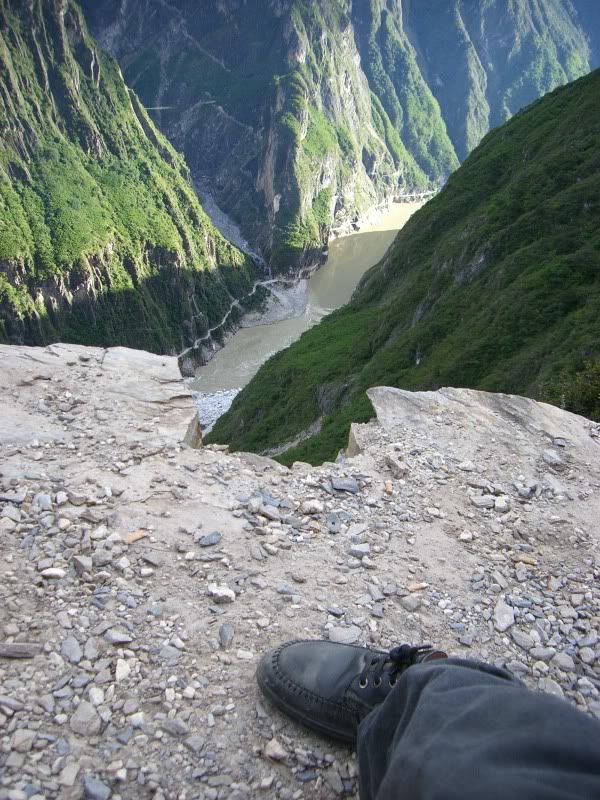
Living on the edge: click on the photo to see the full album.
I'm not actually an outdoors person. Hiking, trekking and camping are not my thing. Being from an island and surrounded by nature all the time, I prefer to travel to big cities instead.
But Tiger Leaping Gorge just sounded too cool to pass up. Claire convinced me to gather more info, then maybe give it a shot.
We went to a hiking club in Lijiang and asked some of the Chinese staff about how difficult the gorge was. They assured us that it was a relatively safe hike, with lots of guesthouses along the way to eat and rest.
I had only alloted four days in Lijiang, and the hike would take at least two. If I wanted to do it, I had to decide today and go tomorrow. I told Claire I'd do it. She was excited.
I couldn't sleep that night, because I totally believed I was getting in way over my head. I'm not in the best physical condition, so I worried that I would slow Claire down. She'd down some hardcore trekking in the highlands of Vietnam. When I travel, I hang out at cafes and bookstores. I couldn't resist the symmetry of it, though. I started my China trip at the Great Wall, one of the biggest manmade wonders of the world. I would end my trip at Tiger Leaping Gorge, the deepest gorge in the world, a natural wonder.
We took a bus bound for Zhongdian and got off at Qiaotou, a small town at the beginning of the trek. To get the latest info, we hit up the Gorged Tiger Cafe. It's run by a cool Australian lady named Margo.
We had coffee and cookies while she gave us advice about the trek. The most important thing was the weather. Margo said that the weather was supposed to be perfect, so now was definitely the time to do it. Once we finished our coffee and used the bathroom, we were off!
The trek wasn't too bad, at first. We were mostly walking on trails. Everything changed once we turned around our first mountain:
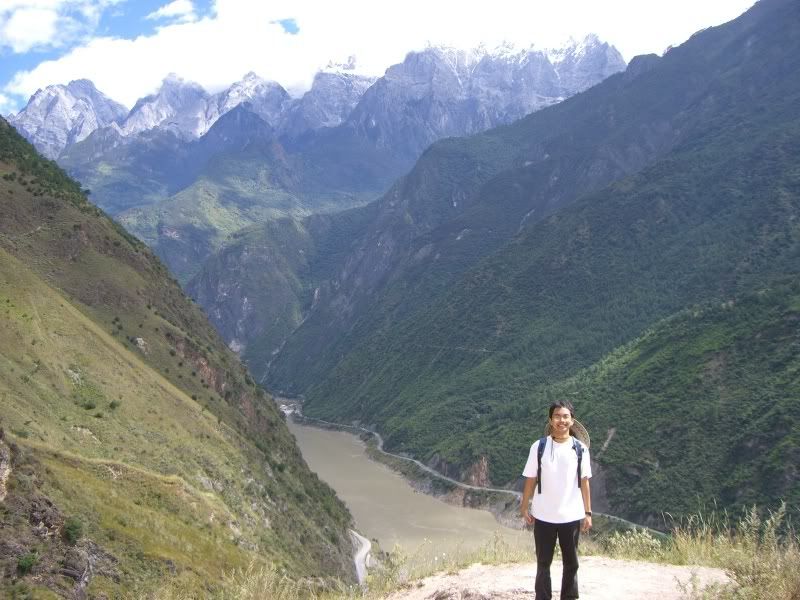
After that, I was hooked. Now I could see why people were willing to get sweaty and push themselves to the limit on treks. When you see stunning natural vistas like these, it more than made up for all the hassle involved.
Although Tiger Leaping Gorge is a really popular thing for tourists to do, we were alone for most of the time. We did walk for a while with a small group of people from Hong Kong that had been with us on the bus to Qiaotou. One of the women was an investment banker, so I ended up talking to her about business in China. She recommended some Chinese companies that would make good investments. I felt weird though, getting stock tips while walking thousands of meters above sea level. Travel sometimes brings out these totally weird situations that would just not happen back home.
While the Hong Kongers were cool, sometimes the locals could be annoying. Local folk on horses would walk behind us for hours at a time, hoping we would get tired and pay them for a horse ride.
Touts in China are legendary. Wherever there's tourists, they'll be people trying to sell you stuff. I've had touts try to sell me picture books at the Great Wall and now the horse rides. What's worse is that the horses would sniff at my ass while I climbed.
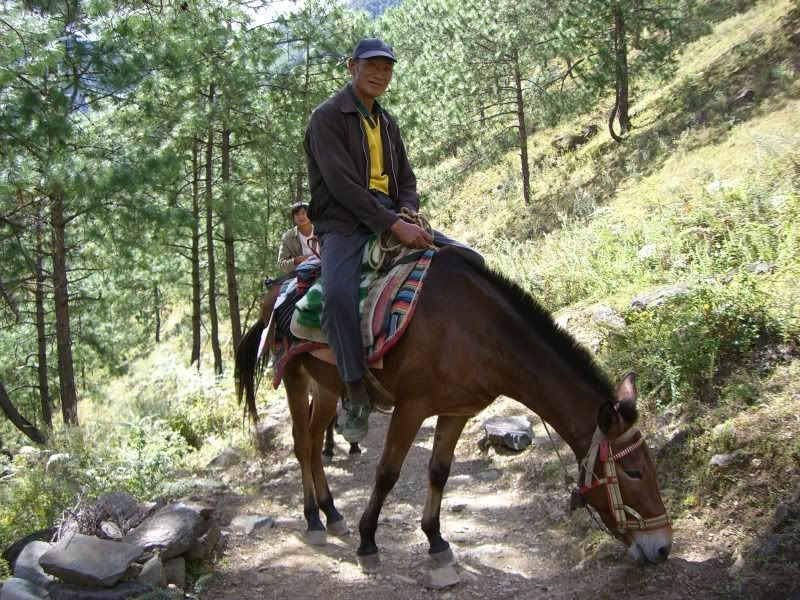
At the end of the day, we encountered the 28 Bends. It's a murderous path of sudden turns and switchbacks at steep angles. I couldn't enjoy the scenery because I had to concentrate 100% on mantaining my balance. By the time we finished, I thought my knees were destroyed.
I'd never been so excited to rest in my life. We spent the night at the Tea Horse Guesthouse. The rooms were perfect, a beautiful wooden lodge.
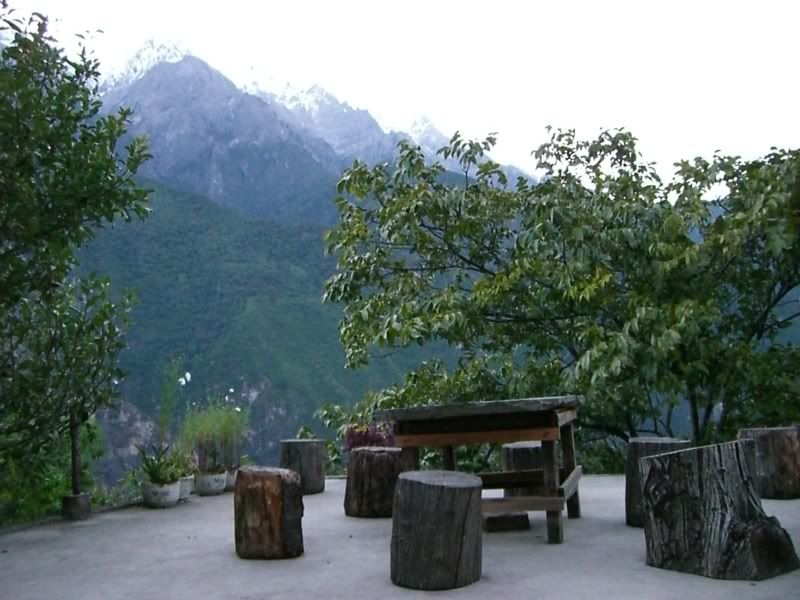
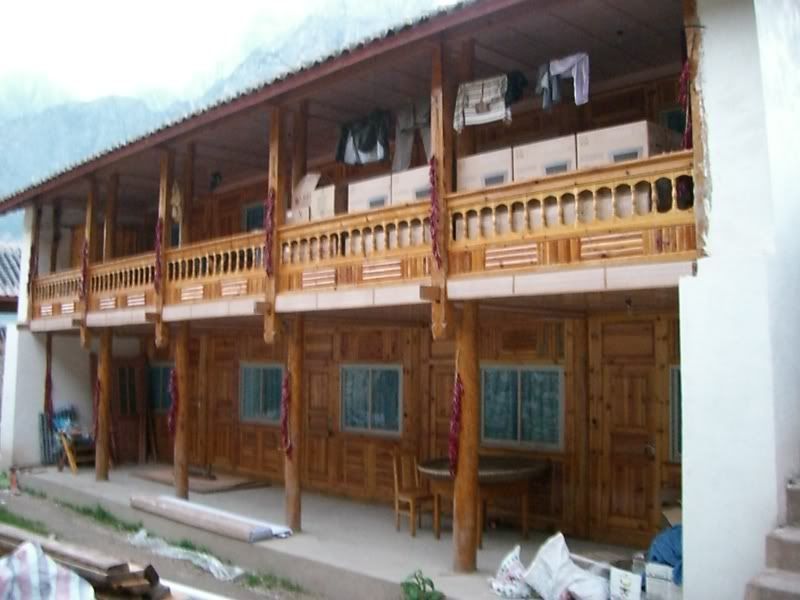
The bathrooms were another story. The "toilets" were a set of bleak concrete stalls. I had to squat over a little gutter and the water would sluice my donations off to their fate. As for the shower, it was an absolutely disgusting wooden shack with a single showerhead. I felt more dirty than clean after bathing in that place. I've spared you guys the photos here, but you can find them in the photo album.
One benefit was that we met this cool couple from Denmark, Peter and Mette. They joined us when we hiked the next day.
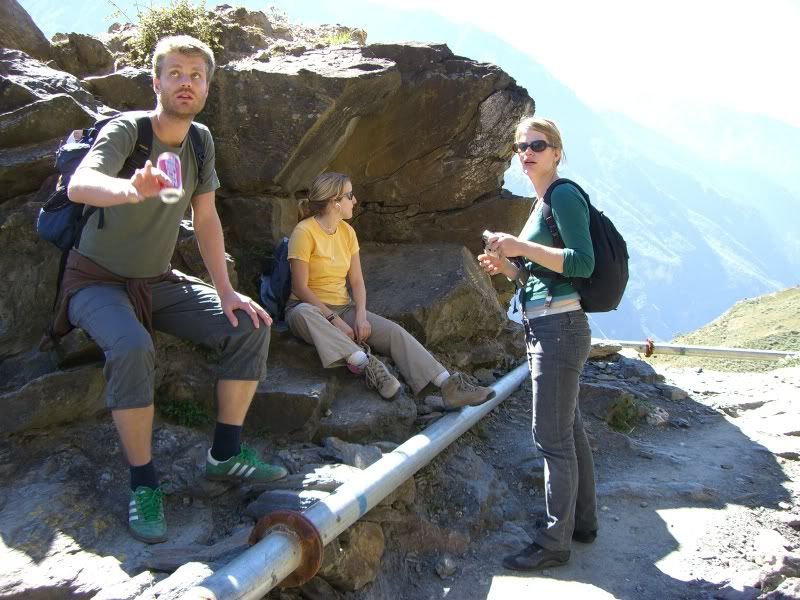
The second day was when I saw the coolest stuff. The rock formations become much more different and weird-looking. I probably took more pictures that day then the day before. Here's one of my favorite shots, I snapped it when my hiking mates were treading under an outcropping of rocks:
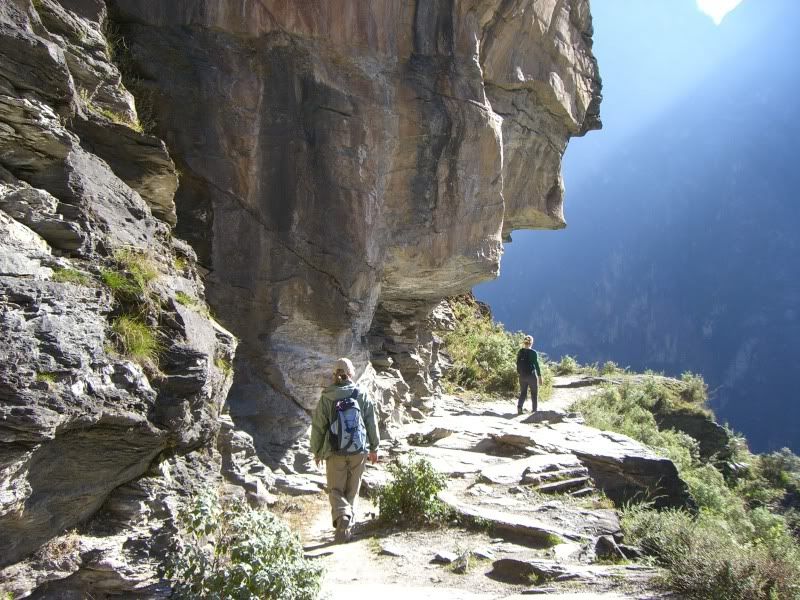
The best was still yet to come. We came across a waterfall. As we got closer, it got bigger and bigger, until the waterfall took up the whole side of the mountain.
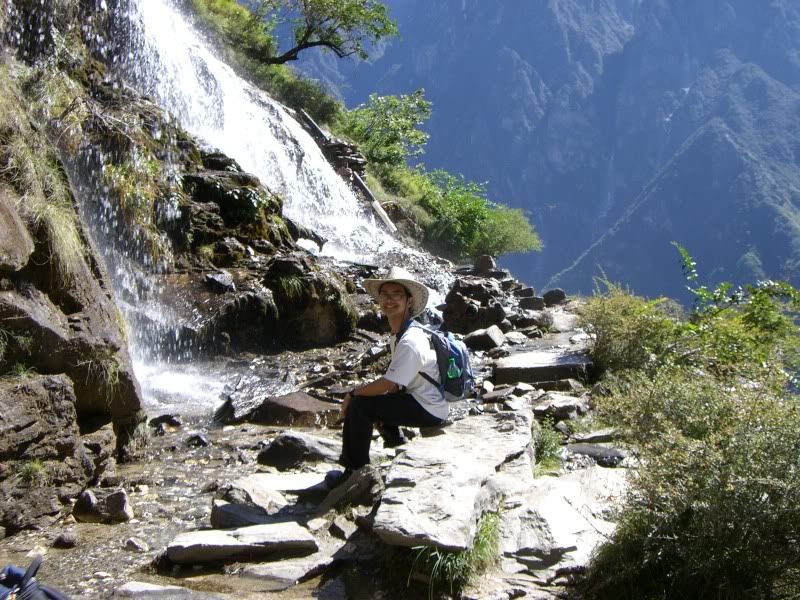
I learned something that day. Waterfalls are pretty to look at, but a pain in the ass to cross. The rocks were unbelievably slippery, so I was freaked out that I'd fall over and get swept by water off the mountain.
I managed to make it across alive, much to my relief. My feet hurt, but the trek was almost over.
We ended our trek at Walnut Garden, a guesthouse run by Sean, a Chinese man with a deformed arm. Nearly everyone uses copies of his hand-drawn map when hiking Tiger Leaping Gorge, since it's available in all the backpacker-oriented cafes in Lijiang. It was so nice to sit back in a beach chair and enjoy the scenery. After everyone finished their drinks, it was time to figure out how to get back to Qiaotou. From there, we'd get another bus back to Lijiang.
I asked some of the waitresses if there were any buses, but they said there were none. Maybe their English wasn't good enough to understand. I sought out Sean, the manager.
"Excuse me, is there a bus back to Qiaotou?" I asked.
"You already asked the waitresses! Why do you ask again?! No! There's no buses!" Sean said.
Taken aback by his vehement response, I asked, "When is the next bus?"
"No buses! Not until tomorrow! Why do you keep asking for bus?! Why should I have to get you a bus?"
Claire broke in, "Because you're the manager and we're customers."
"What? You have my map, everyone have my map, you think is free to print so many maps?!" Sean went on.
"Do you know how much I paid to fly to China from England?" Claire countered.
I gave up on him by this point. Claire stayed to argue with him longer. A German backpacker I'd met at the guesthouse went down to the street with me to look for a ride. She needed to get back to Lijiang as well. In a minute, we flagged down a van that would give us a ride for a low price. No rides until tomorrow, yeah right. The German girl said she couldn't go with us now, she was still waiting for a few friends. I thanked her profusely.
I retrieved Claire and we piled into the van. She was as angry as I was. It sucks when you put so much time, money and effort into a trip, and some jerk ruins it like Sean did. He soured me on the whole hike.
Claire was more street-smart than me. She said Sean must have been lying about the lack of buses, just so we'd be forced to spend a night at his guesthouse. What a hustler.
Our driver was an old Chinese man who chain-smoked as he drove us back along the mountain road, whipping around curves and barely bothering to use the brakes. This wouldn't have been that scary, except there was no guardrail on the road. So if he took a turn too fast and skidded to the side, there was no barrier to keep us from falling off the mountain.
The crisis point hit when we passed under the waterfall we'd crossed earlier by foot. Water flooded the road, the tires lost traction and we started to slip sideways--toward the edge.
I was sitting next to the window that overlooked the cliff. I wish I could say I was brave when I looked death in the face, but I cringed away from that window as much as possible. Meanwhile, Claire leaned past me to take a look. The driver, he just didn't care. He was puffing on his cigarette and steering as if nothing was wrong.
Finally, the tires bit back into the ground and the van heaved back from the edge. It took me a while before I remembered to breathe again.
Subscribe to:
Posts (Atom)


 Posts
Posts

